

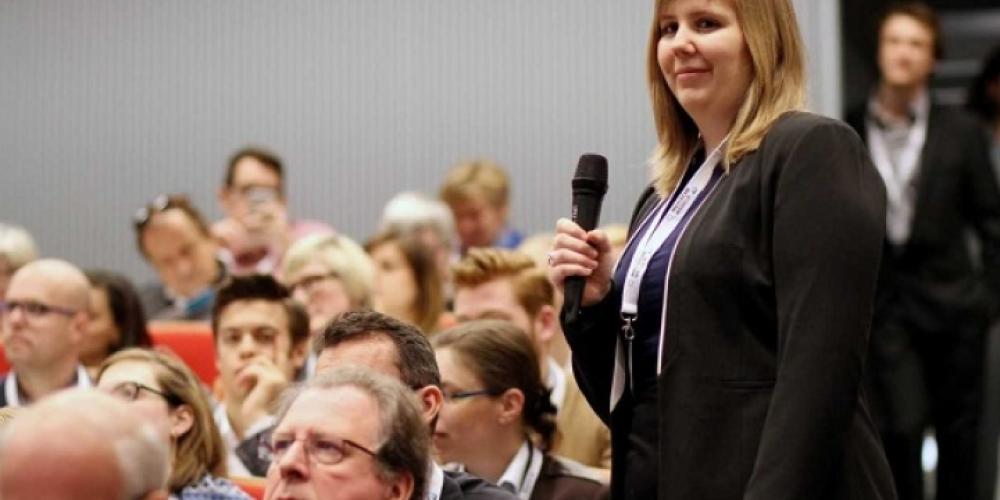


‘Medical World’ originated as a medical students’ initiative to offer fellow students a congress experience on campus. However, it has aimed at the healthcare sector as a whole from the start, which includes the pharmaceutical and biomedical sciences, as well as the nursing degree programme of Erasmus University College Brussels. The on-campus event has come a long way and has been taking place for a couple of years now. The founders still sit on the board of directors, but are joined by new students every year. Some of them act as volunteers or are in charge of a certain aspect of the organisation. The student societies are involved as well, especially when it comes to organising the evening party. In addition, local music artists perform on stage. Social engagement within the organisation of Medical World has become a varied option next to all the other possibilities for engagement on campus.
From day one, Cynthia D’Hondt has been active as a student representative at the VUB. You could say that student representation became her calling after having sat on the pupil council and youth council for six years. The VUB provided her with an ideal environment to pursue her social commitments. In 2014, she joined the central management of ‘Medical World’ as well. We had a fascinating talk to unearth the roots of this medical student’s social engagement.
The chicken or the egg
The Brussels Health Campus in Jette is an actively engaged biotope and thus inspires the students studying there. At the same time, the students are the ones who play a pivotal role in this state of active engagement. So the question is: who was first?
“I do think that you are born with a certain passion for social engagement and student representation “, says Cynthia. “And when such motivated, engaged students meet, a group dynamic arises that can motivate others as well. In this way, a sense of ‘stronger together’ develops. It could be that within medicine, or healthcare in general, more socially engaged students unite, as birds of a feather flock together. But it is difficult for me to judge.”
“However, it is true that, when considering the educational aims and learning outcomes of medical students, you automatically end up with a highly engaged profile. Logically, the medicine programme integrates the training of those skills within the curriculum. In the extracurricular activities of many students attention too is devoted to the development of soft skills. In essence, student representation constitutes an extended application of this principle.”
“In my opinion, this engaged climate thus results from the interaction between both aspects: the characteristics of the prototypical medical student on the one hand, and the programme and study environment that stimulate engagement on the other hand. The accessibility of the University provides the ideal environment for that inner engagement to thrive and be developed further.”
The entrance examination and the challenge of a long and tough study programme
“I doubt if maturity plays a role in taking up engagement. Specialisations can of course still lead to a long learning path, but ever since the reform resulted in the study programme being reduced to six years, the difference between the basic programme and other programmes is not that big anymore. Besides, most medical student become committed in the early years.”
“What does stimulate engagement, in my opinion, is the fact that many students face the challenge of a long, tough study programme from the start. GP’s are required to do another three years of study after the basic training, whereas hospital specialisations require another five to six years of study. So you know in advance that the programme will determine a considerable part of your life. Therefore, you want everything related to your study to be well-organised. As a result, more students are willing to commit themselves to achieve this ambition.”
“The selection that results from the entrance examination gives rise to a dynamic group from the start. A lot of students who pass the examination are perfectionistic by nature and strive for the best. In addition, the fact that you got through the examination boosts your self-confidence. You are motivated to go for it and to bring the programme to a successful conclusion. In a way, your commitment to the programme is related to that stimulating environment.”
Student participation in the reform of the programme
“Our role in the reform of the study programme provided an important impetus for student engagement. From the start, the VUB has actively involved students. Little by little, it became clear to us how important our input really was and still is to the reform and improvement of the curriculum.”
“The small scale of the University and the fact that the VUB values student participation bring about a situation where a lot can be accomplished through student engagement. This is then picked up by students, which stimulates them even more to collaborate on this effort. It is a vicious circle, but a very positive one.”
“There are many ways to make a difference: in numerous student organisations, representative organs on all levels, and even the organisation of our own congress.”
The animated conversation with Cynthia brings us close to the essence of our series on the actively engaged medical student.
Between DNA and context: the conclusion of seven captivating conversations
Intrinsic engagement within a stimulating environment corresponds to VUB’s general formula. The interaction between engaged DNA and context is visible in all echelons, and rather pertains to the University as a whole. In other words, we are not dealing with a chicken-and-egg matter. The VUB provides actively engaged students with a sense of accessibility and a stimulating environment for constructive assertiveness, and both aspects reinforce each other.
All of our conversations made clear that the medical school and its students give priority to student participation and engagement. Some programmes are more focused on humanity and society than other programmes, which is then accordingly translated into the profile of the student population and programme. The specific educational context, requiring an entrance examination and a long learning path, gives an additional impetus.
These two typical aspects are often seen as barriers to the pursuit of a medical degree. However, students who pass the entrance examination are met by a liberating motivation from day one, and the long learning path results in great commitment to the programme on the part of students.
Nevertheless, Cynthia succeeds in explaining why the medical student goes the extra mile by putting forward cogent arguments.
Visit the congress
The congress takes place on the 28th of April this year. Subscribing is possible until April 1. This year partners of participants can join a social-cultural program where interesting places in Brussels are visited. You can find all the information on the website.