

Understand the complex relation between AI-technologies, people, cultural dynamics, and society
This micro-credential is designed for current and future European civil servants and public sector professionals, providing a comprehensive, non-technical exploration of the complex relationships between AI technologies, human behavior, cultural dynamics, and society.
Delivered by top professors from VUB and ULB in collaboration with the FARI AI for the Common Good Institute, the course examines how AI impacts public administration beyond technical and regulatory frameworks.
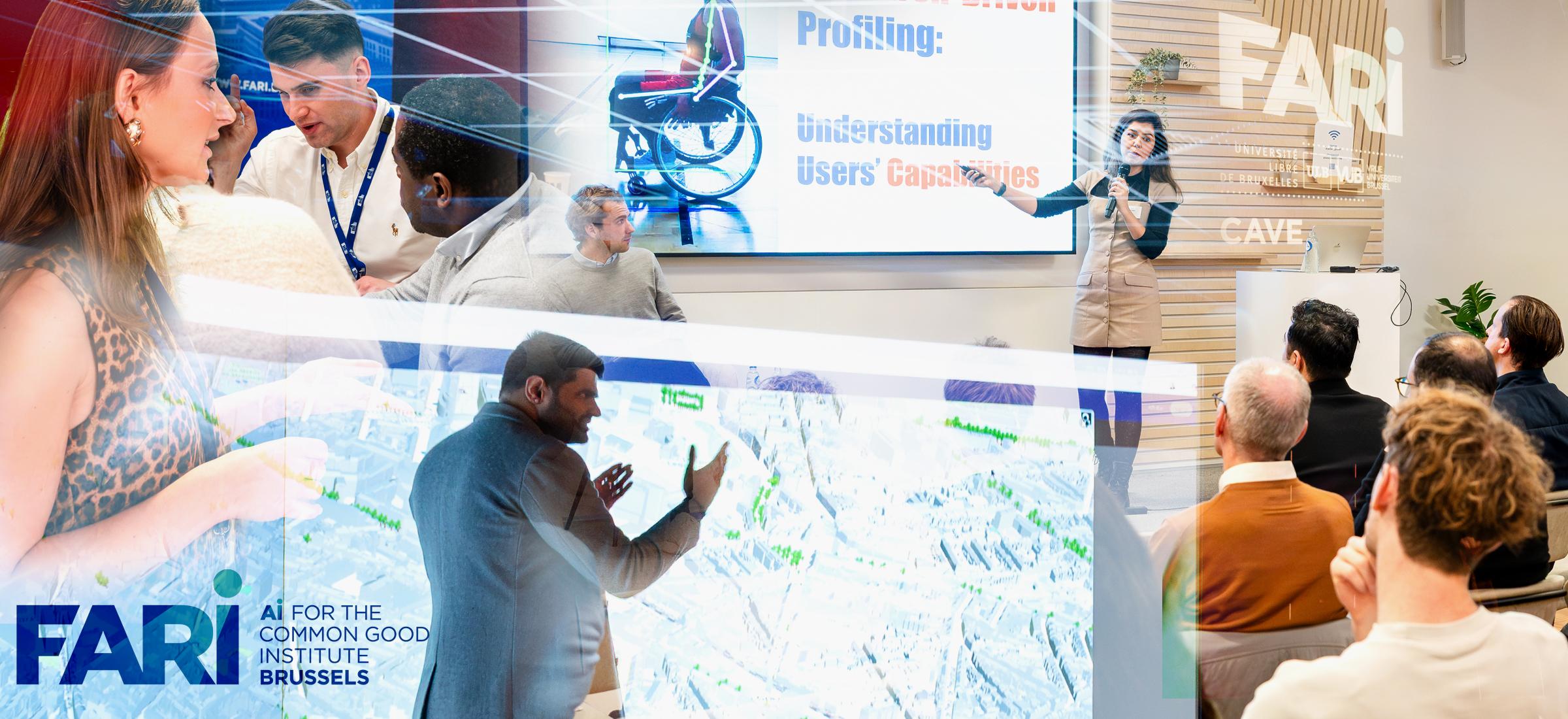
Topics are discussed and illustrated with real world examples, and with different practical workshops to support the critical reflection and discussion.
To name a few:
> Historical Context of AI and Cultural Perspectives
> Human-Centric Approach
> Social, cultural and Psychological Impact and dynamics
> Ethical Considerations and Responsible AI
> Future Trends/scenarios
> Change Management and Communication Strategies with AI implementation.
This module focuses on understanding the complex relationship between AI technologies, people, cultural dynamics, and society to foster critical reflection in the public sector.
Key Topics Covered
- Historical Context & Cultural Perspectives: Tracing the evolution of AI and examining how varied cultural frameworks shape public perception and adoption.
- Human-Centric Approach: Aligning AI systems with human values, user needs, and societal well-being to ensure inclusive public services.
- Social, Cultural & Psychological Impact: Analyzing the broader dynamics of AI on communities, workforce behavior, and institutional trust.
- Ethical Considerations & Responsible AI: Navigating complex ethical dilemmas, algorithmic bias, and fairness to deploy AI responsibly.
- Future Trends & Scenarios: Exploring emerging AI capabilities and preparing public institutions for long-term societal shifts.
- Change Management & Communication Strategies: Developing clear communication and organizational change frameworks to guide teams through AI implementation.
Practical Methodology Topics are explored through real-world public sector examples, interactive workshops, and guided discussions. Participants will engage in collaborative exercises designed to support critical reflection, build actionable insights, and help navigate the social and cultural impact of AI within their professional environment.
Is this for you?
This micro-credential has been developed for professionals that are directly or indirectly involved, or wish to be involved in innovation with AI. This means the training is particularly useful for you in the following roles:
– Innovation, project and product managers
– Functional analyst, solution & enterprise architects
– Project officers at funding agencies
– Business developers
– HR managers and recruiters
– Legals
The FARI AI Academy
FARI is an independent non-profit initiative in the field of artificial intelligence under the guidance of two Brussels universities: the Vrije Universiteit Brussel (VUB) and the Université libre de Bruxelles (ULB).
The FARI AI Academy offers various courses and trainings on AI aimed at helping citizens and organizations. We serve as the educational arm of FARI with the mission to inspire the development and implementation of ethical, responsible, and transparent AI solutions.
Course
Artificial intelligence for sustainable and responsible innovation: people and culture (3 ECTS, 2nd semester)
The classes are part of the postgraduate programme: AI For the Common Good.
Details
3 ECTS
One ECTS-credit equates to roughly 25 to 30 hours of study, from lessons to completing a project or studying independently.
This course is organised during the second semester of the academic year.
Evaluation
Students’ evaluation will be based on class participation.
Day courses
6 half-day in-person sessions on Thursday.
- Classes are scheduled from 9 a.m. to 12 p.m. on: 11/03, 18/03, 25/03, 01/04, 15/04, 22/04
Physical attendance is required to facilitate interaction, discussions, and hands-on exercises that cannot be fully replicated online.
The exam will take place during the week of 10/06 or 17/06
Where: FARI
Courses are organised in BeCentral: at FARI – Cantersteen 16, 1000 Brussels.
Language of instruction
The programme is open to both national and international students, and the language of instruction is English.
Admission Requirements
Prerequisites: Hold a Bachelor’s degree.
Registrations: Open from May 1, 2026. Deadlines vary based on your previous degree.
Places per micro-credential are limited.
Working Students: Compatible with professional commitments and eligible for educational leave (for those working or living in Brussels).
Want to join the full Postgraduate programme?
Discover more at AI For The Common Good
Is this micro-credential for you?
Interested in the full Postgraduate program?
See the full programme here: AI For the Common Good.
What is a Micro-credential?
Micro-credentials are small, academic programmes that focus on specific subjects and competences. They consist of one or more courses or course parts taught in a Bachelor or Master programme at the university. Usually, they are taught for a few hours spread over one semester or one academic year. They are literally micro-courses.
If you pass the micro-credential, you receive a certificate proving that you have acquired the competences. These are official credits. This is where micro-credentials differ from other programmes, such as study days or trainings. The credits and competences you obtain are recognised throughout your career and can lead to exemptions from future programmes, for example, even at other institutions.
Micro-credentials are important for lifelong learning. After all, in our rapidly changing society, it is essential that everyone keeps working to renew their own competences. Micro-credentials are blocks that you can stack and combine throughout your life and career to further direct your own pathway. There are several advantages to taking micro-credentials. Since they are short, specific courses, you only learn what you need to upskill or specialise.
In addition, the certificate guarantees your acquired competences and the credits are often recognised abroad. They are a great asset on your CV.
Costs
The tuition fee consist of a fixed amount and a variable amount
The fixed amount is an administrative fee paid once per academic year. The variable amount is a specific fee per credit or ECTS that you enrol for.
Enrolment
Start your online application here
Look under 'continuing education' to select your micro-credential.
Check the application deadlines here
Need help?
Teaching methods
The VUB is committed to blended learning, a combination of online and on-campus lessons. Therefore, students need not necessarily be on campus if they do not have to be, but we still believe in the added value of physical teaching moments.
Classes are usually taught for a few hours spread over one semester or one academic year. You can always check the class timetable, where you can see if a course is online, on campus or taught through recorded lessons. It is best to view the timetables for each individual course.
Any questions?
microcredentials@vub.be

The new training offer of micro-credentials was developed and announced with the support of the European Union.