



For the first time, the Vrije Universiteit Brussel (VUB) is partnering with the Horst Arts and Music Festival, set to take place from 14 to 16 May at Asiat Park in Vilvoorde. In a move that bridges academia and the cultural sphere, lecturers from the architectural engineering programme have aligned a first-year design assignment with this distinctive site.
“The students were asked to design a pavilion with three objectives,” explains Judith Cools, who supervises the course Design Studio: Humans & Adaptability. “There had to be a connection with the city and the residents of Vilvoorde. The design also needed to serve a function for the Horst Arts and Music Festival and establish a link with the VUB.”
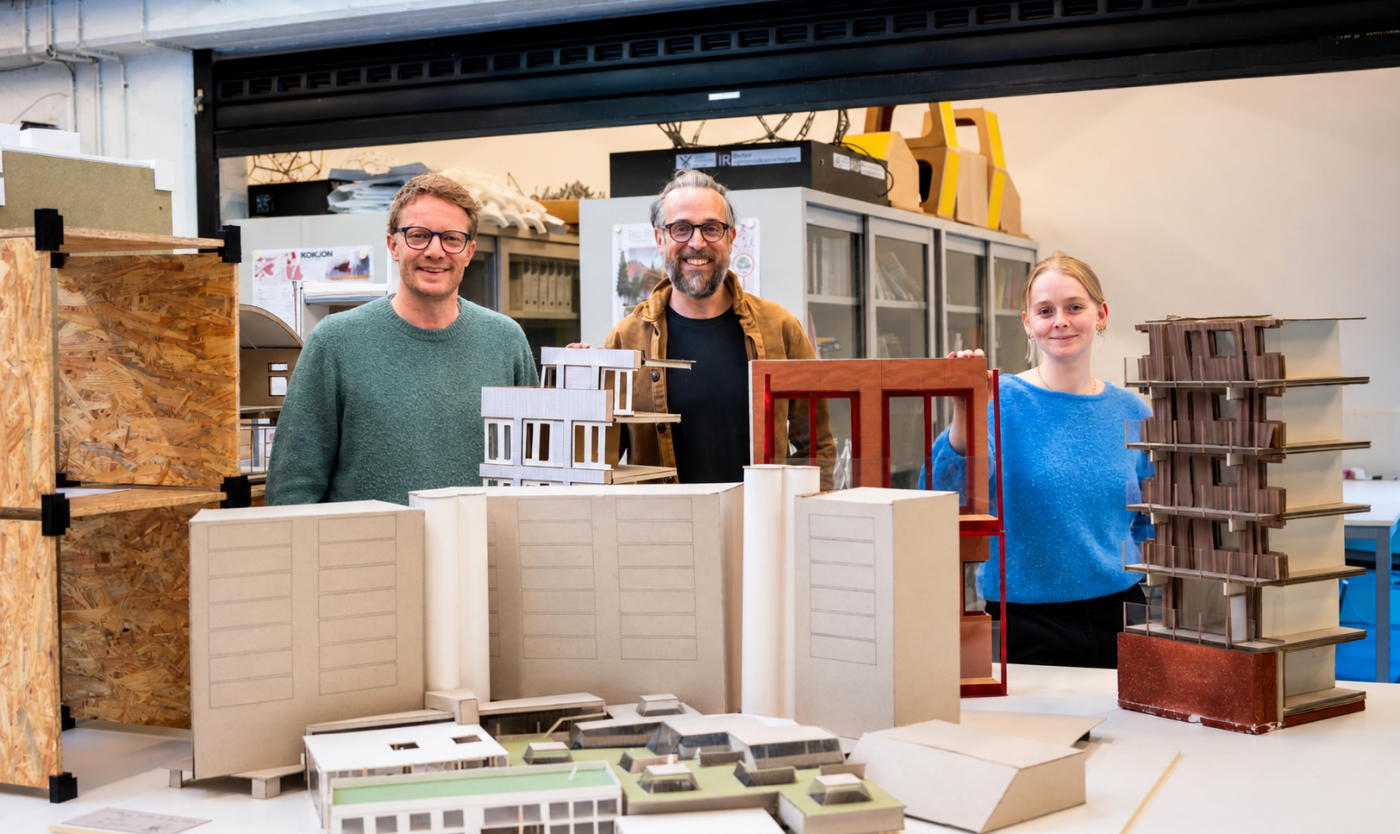
Niels De Temmerman, Simone Valerio and Judith Cools
Lecturers Niels De Temmerman and Simone Valerio, who teach the design studio, proposed two possible directions: a pavilion for an artist in residence or a stage, but students were also free to come up with their own concept. After a guided site visit in October, the students were given time to explore the area thoroughly and to identify where they saw either a problem or an opportunity.
As this was the first time the first-year students had ever designed a building, the process was highly structured. They began with an analysis of the site: its history, circulation and the different types of users. From there, they progressed week by week: choosing a location, justifying why it was suitable, seeking inspiration, and gradually developing the design and its structure. “We train engineer-architects,” says Judith. “That also means paying attention to the technical aspects.”
An important condition of the assignment was that students had to start from materials already present on the site. This dovetails perfectly with both the design philosophy of Asiat Park — which aims to use as little new material as possible — and the guiding principle of the design studio led by Niels and Simone: circular design of adaptable structures with maximum reuse of building materials. “We explicitly told them they could hypothetically dismantle an existing stage and reuse its components in their design,” Judith adds. “It was wonderful to see how some students gave existing elements a completely new leading role.”
Between October and December, the students worked on their project every Tuesday for a full day, often also outside regular class hours. They finished the semester with a presentation to a jury, which attracted considerable external interest. During a mini-exhibition, the most interesting designs were presented to members of the VUB community, the Asiat team, and even the Mayor of Vilvoorde showed interest. “The people from Asiat were impressed by how these young designers, doing this for the first time, were able to read the site so well.” The lecturers are also pleased with their students’ progress. “I think several designs have a high degree of feasibility,” Judith concludes. “They are, of course, still first-year students, so there is a certain naïveté in the work. But I was genuinely surprised by the quality they delivered.”
Timo Baekelandt dreams of a stage for ambient music
What is the idea behind your model?
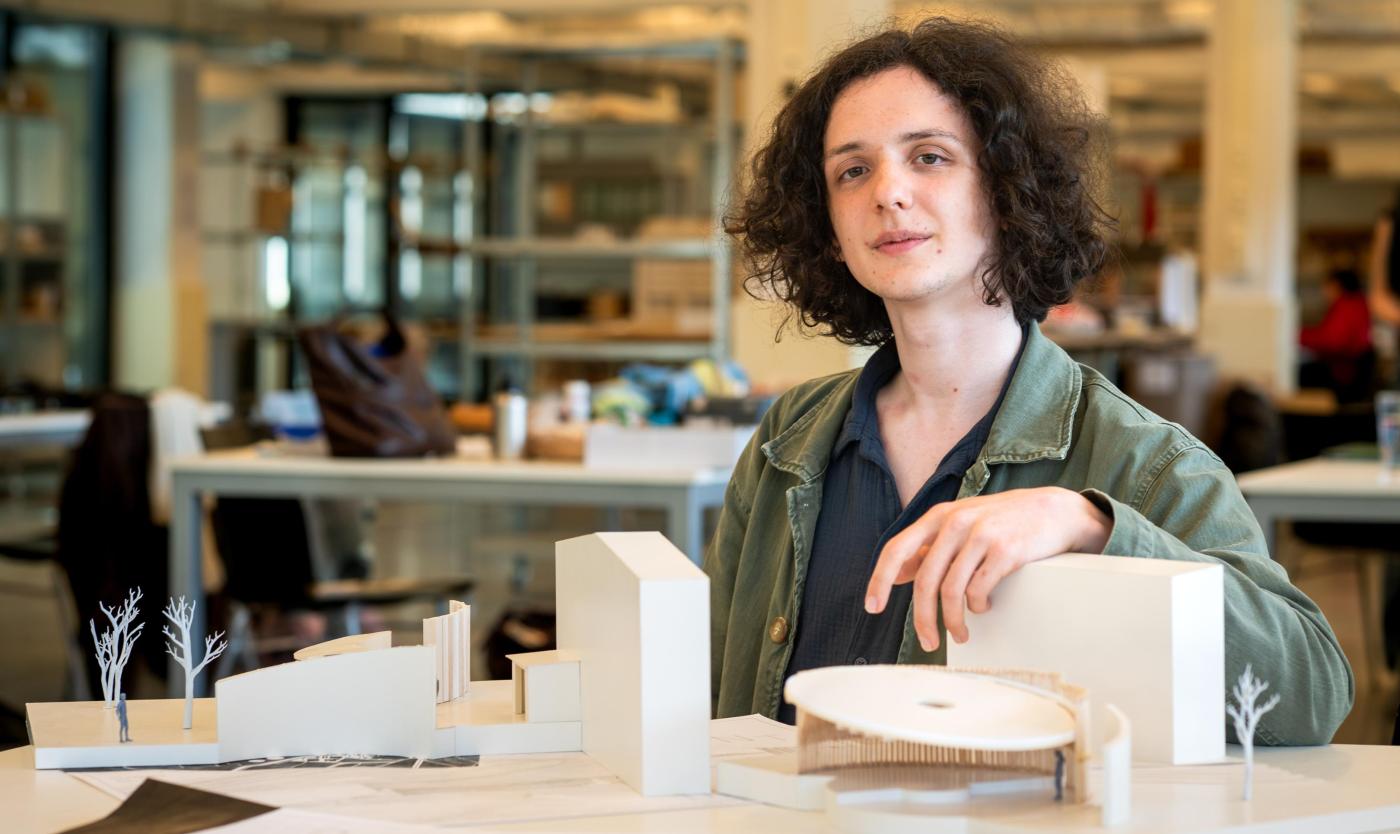
Timo Baekelandt: “I designed an intimate stage for ambient music, a genre where people don’t dance but listen while sitting or lying down. For that reason, I wanted to create a place that radiates calm and a sense of safety. For the roof, I used an existing artwork: a red circle with a diameter of ten metres. That red ceiling creates a warm glow inside and formed the starting point for the design of the entire pavilion.”
“A load-bearing wall made of wooden slats creates a separation from the outside world, but I deliberately made it non-airtight so that a sense of connection remains. I placed the stage in the centre so that everyone can sit around it. Above the stage, I created an opening in the roof. This way, the musicians are literally standing in the light.”
What did you learn from this assignment?
“It was quite a large assignment for a first semester, with many elements to take into account. At the same time, we were given a lot of freedom. In secondary school I had studied architectural subjects, so I fairly quickly developed a sense of the direction I wanted to take. What I found especially interesting was that we had to reuse materials from the site. It made me look at things differently: what already exists, and what can I do with it?”
Why do you think your design deserves a chance to be realised?
“I think a genuine place for rest is currently missing from the festival site. There is a space for yoga classes, but that will soon be taken down. My design could replace it. Thanks to a movable and insulating wall, the space can also be used both in summer — for concerts — and in winter — for yoga sessions or other activities.”
Leda Ricchiuti conceived a sensory room made from jeans
What is the idea behind your model?
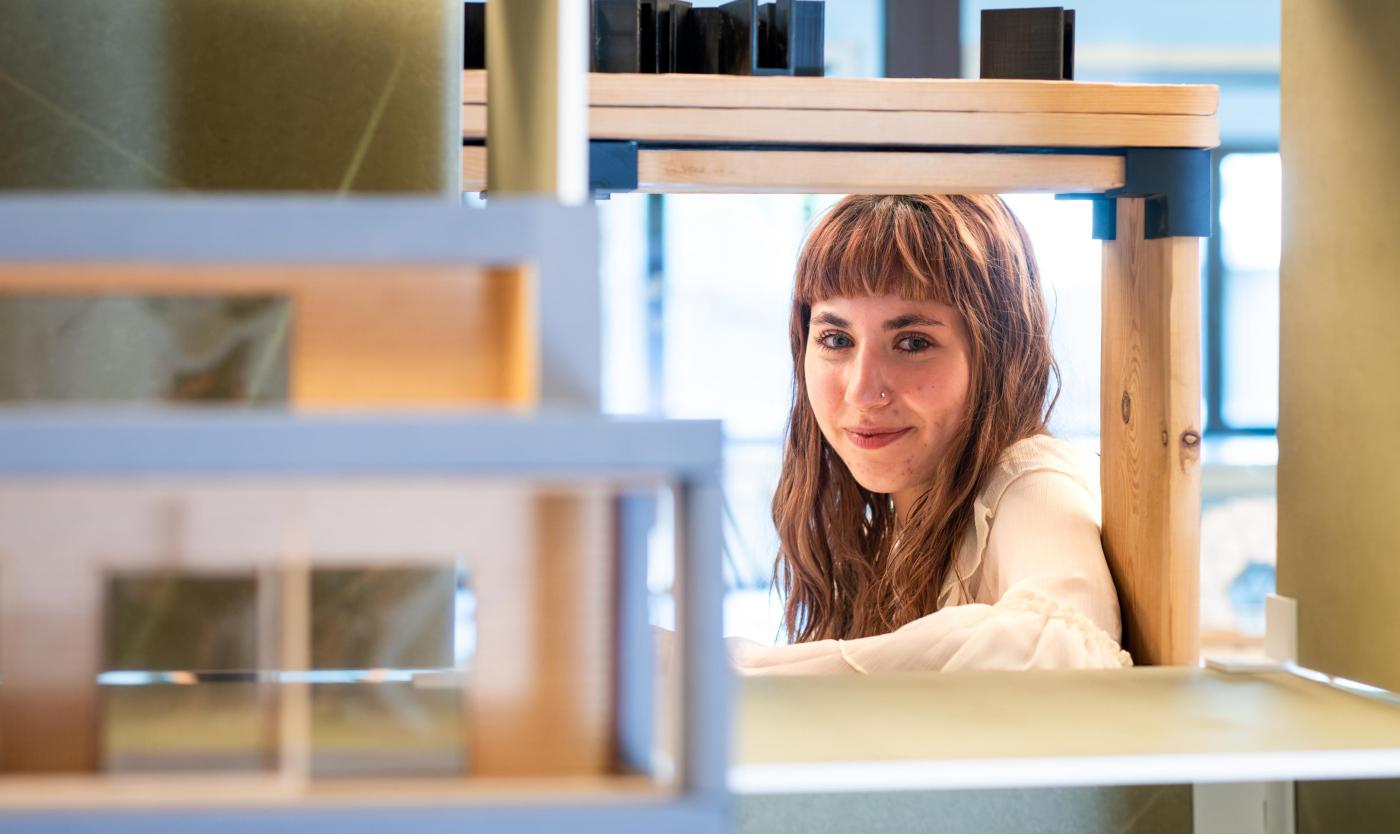
Leda Ricchiuti: “I found the values of the Asiat site — inclusivity and circular construction — very inspiring. I asked myself how I could translate those values in a personal way and started from something I do often myself: shopping second-hand. I designed insulation made from unsold jeans from a charity shop. In this way, I created a soundproof sensory room where people can calm their senses. Such spaces are often used by people with autism, but they can also offer relief at a festival, where there is a lot of noise and sensory stimulation. After the festival, the space could also serve as a quiet study room for (VUB) students.”
“I started from the idea of working with that insulation and then designed from the inside out. To keep the exterior sustainable as well, I opted for timber construction. I was inspired by the serene atmosphere of Japanese architecture, which also makes extensive use of wood.”
What did you learn from this assignment?
“I wanted to make the design accessible to everyone, while also keeping it subtle. However, a wheelchair ramp requires a lot of space, which surprised me. That’s why I eventually opted for two entrances: one with a ramp and one with stairs. That looked calmer than combining both in a single entrance.”
Why do you think your design deserves a chance to be realised?
“Many projects on the Asiat site are built together with residents of Vilvoorde, and that could also be the case here. The insulation could, for example, be produced locally. The charity shop is located close to the site, which makes a collaboration logical. The idea is to cut the jeans into strips together with local residents and stack them in the walls. This way, the design becomes not only sustainable, but also something you build collectively.”
Roos Vanderstichele designed a floating stage that also functions as a bridge
What is the idea behind your model?
Roos Vanderstichele: “I designed a bridge over the River Zenne made up of five separate floating elements that can be arranged in different configurations: as a large triangle or a small square. During the festival, they can serve as a stage, and depending on how they are positioned, they create a different atmosphere each time. In addition, I designed a garden along the riverbanks where visitors can relax. I reused the concrete sewer pipes found all over Asiat Park — often used for exhibitions — as planters. In this way, I created a design that adds value to the site throughout the year.”

What did you learn from this assignment?
“What I learned above all is that architecture can be more than just a building. I found it interesting to think in that way and to work out my idea technically. The elements are made from IBC containers — 1,000-litre tanks — which I filled with recycled polystyrene. According to my calculations, together they can carry up to 17.4 tonnes.”
“Because of the loose elements, it also becomes a kind of puzzle in which users themselves help create the architecture. That fits well with Asiat. There is a strong and engaged community around the site.”
Why do you think your design deserves a chance to be realised?
“During the site visit, I heard that they would like to expand to the other side of the river, but that the bridge is a challenge. The river is about twelve metres wide, and a permanent bridge is difficult to realise within the budget. I looked for a solution that could also function during the festival.”
Josefien Muller created a stage pavilion bathed in light
What is the idea behind your model?
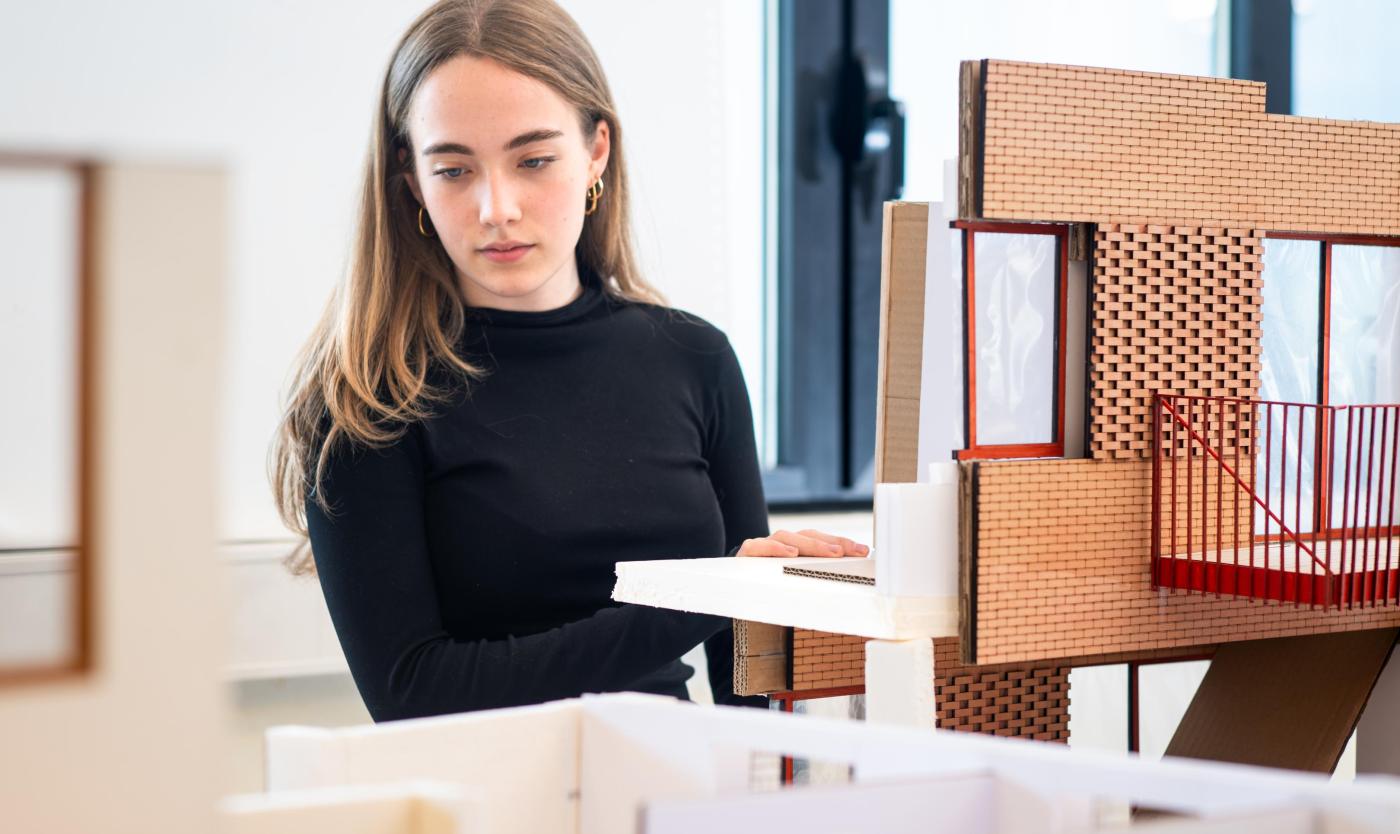
Josefien Muller: “I opted for a multifunctional stage that I would place in the middle of the site. Because I didn’t want the elliptical pavilion to have too much impact on its surroundings, I chose a load-bearing structure that resembles lamellae. You can walk through it and see through it completely.”
“Outside the festival, the pavilion can function as an exhibition space, for example for research carried out at the VUB. Artworks, posters or other works can be hung on the lamellae and on the platform inside. During the festival, the platform transforms into a DJ booth, with the audience standing underneath. Because the audience is not facing the stage directly, there is more interaction between visitors. People can also go upstairs and look out over the park or the dance floor below. In some places upstairs, there are wider areas where you can dance.”
What did you learn from this assignment?
“I enjoy going to festivals and was inspired by the Booth at Pukkelpop, a stage for electronic music. Still, I wondered: how do I even begin? In secondary school I followed general academic education (ASO). It was the first time I had to draw a building in perspective. I learned that building a scale model really helps to develop spatial insight. So I’m quite proud that I managed to do it.”
Why do you think your design deserves a chance to be realised?
“It aligns with the sustainable way in which Horst operates. Almost everything is made using materials from the site. Upstairs, for example, I used recycled window frames. With those, I created glass mosaics inspired by the Europa Building in Brussels. I coloured the windows so that when the sun rises, cool colours are projected into the building. As the sun moves, the colours move with it. In the evening, the design is bathed in orange or red tones.”