

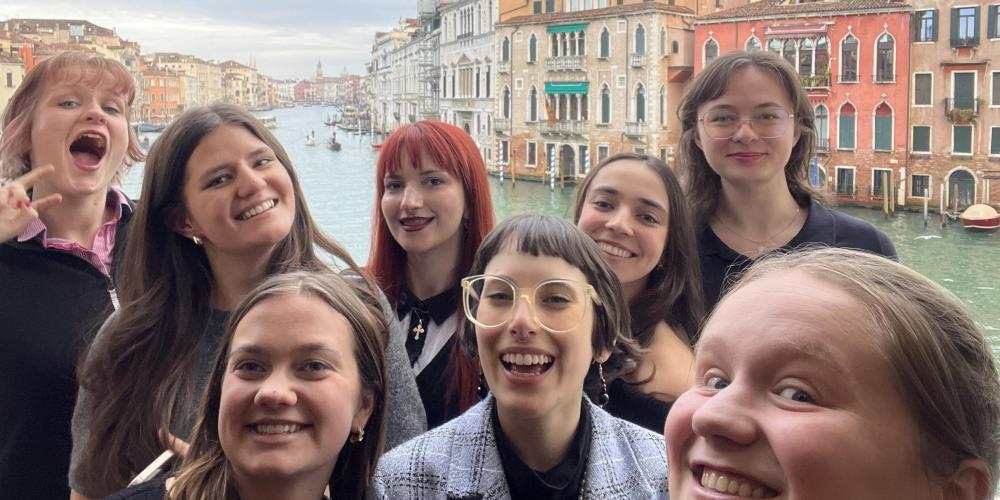


When two Student Career Ambassadors from VUB travelled to Venice this year, it was not just another academic gatheringthat they were attending. They were stepping into a broader European conversation about what it means to build a career in an interconnected world. Hosted by Ca' Foscari University of Venice and organized within the framework of EUTOPIA, the meeting brought together Student Career Ambassadors from across the alliance to exchange ideas, reflect on their role, and explore how to better support fellow students in the transition from university to professional life.
The EUTOPIA Student Career Ambassadors are selected students who work alongside their universities’ career services to strengthen the link between studies and professional life. They share job and internship opportunities across the alliance and organize workshops open to the wider EUTOPIA community. These sessions range from practical guidance on CVs and interviews to insights into job cultures and EU career paths. Through these initiatives, the ambassadors contribute to a shared European space for career development.
For Amanda Gugliucci, now in her third year as a Student Career Ambassador at VUB, the journey began almost by chance. Before even starting her bachelor’s degree, she noticed the vacancy online and decided to apply without expecting to be selected. Being chosen opened doors she had not anticipated, including international meetings and workshops that provided insights into career paths she had never previously considered. Lore Verheyen, who joined after spotting the opportunity slightly later, similarly describes how taking that initiative led to unexpected experiences, including an early meeting in Paris and, more recently, the gathering in Venice.
In Venice, one of the most striking realizations was how differently the Student Career Ambassador role is structured across universities. While the overall mission is shared, the level of autonomy and responsibility varies. At some institutions, ambassadors have significant freedom to develop and implement workshops independently, while at others the process is more centralized. This exchange of perspectives proved valuable for both improving coordination and for demonstrating how EUTOPIA functions as a space of institutional learning. Meeting face-to-face also strengthened the sense of belonging to a wider European community. Conversations extended beyond logistics and into broader reflections about motivation, ambition, and the kinds of careers students imagine for themselves.
The Venice programme was not short of activities. One session focused on launching a career and navigating uncertainty, reinforcing a message that resonated strongly with both VUB participants: career paths are rarely linear, and changing direction is normal. Amanda reflected on how reassuring it was to hear that a bachelor’s degree does not rigidly determine one’s future and that flexibility is an asset rather than a weakness. Lore highlighted how interacting with ambitious and internationally minded peers creates a motivating environment in which students begin to see possibilities that previously seemed distant or inaccessible. Through informal conversations, participants shared internship experiences and career trajectories that expanded each other’s horizons.
For VUB students who may be wondering whether to attend a workshop or apply for a vacancy, the message from Amanda and Lore is straightforward. Participation may seem like a small commitment, perhaps just an hour of a workshop, but it can provide valuable information, unexpected inspiration, and connections that last far beyond graduation. The experience in Venice illustrates that EUTOPIA is not an abstract institutional project. Rather, it is a living network shaped by students themselves. Getting involved means becoming part of that network, expanding one’s perspective, and taking an active role in shaping one’s own future. For those hesitating, the advice is simple. Try. Apply. Participate. You never know which door it might open.