

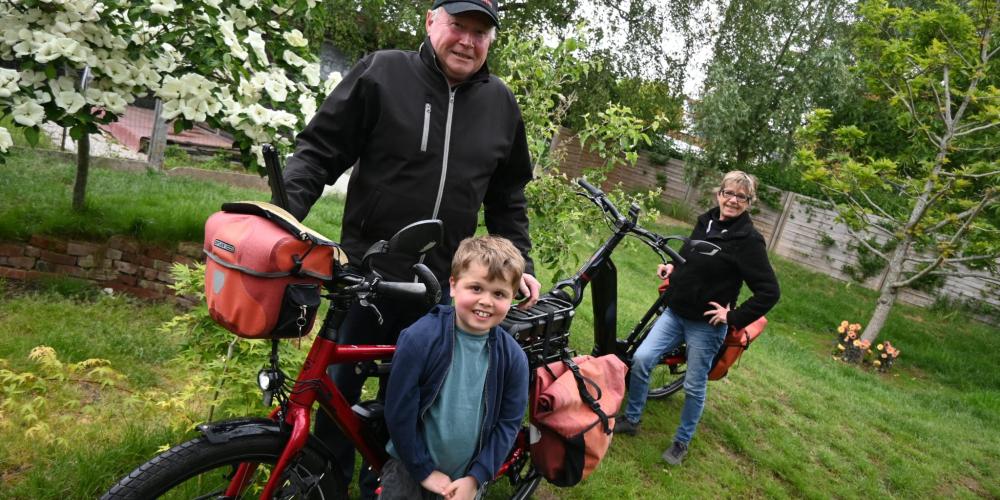


For the second year running, Luc Vandevyvere from Wevelgem is taking on an extraordinary cycling challenge. Over the course of 100 consecutive days, he aims to cycle 100 kilometres every day — a total of 10,000 kilometres. He is doing it in support of the Duchenne Fund, which finances research into Duchenne muscular dystrophy. Luc set off on 31 May and hopes to complete his journey on 7 September, World Duchenne Awareness Day.
His motivation remains unchanged: his grandson Stan, who is living with Duchenne. Yet Luc’s challenge is about more than one child. “Stan was the reason I started,” he says. “But I’m doing this for every boy born with Duchenne. For as long as it’s needed, I’ll keep going.”
What does this year’s challenge involve?
“This year, I want to cycle for 100 days in a row, without a single rest day. I’m aiming for around 100 kilometres each day, which should bring me to a total of 10,000 kilometres. Last year, I cycled for 79 days and covered around 8,100 kilometres. When I finished, I actually felt surprisingly good. I wasn’t tired of cycling yet. That’s when I thought I might be able to add a few more days. So the idea of cycling for 100 days was born. It’s a nice round number, and 10,000 kilometres is a great target to aim for. We’ll see where it takes me.”
You have covered a remarkable number of kilometres over the years. Can you look back on some of your previous journeys?
In 2020, I cycled around the Benelux, covering around 2,000 kilometres. In 2021, I rode to Santiago de Compostela, a journey of roughly 2,700 kilometres. The following year, I cycled to Rome, covering about 2,800 kilometres.
In 2023, my plans were a little more modest because I had fallen ill in late 2022. That year, I completed the Flanders Cycle Route instead.
In 2024, my wife and I cycled around the Netherlands together. Then, last year, I took on my biggest challenge yet: a 79-day journey covering approximately 8,100 kilometres.
What keeps you coming back to these challenges?
“Quite simply, it comes from the heart. If you want to do something for others, you do it for as long as it’s needed and for as long as your health allows. Cycling is my hobby, but now it’s become a way to support a cause that matters deeply to me. That’s a wonderful combination. As long as it’s needed, I’ll keep cycling. And as long as I’m physically able to do it, I see no reason to stop.”
How does Stan experience your journeys?
“He understands more than people might think. His mum once asked him whether Grandad always cycles for the children with poorly muscles. So he does pick things up. After every trip, I give him a cycling jersey with the route and destination printed on it. Perhaps that’s more for the future. One day he’ll open his wardrobe, look at those jerseys and think: ‘That’s a reminder of what Grandad did back then.’”
“After every trip, I give him a cycling jersey with the route and destination printed on it. One day he’ll be able to look at it and think: ‘That’s a reminder of what Grandad did back then.’”
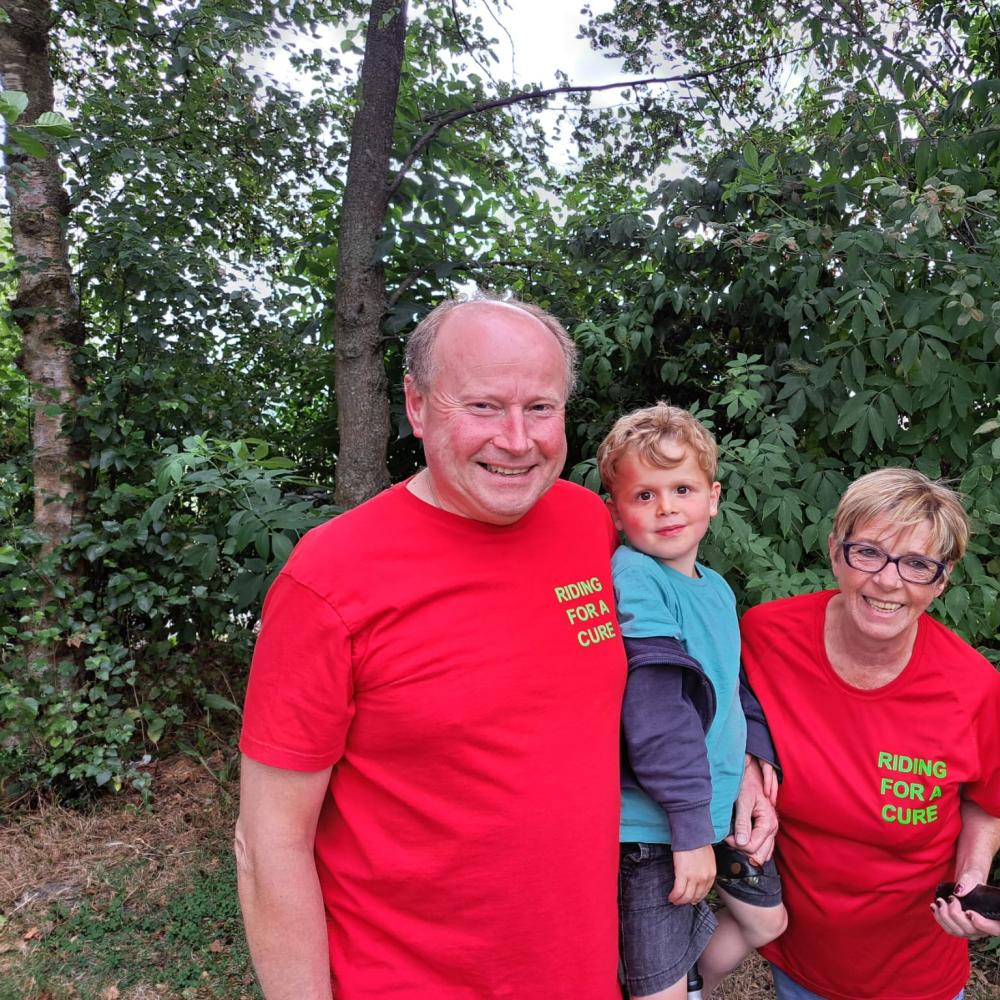
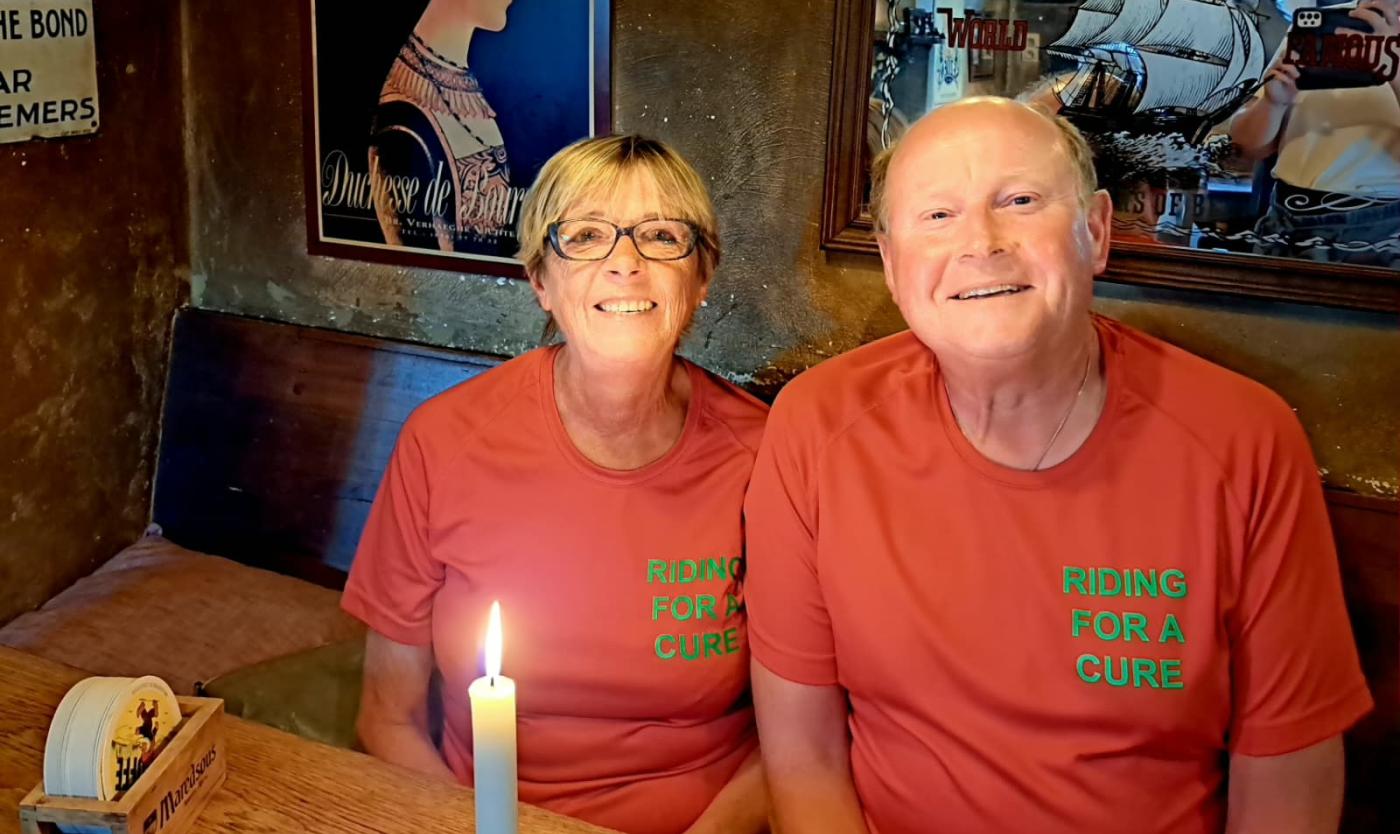
Luc with his wife Christine
What do you hope research will achieve?
“Ultimately, I hope Duchenne can be cured. That is the goal, and I remain hopeful. The research is incredibly complex and I’m not a scientist, so I don’t understand every detail. But I have great confidence in the professor and the research team. What stands out to me is that they are not only looking at ways to slow down or stabilise the disease, but genuinely working towards a cure. From what I understand, they are exploring gene therapy and ways to restore muscle tissue by addressing the scarring that replaces healthy muscle. To me, that shows a real belief that a cure is possible — and that gives me hope.”
Do you feel that progress is being made?
That is difficult for me to judge because the research is so technical and complex. I am not a scientist; I am an outsider looking in. But I do have the sense that real progress is being made. What matters most to me is that, at the VUB, the focus seems to be on finding a cure. In many other research programmes, you hear more about slowing down or stabilising the disease. That is valuable too, of course, but curing a disease is something entirely different. I do not think people always realise the distinction. Slowing progression can improve lives, but the ultimate goal remains a cure. That is what gives me hope.
What appeals to you about the way this fund operates?
“The direct connection. You know exactly where the money is going. It goes straight to the professor and the research itself. With larger fundraising campaigns, that can sometimes be less transparent. You know the money is supporting research, but not always exactly where it ends up. Here, that is much clearer.”
Is there a moment from one of your previous cycling journeys that has always stayed with you?
“There have been many memorable moments, but one encounter in Spain often comes back to me. It was incredibly hot, around 40 degrees or more. I had just left a small village, with rocky mountains on my left and virtually nothing on my right. In the distance, I spotted something moving. As I got closer, I realised it was a Dutch cyclist.
His bike was heavily loaded with camping gear and all the equipment he needed for the road. Whenever the road started to climb, he had to get off and push because he no longer had the strength to keep pedalling. The man was 79 years old and had a heart condition. I asked him why he was doing it. His answer was simple: “What am I supposed to do at home? Sit behind the geraniums all day?” I thought that was fantastic. That is attitude. That is determination. He would rather be out cycling in 40-degree heat than sitting at home. You do not forget something like that.”
What do you hope to look back on when this journey ends on 7 September?
“Above all, I hope I can complete the full 100 days and stay healthy throughout. Of course, I also hope to raise as many donations as possible. But just as importantly, I hope to raise greater awareness of Duchenne. The donations are motivating. When you see money coming in, you think: all of this effort is making a difference. But it is not only about the money. It is also about helping people understand what Duchenne is and why research remains so desperately needed.”
Follow or support Luc
Luc’s journey can be followed via the Cycling Against Duchenne Facebook page.
Donations can be made to account number BE51 0013 6779 3562, quoting GIFT FO10, or via the online donation platform. Every contribution supports the Duchenne Fund and vital research into Duchenne muscular dystrophy. For Luc, every donation is another reason to keep pedalling — day after day, kilometre after kilometre.