



An international research group led by researchers from VUB-UZ Brussels and KU Leuven has demonstrated that a combined approach targeting both the immune system and the insulin-producing beta cells can slow the progression of type 1 diabetes more effectively than individual treatments. The results were published in the leading scientific journal Diabetologia.
Type 1 diabetes develops when the immune system attacks and destroys the insulin-producing beta cells in the pancreas. In recent years, significant progress has been made with immunotherapies that can delay the onset of clinical diabetes in people at increased risk. However, their effect is often limited in duration and the response varies greatly between individuals. The researchers therefore investigated whether simultaneously protecting the beta cells themselves could enhance the efficacy of immunotherapy.
Two targets, one treatment
In the study, prediabetic NOD mice (a mouse model for type 1 diabetes) were treated with a low dose of anti-CD3, GLP1-E2 or a combination of both. Anti-CD3 is an immunotherapy that inhibits the autoimmune attack on beta cells by reprogramming the immune system. GLP1-E2 is an experimental compound that is delivered specifically to beta cells, where it activates protective oestrogen signalling. This makes beta cells more resistant to stress and loss of function.
The combination proved to be significantly more effective than either treatment alone. At 30 weeks of age, 77 per cent of the untreated mice developed diabetes. This figure was 66 per cent following treatment with anti-CD3 alone and 61 per cent with GLP1-E2 alone. With combination therapy, the incidence fell to 38 per cent. Furthermore, the onset of diabetes was significantly delayed. Part of the protective effect persisted after GLP1-E2 treatment was discontinued.
“These results support the idea that type 1 diabetes is not solely a disease of the immune system, but also of vulnerable beta cells,” says Prof. Dr Nico De Leu, an endocrinologist at UZ Brussel and the VUB. “By tackling both autoimmunity and the stress and vulnerability of beta cells, we observed significantly stronger protection in this model than with a single treatment alone. This opens up interesting prospects for future preventive therapies.”
Protection of the beta cell
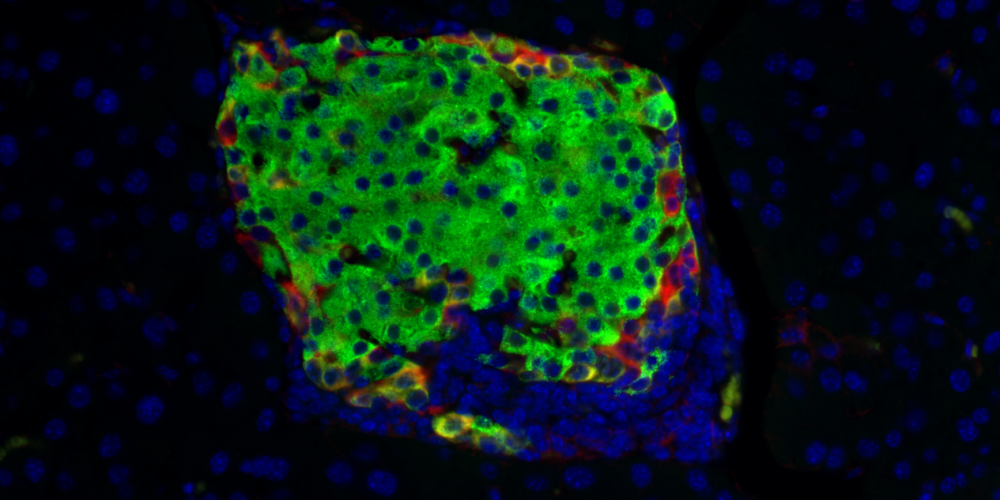
To better understand why the combination treatment worked, the researchers analysed the pancreas of the treated animals. This revealed that GLP1-E2 and anti-CD3 each exerted a different but complementary effect.
Anti-CD3 worked primarily by inhibiting the immune system’s attack on the beta cells. GLP1-E2 made the beta cells themselves more resilient, meaning they sustained less damage, continued to function better and were less likely to be recognised as targets by the immune system. Together, these effects ensured that more functional insulin-producing beta cells were preserved and the disease progressed more slowly. This suggests that protecting beta cells could be a valuable addition to treatments that focus exclusively on the immune system.
An important step, but not yet a treatment for patients
The researchers emphasise that this is a preclinical study. The results were obtained in a mouse model and cannot be directly extrapolated to people with (or at risk of) type 1 diabetes. Further studies will be needed to determine whether a similar combination treatment could also be safe and effective in patients.
“For patients, this is not yet a new therapy,” says Prof. Dr Willem Staels, a paediatric endocrinologist at UZ Brussel and the VUB. “But this study provides important evidence that we may need to look beyond immunotherapy alone. By also actively protecting the beta cells, future treatments may become not only more potent but also more sustainable.”
Reference
Degroote, L., Chrzanowski, J., Lemaitre, P. et al. GLP1-E2 therapy delays autoimmune diabetes in late-stage prediabetic NOD mice and potentiates low-dose anti-CD3 therapy for enhanced disease protection. Diabetologia 69, 2307–2322 (2026). https://doi.org/10.1007/s00125-026-06750-1