

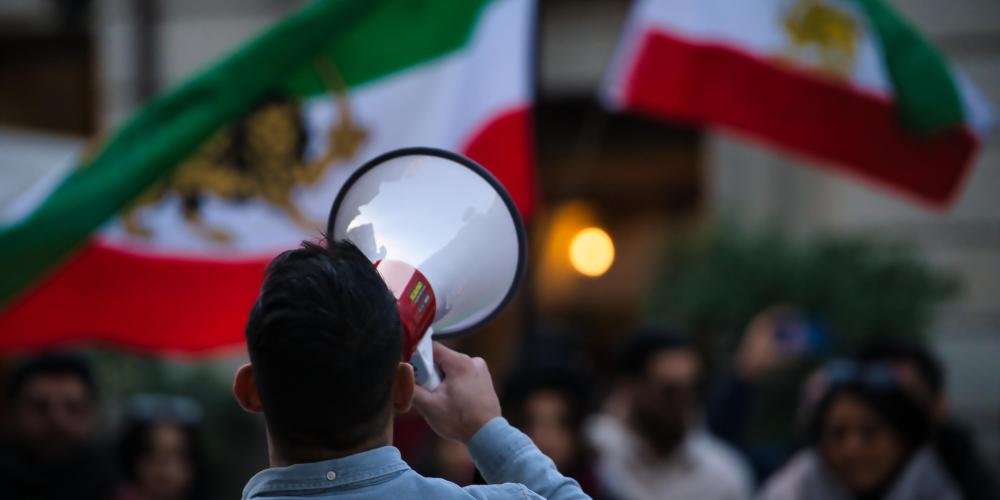


Elly Mansoury is a Belgian-Iranian political scientist at VUB. She observes US and Israeli support for Iran’s street protests, but says it is by no means aimed at bringing democracy to the Iranian people. This opinion piece was originally published in De Morgen.
Unrest in Iran has now entered its third week. What began as a strike by traders in the Grand Bazaar of the capital has since expanded into protests by students at universities and young people on the streets, across all 31 provinces. Human rights organisations report that Iranian security forces have shot dead at least 116 demonstrators and arrested 2,600 others.
The immediate spark this time is the financial hardship facing most Iranians — but that is only the tip of the iceberg. The Iranian currency has hit a historic low, inflation has soared to 42 per cent, and food prices have risen by 70 per cent.
On top of that, the country is facing a water crisis, and in 2025, the Iranian capital ranked among the world’s top ten most polluted major cities. Years of Western sanctions, corruption, and mismanagement by the regime’s leadership have severely damaged Iran’s economy.
The Iranian rial has plummeted even further since last year’s Israeli-American attacks, which mainly targeted nuclear facilities and ballistic missile stockpiles. The West accuses Iran of working on nuclear weapons — a claim the Islamic regime denies. It points instead to Israel, which possesses undeclared nuclear arms. Iran argues that the International Atomic Energy Agency applies double standards, as Iran has signed the Non-Proliferation Treaty and is under constant international scrutiny, while Israel — not Iran — has been responsible for wiping a country off the map in the past two years: Palestine.
‘The US is ready’
Iranian security forces are now using increasing violence against protesters, pushing the death toll higher. In response, Trump issued several warnings last week and has escalated his rhetoric: “Iran is looking for FREEDOM, maybe more than ever before. The US is ready to help!!!” He later declared that the US would “start shooting” if demonstrators in Iran became targets of the security forces.
The Islamic regime’s attempts to suppress the widespread wave of anti-regime protests are being undermined by threats from the US President. At the same time, the regime’s other key adversary — Israel — is also exerting pressure, backing the street protests and threatening new military strikes against Iran.
“For the US and Israel, the ideal scenario is that Iran is sidelined as a major player and completely weakened.”
During the twelve-day war in June, Israeli Prime Minister Netanyahu had already attempted to directly incite an uprising in Iran. He gave a speech in which he encouraged the Iranian people to “rise up and make their voices heard”. He justified Israel’s military bombardments of Iran as a way to “pave the road to your freedom” and misused the slogan “Women, Life, Freedom” from the Jina Mahsa Amini protests.
The Israeli government claims it wants “freedom” for the Iranian people. In reality, it is a pressure campaign aimed at provoking war. Whether it’s Iran’s nuclear programme or the anti-regime protests in the streets, the US and Israel clearly want a renewed military escalation with Iran. This diverts attention from the genocidal violence in Palestine, allows Netanyahu to remain in power in Israel, and reduces Iran to a toothless tiger.
For the US and Israel, the ideal scenario is that Iran is sidelined as a major player and completely weakened. It has nothing to do with bringing democracy to the Iranian people, and everything to do with strategic self-interest.
Diverse oppositie
Moreover, the US and Israel are already grooming someone for a possible regime change: Crown Prince Reza Pahlavi, the son of the late Shah of Iran, who was exiled during the Islamic Revolution in 1979. Critics, however, view Pahlavi as a sure-fire puppet of the US and Israel. Although various Iranian diaspora opposition groups have consistently opposed foreign military intervention, Reza Pahlavi supports it. During the twelve-day war he called on the Iranian people on social media to rise up at what he sees as the historically weakest point of the Islamic Republic.
A common but distorted image, also shown in the documentary series De deal met Iran, is that Iranian politics consists merely of a simplistic bipolar opposition. On one side are the supporters of an Iranian monarchy, the Pahlavi dynasty, and on the other the Islamic regime led by Khamenei, with only one marginal other player, the MEK (Mojahedin-e-Khalq) or People’s Holy Warriors. This opposition group combines leftist ideas and Islam. It is remarkable that the documentary insinuates that this is “the Iranian opposition”.
Iran has long had — including around the period of the 1979 Islamic Revolution — a history of many diverse opposition groups: secular, conservative, and progressive alike. For example, in the 1940s and 1950s the Iranian political party National Front played a major role because it sought to nationalise Iran’s oil against the wishes of the United Kingdom and the US. Just as with overthrowing Maduro in Venezuela, the American CIA, in cooperation with the British MI6, overthrew the first democratically elected secular prime minister, Mohammad Mossadegh, in 1953. It was only in 2013 that the CIA publicly confirmed this.
Pervers effect
In short, the US and Israel consistently undermine the democratisation process from within in Iran and pose a danger to the safety of the Iranian people and others in the region. Currently the EU, together with the US and the UK, is sanctioning the country so harshly that it mainly affects ordinary citizens in Iran. As a result, the Iranian population is especially bearing the brunt of Western sanctions, while the Revolutionary Guard has clandestine ways to remain financially strong. The Western sanctions therefore have a perverse effect.
The EU can provide assistance to human rights activists, political prisoners, trade unions and associations that help bring about Iran’s democratisation from within. In addition, the Islamic regime can be targeted more precisely, for example by expanding its leadership on the sanctions list, imposing a travel ban to Europe, and further freezing their assets.
International attention on the country must also continue. The regime fears further isolation because it is particularly vulnerable to foreign interference and damage to its reputation. Moreover, unlike Israel, Iran has signed the Non-Proliferation Treaty, meaning there is no room to lift sanctions in exchange for concessions on the nuclear programme.