

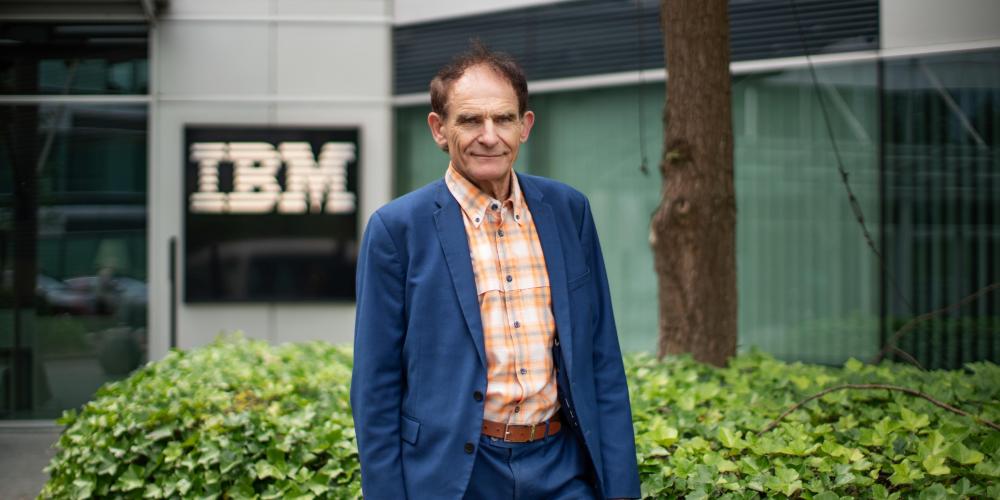


Strengthening ties and creating cross-pollination between the university and the rest of the world: that is the philosophy behind the VUB Fellows at Vrije Universiteit Brussel. Every month, one of these fellows is featured. This time it is Eric Michiels from IBM. Eric works as a quantum ambassador and gives lectures and workshops on quantum computing in both companies and academic settings.His advice for young people? “Study mathematics. Anyone with a strong sense of mathematics can quickly master quantum algorithms. Or consider a STEM degree if a heavy focus on mathematics feels too challenging.”
Classical computers work with bits that are either 0 or 1, while quantum computers use qubits that can be both 0 and 1 at the same time—or more precisely, in a superposition of 0 and 1. Strange little things, those qubits. What is the point of that?
Eric Michiels: “A quantum computer tackles complex calculations in a completely different way than a classical computer. As a result, we will be able to solve complex problems faster, more accurately, or even solve problems that were previously out of reach.”
Will quantum computers replace classical computers?
“Not at all. We are moving toward a hybrid model, where a classical computer works together with a quantum computer. The two will complement each other.”
So quantum computers won’t become PCs?
“No. They are not meant for everyday home or office applications like word processing or gaming. Quantum computers are designed as back-end systems, operating behind the scenes. Some machines even require cooling to extremely low temperatures. Quantum computing will mainly be useful in research and in large, complex problem domains.”
“Kwantumalgorithms can predict whether certain molecules may lead to breakthrough medicines”
Where will quantum make the biggest difference?
“First and foremost in quantum chemistry. This field studies chemical reactions at the smallest level of matter: atoms, electrons, and other subatomic particles. This could lead to better batteries, materials that capture CO₂, and stronger, lighter, more corrosion-resistant substances. Drug development will also become faster.”
How would that work in medicine?
“Some diseases are caused by proteins in the body folding incorrectly. One of our clients, the Cleveland Clinic, is working on developing therapeutic molecules that help proteins fold correctly. To predict which molecules are most effective, they have been using AI for some time. More recently, they have started using quantum algorithms as well. For short amino acid chains—the building blocks of proteins—the quantum system is already producing more accurate predictions. In the future, this should also work for longer amino acid chains.”
In which other areas could quantum computing be useful?
“In logistics optimization problems. If a rail defect appears somewhere today, the railway company must immediately close that track and reorganize the entire network. Today, that is still done manually, while such a highly complex task is exactly what quantum computers are well suited for. The same applies to the logistical challenges faced by supermarket chains, which must efficiently route hundreds of trucks from dozens of depots to thousands of stores with hundreds of thousands of products, while accounting for breakdowns, traffic jams, and other unforeseen events.”
Quantum could also help solve aerodynamic problems?
“Yes, that is a relatively recent insight. To optimize the aerodynamics of objects such as airplanes or wind turbines, you need to solve complex partial differential equations. Quantum computing is also strong in this area. Scientists working with the future Einstein Telescope will also need to solve such equations to interpret their measurements.”
“Superconducting qubits operate at a temperature of about -273°C”
You previously mentioned a hybrid approach combining classical and quantum computers?
“You can train AI models on quantum computers. Until recently, people mainly thought in terms of traditional machine learning and deep learning models, but now Large Language Models (LLMs) are also entering the field of Quantum Machine Learning.”
How does that work?
“A concrete example relates to the ‘perplexity’ of an LLM. This is a measure that evaluates how well such a language model predicts the next word. The fewer words the model considers on average, the lower the perplexity—so to speak, the lower the confusion—and the better the prediction. Now, such a language model consists of billions of parameters. Recently, six thousand parameters were added that had first been trained on a quantum computer. As a result, the quality of the LLM immediately improved by 1.4%, despite the very limited addition of only 0.000075% extra parameters.”
I still hear a lot of “will” and “will be.” What stands in the way between dream and quantum computing?
“Technical challenges. The qubits produced by IBM are built on a new type of chip, which we call QPUs or Quantum Processing Units. QPUs are made using aluminum and niobium and are therefore superconducting. They operate at extremely low temperatures, down to about -273°C. That is colder than the temperature outside Earth’s atmosphere. This requires cryogenic equipment—think of a super-cold deep freezer with a quantum chip at its coldest point inside.
Producing these QPUs and making them operate stably is still not perfect. There is still noise, or ‘quantum noise’. That needs to be reduced.”
When will we get noise-free qubits?
“We expect to have a fully fault-tolerant quantum computer operational by 2029 or 2030. Such technological breakthroughs always come with uncertainty, but we are convinced we are on the right track. We will start with a few hundred QPUs, and from there scaling up can happen quickly. Policymakers also believe in it. The U.S. government is investing 2 billion dollars in quantum technology, of which 1 billion is allocated to the research and development activities of Anderon, a new IBM subsidiary that will handle industrial production of QPUs.”
Can this scaling be sustainable?
“More sustainable than AI in some ways. The energy required to create and maintain the cryogenic environment does not increase proportionally with the number of qubits. In other words, in terms of power consumption, it doesn’t matter much whether you need to cool a hundred or a hundred thousand QPUs.”
Are there also threats?
“Data security is a concern. A powerful quantum computer could relatively easily break current encryption systems and decrypt them. Companies and governments are already preparing for this by working on quantum-resistant cryptography.”
“You can perfectly work on a quantum computer via the internet”
The U.S. and China are investing heavily in quantum. Is Europe falling behind again?
“The race is currently indeed between the U.S. and China. Although quantum computers are also being built in Europe. You don’t need your own quantum computer to do research and design quantum algorithms. You can simply access quantum computers via the internet, just like using cloud servers. Both IBM and other companies offer different payment models: from a few minutes of free individual use to annual subscriptions with full support.”
Is that already happening today?
“Globally, about three hundred clients are already using such systems, including a handful in Belgium and Luxembourg. For startups, this is a great way to work with quantum computing—they also get favorable conditions. There, in my personal opinion, may lie some of the best opportunities for Europe and Flanders. I would focus on designing algorithms in areas where we are strong, such as logistics, banking, chemistry, or health sciences. After all, it is the applications that will make the difference. A startup can develop them and then sell or license them to large organizations.”
“VUB students could introduce quantum computing in companies”
You are a VUB Fellow. How did that come about?
“I have good contacts with professors Jan De Beule and Ann Dooms from the Department of Mathematics and Data Science. I regularly give lectures there for students. Last year, we even organized a quantum competition for master’s and PhD mathematics students, the so-called Qiskit Fall Fest. Qiskit is the most popular open-source development kit for quantum computing.”
What was the assignment?
“All participants received anonymized data from first-year mathematics students: how many hours of classes they attended, how many hours they studied, how well they performed in various subjects at the end of the year, and so on. Based on that data, they had to use quantum computing to build a machine learning model that could predict how many students would successfully complete their master’s degree.”
“In about four years we’ll know whether the predictions are correct! How should young people prepare for a world with quantum computers?”
“Study mathematics. Or follow a programme with sufficient mathematical coursework. Anyone who enjoys mathematics will quickly get the hang of quantum computing. Stay curious after your studies as well. And don’t forget your soft skills. Learn to listen so you truly understand what your client is asking. Be open to different cultures. Learn to collaborate. Maintain your language skills. AI generates text, but people quickly notice when it is not ‘real’ or authentic. And by the way: all the top scientific papers I read in quantum computing are still written by humans. Truly groundbreaking innovation still comes from people today.”
“As a Fellow, can you help VUB students get on the right quantum track?”
“Many companies are still hesitant about quantum, or simply don’t have the time. Students could therefore add enormous value. As part of their master’s thesis or PhD, they could introduce quantum computing in a company to show how it can be used to tackle real-world problems. That seems like a win-win situation.”
The VUB Fellowship is a network of experts and leaders who voluntarily commit themselves to the Vrije Universiteit Brussel and UZ Brussel. These business leaders, social entrepreneurs, community activists, scientists, artists, and athletes act as our antennas in society and industry. They not only serve as a source of inspiration for our academics and students, but also help promote and represent the university’s philosophy as ambassadors. Read more about it here.
Bio Eric Michiels
Eric Michiels has been working at IBM since 1999. He is an Executive Architect, Quantum Technical Ambassador, and Quantum Regional Lead for Belgium and Luxembourg. He is also a Qiskit Advocate. Qiskit is an open-source environment that allows users to build quantum applications and algorithms. Eric Michiels was appointed a VUB Fellow in 2023, nominated by Prof. Dr. Jan De Beule from the Department of Mathematics and Data Science at the Vrije Universiteit Brussel.