

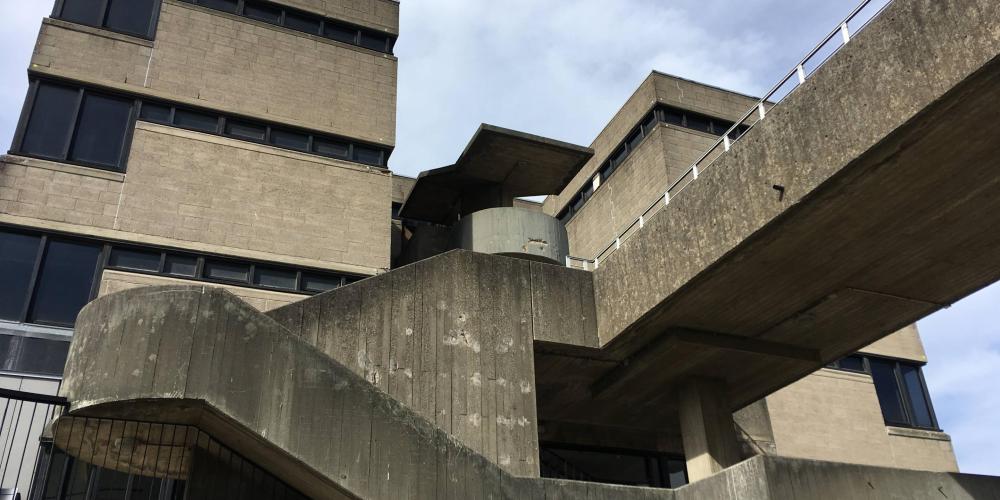


Concrete architecture was long reviled, but is now undergoing a revival. This renewed attention for Brutalism — the architectural movement that made its mark in the 1960s and 1970s with striking concrete forms — will gain additional visibility in Brussels this spring. In a new photographic exhibition and the book Brutalisme Bruxelles (CFC-Editions, April 2026), photographer Adam Paluch captures iconic examples from the capital, including buildings belonging to the Vrije Universiteit Brussel. The VUB campus itself features several notable examples.
Paluch specialises in Brussels architecture and has been documenting the city’s modernist heritage for years. His work records, among other things, post-war concrete Brutalism and is now brought together in a richly illustrated publication. At the same time, an exhibition of his photographs is on display at Maison CFC, where the raw use of materials and the sculptural qualities of these buildings take centre stage.
Several representative examples of this architectural style can be found on the VUB campus. Their robust volumes, exposed structures and functional aesthetic reflect the broader context of university expansion in the second half of the twentieth century. Today, these buildings are increasingly being reassessed as valuable heritage, with greater recognition of their historical and architectural significance.
Paluch is not only a photographer, but is also involved in heritage-related research. He has contributed to publications on Brussels architecture and has worked on documentation projects for, among others, the VUB and urban.brussels. His work therefore aligns with a growing academic interest in the preservation and reappraisal of modernist sites.
With the exhibition and the book Brutalisme Bruxelles, Brussels Brutalism — and that of the VUB in particular — is given a new platform. What was once seen as austere and impersonal now appears surprisingly expressive and newly relevant.