

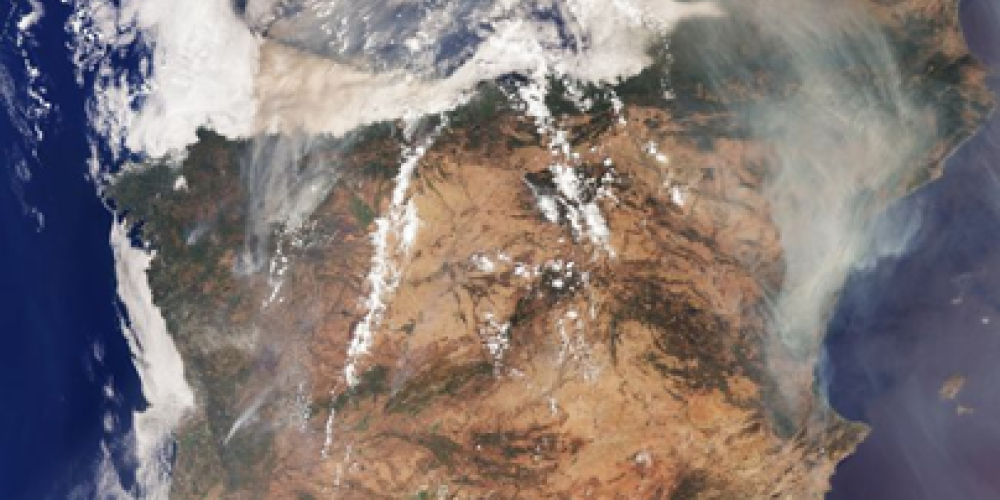


In 2025, northwest Spain and Portugal alone accounted for more than half of the area burned in Europe. This shows that in certain parts of Europe, the impacts of climate change are being felt today, already hurting people and their rights to a healthy life and environment. A new study, by an international team of scientists, led by researchers at the University of Murcia in Spain and co-authored by climate researcher Rosa Pietroiusti the Water and Climate Department at the Vrije Universiteit Brussel examines the causes for these intense fires.
“We consider the combination of extreme weather and highly flammable vegetation the main cause of the record-breaking area burned during the wildfires last August in northwest Spain and Portugal. This region, which represents barely 2% of European territory, accounted for more than 50% of the total area burned across Europe up to the end of August (approximately 541,000 hectares out of one million)” says Rosa Pietroiusti.
The study examines both the climatic aspects and vegetation characteristics of the burned region. It emphasizes that these fires were not an isolated event, but rather coincided with an intense heat wave that lasted for 16 days in southwestern Europe, which favored the emergence of extreme weather conditions conducive to fire spread. This was reflected in an increase in the Fire Weather Index (a fire danger metric that combines temperature, humidity, wind, and precipitation), which in August 2025 reached its most extreme monthly value in the northwest of the Iberian Peninsula, since continuous records began in 1985.
“What’s also important to understand is that extreme weather conditions alone are not sufficient to explain the magnitude of the fires. Land management is also key, and needs to be taken into consideration for the future, especially in the context of a changing climate with hotter and drier conditions projected across the Mediterranean” adds Rosa Pietroiusti. The fires in 2025 particularly affected shrubland areas, which burned to a much greater extent than expected. This disproportionate burning suggests that an increase in the continuous area covered by this type of vegetation, resulting from decades of forest degradation, land abandonment and effective fire suppression in the region, increased the buildup of this fuel, and the risk of such fires.
To prevent summers like that of 2025 from becoming the new normal, the researchers urge coordinated action that addresses the three dimensions of risk: hazard, exposure, and vulnerability. One of the key levers is greenhouse gas emission reductions, to limit the occurrence of extreme hot-dry conditions, conducive to such disastrous fires. The researchers also highlight it is essential to shift from a predominantly reactive strategy to proactive prevention and land management strategies that recognizes fire resilience in fire-prone areas as a matter of national security.
Reference:
Sánchez-Hernández, G., M. Turco, I. Repeto-Deudero, et al. 2025. “ Record-Breaking 2025 European Wildfires Concentrated in Northwest Iberia.” Global Change Biology 31, no. 12: e70649. https://doi.org/10.1111/gcb.70649.
Contact:
VUB Researcher - Rosa Pietroiusti - bclimate group, Water and Climate Department, Vrije Universiteit Brussel, rosa.pietroiusti@vub.be, 0496836663
Valorisation manager Marie Cavitte - bclimate group, Water and Climate Department, Vrije Universiteit Brussel, marie.cavitte@vub.be, 0470192415.