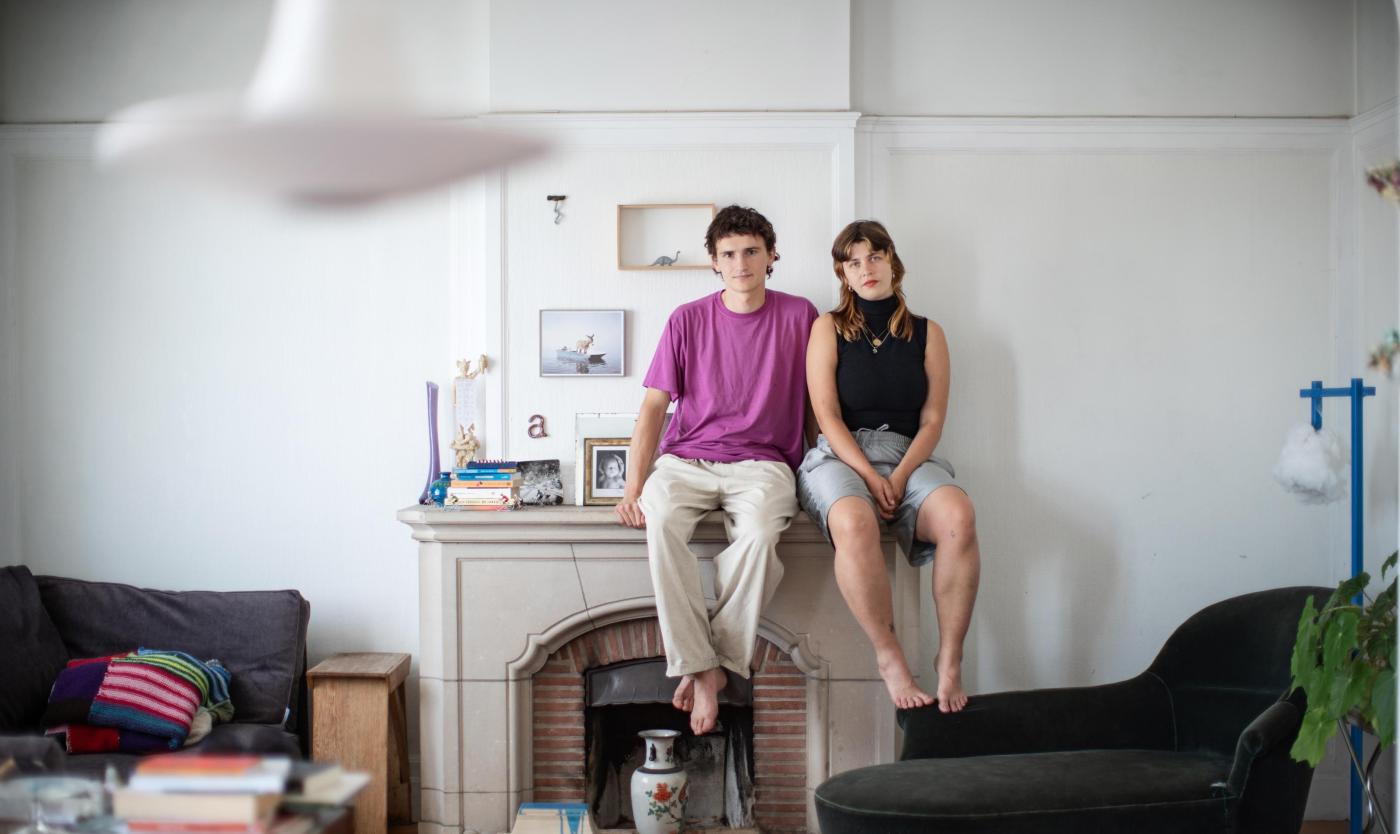
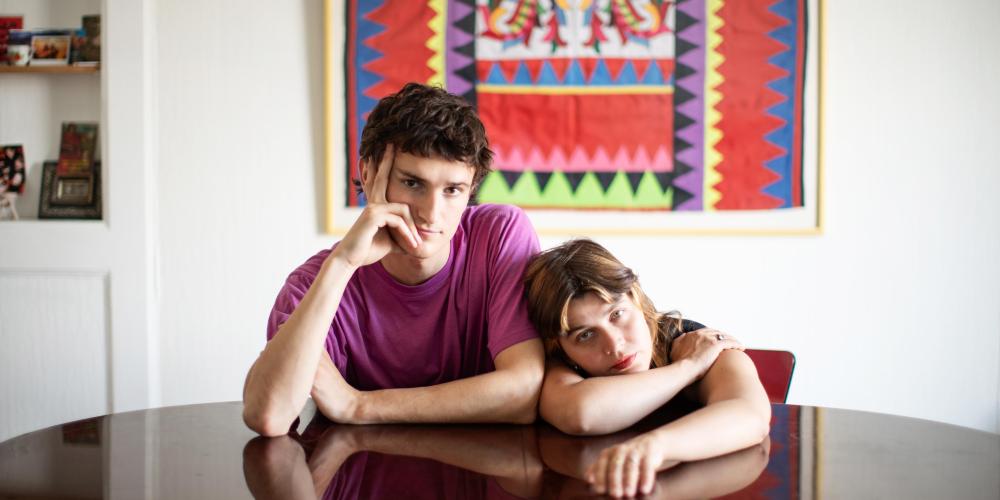


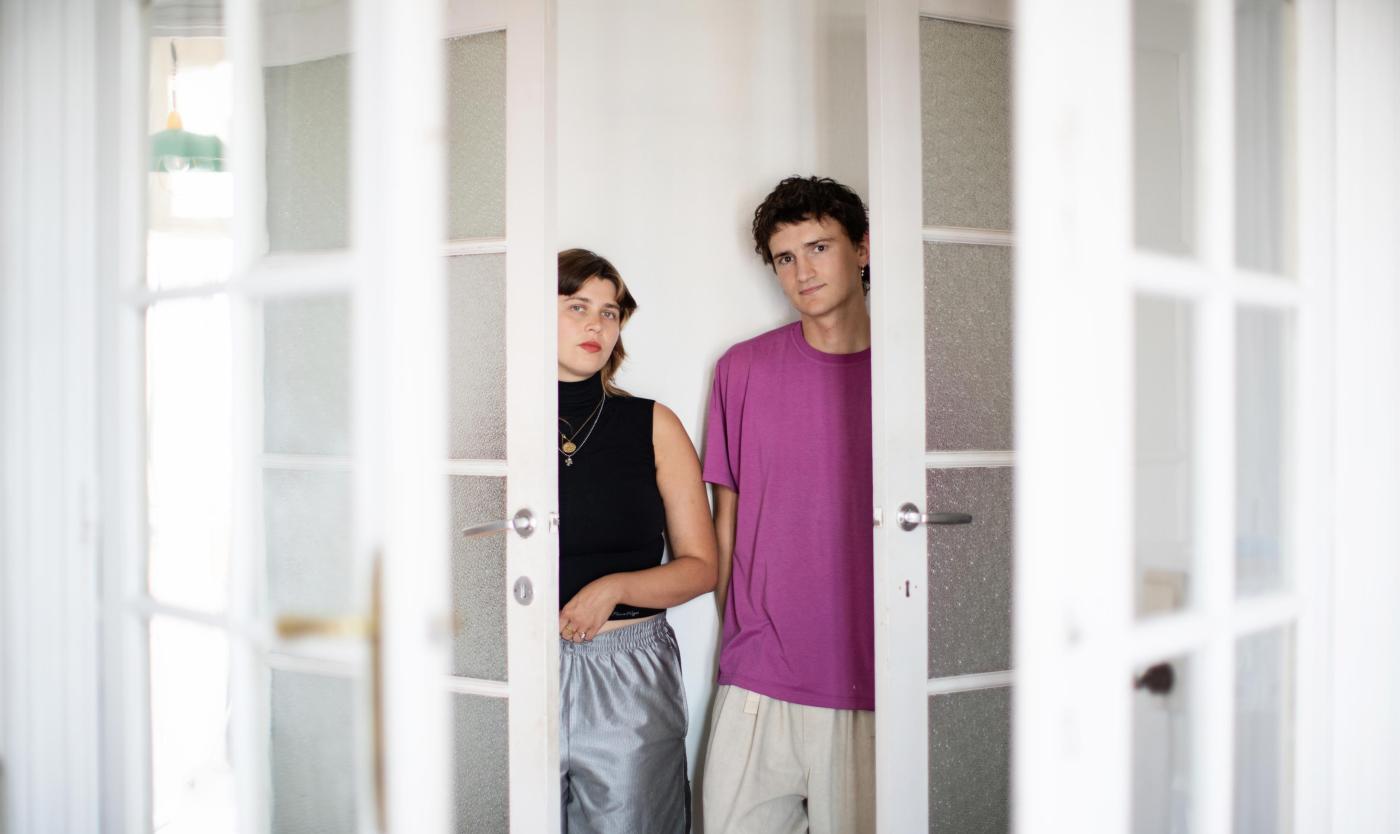
Leon Adriaensen is a climate scientist, Martha Balthazar makes theatre and writes. Together, they created the play Aha, with support from the Caroline Pauwels Grant for Wonder. This grant supports performing artists and researchers who build bridges between art and science. Leon and Martha wrote the text for Aha at the kitchen table. Literally, because the two are also a couple. That occasionally sparked some friction, Martha admits.“We had the odd argument now and then, but we felt it was worth it.”
View the tour dates and book your tickets. The performance is in Dutch.
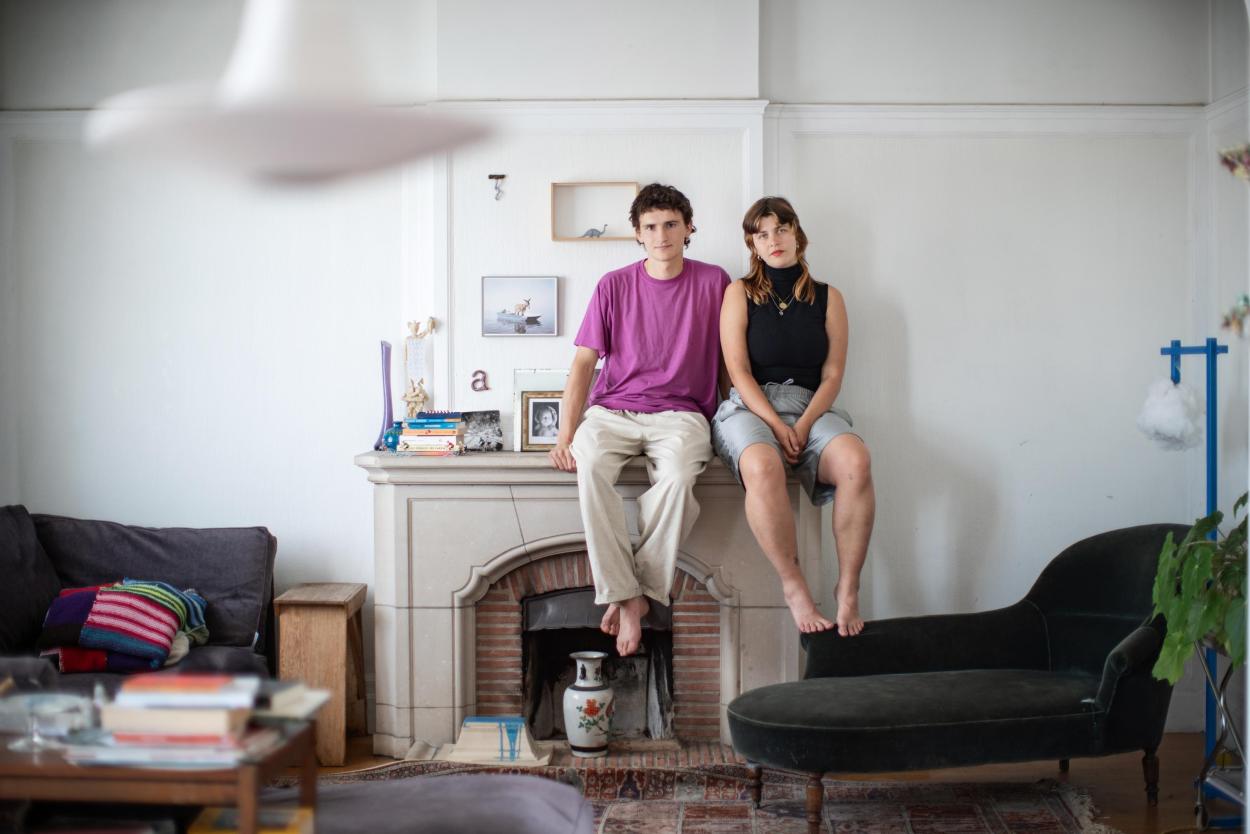
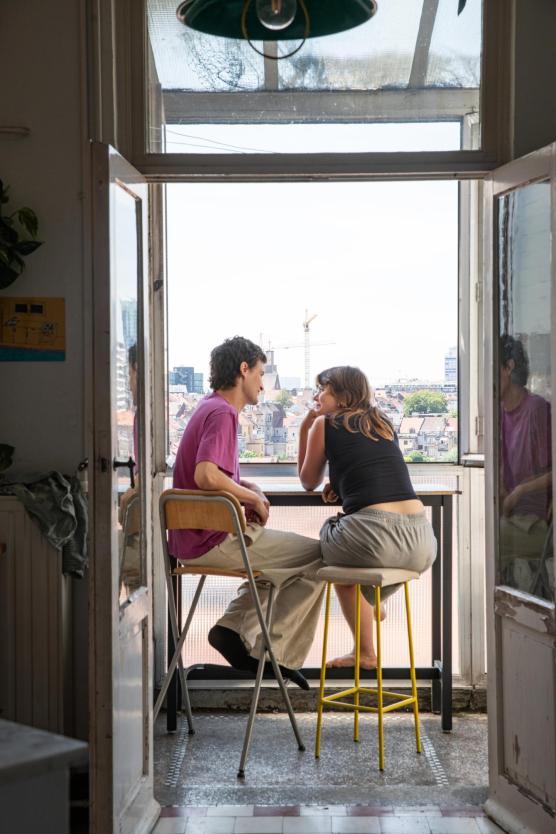
The first heatwave of 2026 is nearing its peak when we ring Martha’s doorbell. She lives on the seventh floor and the lift is out of order. Upstairs, we are consoled with iced coffee and a panoramic view over the rooftops of Schaerbeek. The red roof tiles shimmer in the sun, as though they are being baked for a second time. But we were there to talk about Aha and the bridge between art and science. Leon immediately felt that this theme was tailor-made for them when he came across the call for applications for the Caroline Pauwels Grant for Wonder. His partner, however, was less enthusiastic.
Martha: “I had no desire to wake up on a free Sunday morning and immediately start talking about work. In the end, we submitted a proposal anyway and secured the grant. The condition was that we would keep work and private life separate. Which, naturally, did not always work out so well.”
The Caroline Pauwels Grant encourages ideas to collide, shift and evolve. Is that what happens around your kitchen table?
Martha: “Sometimes. Leon is a scientist, I’m an artist. We have learned to look at the world in different ways and, from there, to arrive at understanding and eventually at conclusions. Because of those different approaches, we sometimes hit a wall. We used precisely that friction between the two of us as a metaphor to say something about the tension between science and society, and about themes such as truth, belief and trust.”
“If our play contains a message at all, it might be: get involved with science”
In your play, someone is disappointed when her partner explains that shooting stars are actually comets. Was that inspired by a conversation at the kitchen table?
Martha: (laughs) “I had simply never really thought about it before. I mainly knew that you were supposed to make a wish when you saw one, and I was genuinely outraged that Leon didn’t. I enjoy learning, but if the explanation doesn’t suit me or turns out to be less poetic than I had hoped, I can become rather grumpy about it, I admit.”
Leon: “As that character in Aha says: you can still make a wish on a shooting star, even if you know that it is actually a comet.”
Martha: “Agreed. In fact, scientific explanations often make the world more beautiful. Understanding how gravity works, or that oxygen molecules move faster when heated during a heatwave: to me, that is pure poetry.”
Yet people often seem to have little affinity with science. Resistance even appears to be growing.
Leon: “Our entire lives are shaped by technology, but most people have little connection with the science behind it. Usually that is not a problem, until we face a pandemic or a climate crisis and science asks us to change certain things. Not that we wanted to present science in our play as all-knowing or infallible. Rather, we wanted to show it as something profoundly human. With its flaws, but also with the sense of wonder it inspires.”
Is that the message of Aha?
Martha: “If our play has a message at all, it might be: engage with science. There needs to be dialogue between society and science. At the moment, there is a contradiction: on the one hand, we demand certainty and objective truth from science; on the other, we find it strange that we are expected to trust that authority blindly, because we do not understand the underlying knowledge. That is where much of the tension in society comes from.”
“With a different worldview, we would develop very different scientific practices”
You mentioned the flaws of science. What do you think they are?
Leon: “One example is the way science is funded. Research costs money. It is easier to secure funding if you choose research questions that deliver answers quickly. Fundamental research that looks further ahead, takes risks and could lead to major paradigm shifts therefore gets fewer opportunities. The way science is communicated can also be problematic. Communication should be clear and accessible, but that does not mean complexity should simply be swept under the carpet. Scientists should not underestimate their audience.”
Do you agree, Martha?
Martha: “For me, the problem goes deeper than that. Science is embedded in a particular worldview that is hardly ever questioned. Imagine starting from a different worldview, one in which humans are less central, or where we approach things more holistically. You would probably develop very different scientific practices. What were once choices have become self-evident truths: ‘this is how we do science, and not otherwise’.”
Can you make that more concrete?
Martha: “Take the approach to the climate crisis. The IPCC reports are based on a very specific economic system. There is little room for degrowth or alternative scenarios. Such a report is the outcome of a very long negotiation process, involving many choices about who participates, which research is included and where the funding comes from. It is problematic to obscure the fact that it is a negotiation and to present such a report as thetruth.”
“After quantum mechanics, you can never quite look at life in the same way again”
So, to some extent, you understand why some people are sceptical of science?
Martha: “I think, at the very least, that we should take them seriously. There genuinely is a sense of unease among the public. ‘According to the experts…’ or ‘research shows that…’. When I read that in the newspaper, I sometimes think: haven’t we been taught not to accept everything we are told without question?”
Leon: “That dilemma is also addressed in Aha. On the one hand, you should question things, as Martha says. But I also believe that science should not be relativised to the point of destruction, because there is enormous power in it. That is also where the title comes from. The ‘aha’ refers to those moments of wonder I have experienced through doing science and suddenly understanding something.”
The play also touches on black holes.
Leon: “The fact that someone could imagine, through mathematical equations, that black holes must exist, and that decades later they are actually observed — that is truly extraordinary.”
Which area of science completely blew you away?
Leon: “My first lessons in quantum mechanics. Because it is all so counter-intuitive. You spend your whole life believing in a continuous, linear universe, and suddenly you have to let go of those certainties. At first, that is difficult. But as understanding grows, so does the sense of wonder, sometimes even ecstasy. It is not that I wake up thinking about it every day, but afterwards you can never quite look at life in the same way again.”
And what has turned your world upside down, Martha?
Martha: “Fiction, especially science fiction. Parable of the Sower by Octavia Butler, for example, or Slaughterhouse-Five by Kurt Vonnegut. In that book, time is no longer linear for Billy Pilgrim, the protagonist: he jumps uncontrollably between his past, present and future. I knew non-linearity as a concept, but a story like that makes you actually feel it. When you finish such a book, you spend a while walking through the world on tiptoe. Beyond the realm of the self-evident.”
“With this play, we also want to challenge scientists to reflect on their own work”
Is art freer than science?
Martha: “They often stem from the same impulse and can produce the same effect: showing that things are not always what they seem. Science may actually be better at that than art. We tend to think that science reveals objective facts and tells the truth, but that is not always the case. Quantum mechanics teaches us that reality, at a certain level, consists of a kind of symphony of probability waves. That completely overturns our way of thinking. The disadvantage of science is that you need a certain level of prior knowledge. You do not need that when you come to see our play. Art, by definition, exists in relation to an audience.”
And who is that audience? Aren’t you often preaching to the converted?
Martha: “Those theatres are not filled only with left-wing university graduates, you know. After Theater aan Zee, we will also be touring. Not only at the KVS, but also at cultural centres. They attract a very diverse audience of curious people from all walks of life. You can quote me on this: in Flanders, we should be proud of our network of cultural centres!”
Leon: “We will also be performing Aha at academic institutions, because we want to challenge scientists to think about their own work.”
You want to give them a guilty conscience?
Martha: “Yes, a scientific conscience.” (laughs)
“Wonder alone is not enough to change things”
What do you think of the concept of wonder that Caroline Pauwels wrote about?
Leon: “I first read her essay Enlightenment Belongs to Everyone when I was nineteen. It was a real eye-opener. And Ode to Wonder beautifully articulated that experience of admiration and ecstasy that scientific insights can inspire.”
Martha: “In my work, I hope to question what we take for granted. Wonder is a fantastic tool for doing that. Wonder and curiosity are usually the starting point of any project. If a market trader tells me that climate activists like me are driving farmers to suicide, I go and speak to farmers and try to understand how they live. Other projects have focused on older people and on people with far-right views, and at the moment I am interviewing Eurocrats for a performance about the phenomenon of power. So wonder is an important instrument. At the same time, I also strongly believe in indignation as a way of looking beyond what seems self-evident. Wonder alone does not provide enough ambition for change.”
Premiere of Aha at #TAZ2026
Aha will premiere at Theater aan Zee on 3 August and will run there until 8 August. The production will then go on tour, with stops including KVS in Brussels and GUM in Ghent. The production was made possible in part thanks to the Caroline Pauwels Grant for Wonder, an initiative of deAuteurs, TAZ, VUB and KVS.
Language: Dutch
Martha Balthazar: Concept, text and direction
Leon Adriaensen: Concept and text
Carine Van Bruggen: Performance and text
Barbara T’Jonck: Performance