

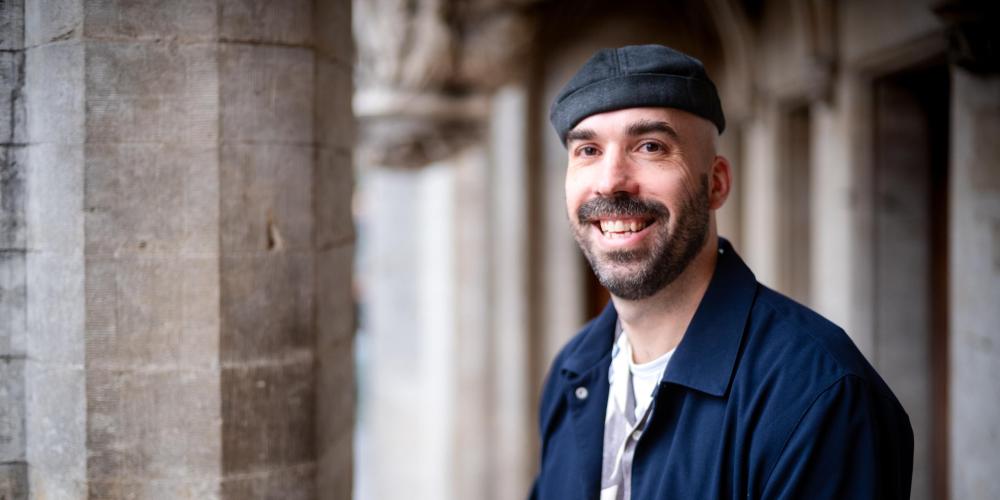


With three VUB degrees under his belt, Hans Moyson is now Media Relations Manager at WWF. His civic engagement and professional ambitions come together there. “I’m glad I can combine both roles in one project.”
What does your job involve, and what do you enjoy about it?
“As Media Relations Manager, I write press releases whenever WWF wants to communicate proactively about an issue. Last summer, for example, we released sturgeon into the wild in Bulgaria. I informed the press about that. Conversely, journalists also contact me when they have questions for WWF. You can see me as the link between the media and the expertise within WWF. That means I don’t necessarily have to answer every question myself. We have several biologists in-house whom I can always consult.
What I really enjoy about my job is the feeling that I’m working on something meaningful. At WWF, we aim to stop the decline of nature and help restore it to a healthier state. Not only in Belgium, but worldwide — WWF is active in almost 100 countries. Being able to contribute to that by sharing information with the wider public feels extremely valuable to me.”
You hold degrees in philosophy, political science and communication. How did that come about?
“I started studying communication sciences out of an interest in journalism and media. Through those studies, I came into contact with subjects such as political science, sociology and philosophy. Those courses were a revelation and really broadened my perspective. I found them so interesting that I wanted to explore them further afterwards. That’s why I extended my studies. During my bachelor’s in communication sciences, I already took some political science courses. Philosophy then kept me busy for another four years. That was a deliberate choice: four years of thinking deeply and critically.”
“At the VUB, I really found peace”
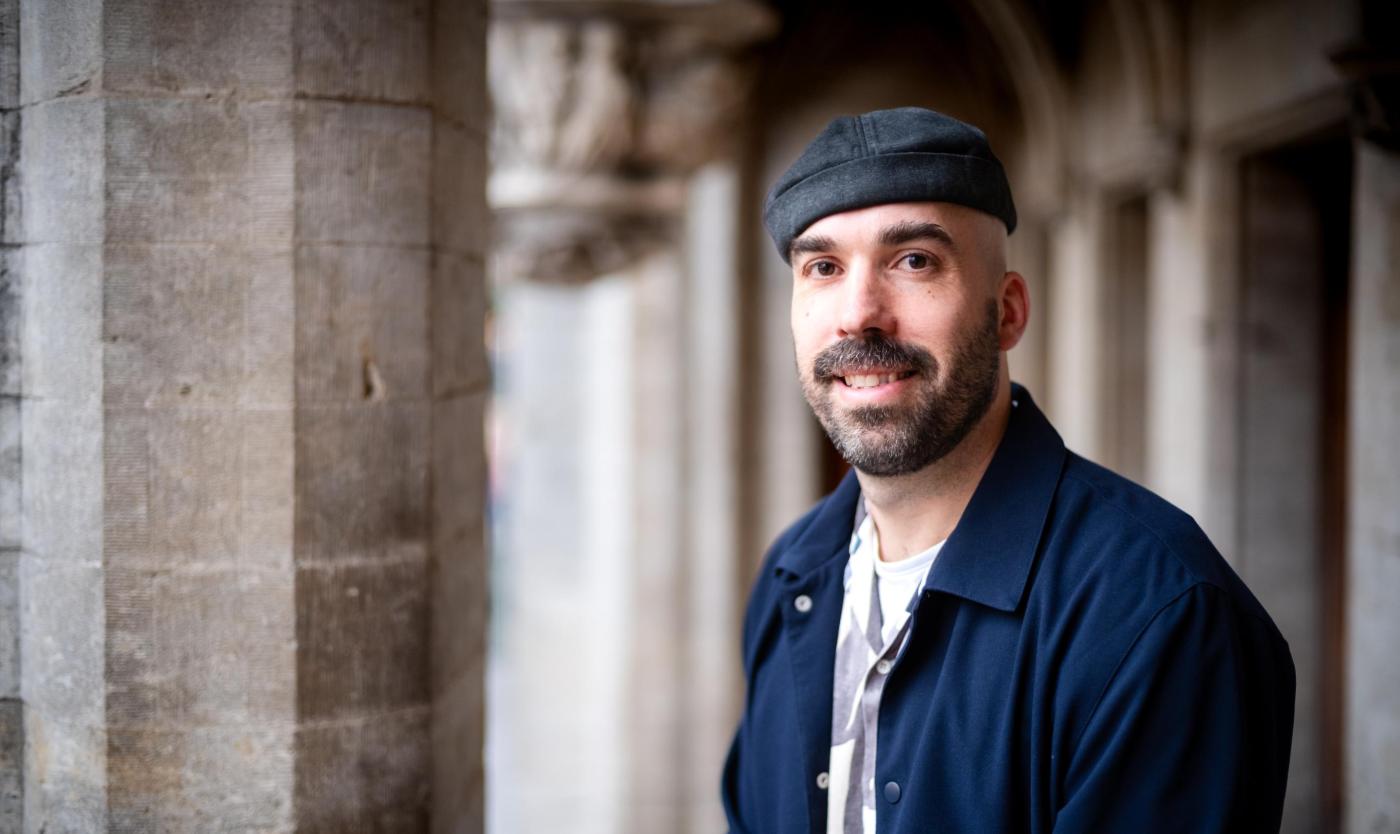
You studied for a total of eight years. What memories do you have of your student days?
“Before coming to the VUB, football had taken up most of my life. At seventeen, I was playing at a professional level. As a result, my secondary school studies suffered somewhat. I was mainly focused on sport. University was therefore a completely new world for me. I will never forget that first impression. I felt a sense of calm and really enjoyed spending time in the library, reading and studying.”
Are there any professors or courses you remember in particular?
“I still remember all my professors, and I think I took something away from each of them. If I have to single out one person, it would be Jean-Paul Van Bendegem. He had a real gift for presenting dry material in a humorous, almost entertaining way. Thanks to that light touch, he was able to genuinely enthuse students about serious topics. I admired that.”
Are you still in touch with fellow students from that time?
“Yes. One of my best friends is someone I met during my philosophy studies. The group in that programme was particularly interesting. Philosophy attracts very diverse profiles. On the one hand, you have students who come straight from secondary school and choose philosophy out of conviction — which is quite remarkable at that age. On the other hand, the programme also attracts slightly older students, people who are already further along in life. The group was also small, which created an intimate setting and led to rich discussions. Communication sciences and political science — both much larger programmes — also had a pleasant atmosphere, but it was different.”
What advice would you give to today’s students?
“When I graduated from the VUB, I thought the job market would be waiting for me with a fantastic job. It didn’t quite work like that. A degree opens doors, but you also have to be willing to take detours. You shouldn’t expect your dream job to be handed to you on a silver platter. Never give up on your courage or your dreams. Keep working, keep developing yourself. Eventually, you’ll get where you want to be.
After my studies, I taught for a while, gained journalistic experience and even worked briefly for a multinational. That allowed me to see how different sectors operate. Then I asked myself: which issue do I personally want to speak out about and help change in society? During my philosophy studies, I had written a paper on animal welfare, based on the work of Peter Singer. That topic was close to my heart. When GAIA had a vacancy, I sent them my paper — and I was able to start immediately. Later, I broadened my focus to wild animals and nature in general, which eventually led me to WWF.”
Which professional achievement are you most proud of?
“My first campaign at WWF, which focused on the lynx. WWF had published a report showing that there is room for around 75 lynx in Belgium. As part of a press action, we invited journalists to the south of the country to explore the lynx’s potential future habitat together. The turnout was enormous. It was an exceptionally special moment. There I was, standing in the middle of nature, surrounded by a whole caravan of journalists. That evening, the story featured on all the news programmes; the next day, it was in the newspapers. And that was my very first major WWF campaign.”
How do you expect your job to evolve in the future?
“AI will bring changes to the labour market. There may be fewer people needed in communication, but there will always be a need for communicators. The advantage is that a large part of the routine work will be done by AI, leaving more time for in-depth work. I remain deeply passionate about communication. In a few years’ time, I still see myself doing the same job — but perhaps with an even greater impact and a broader network. At its core, this is what I want to do: share WWF’s knowledge with society. I’m fortunate in that sense. As human beings, we have a role to play in the labour market, but also in society. Both need us — perhaps society even more so. I’m glad I can bring both roles together in one project.”verenigen.”