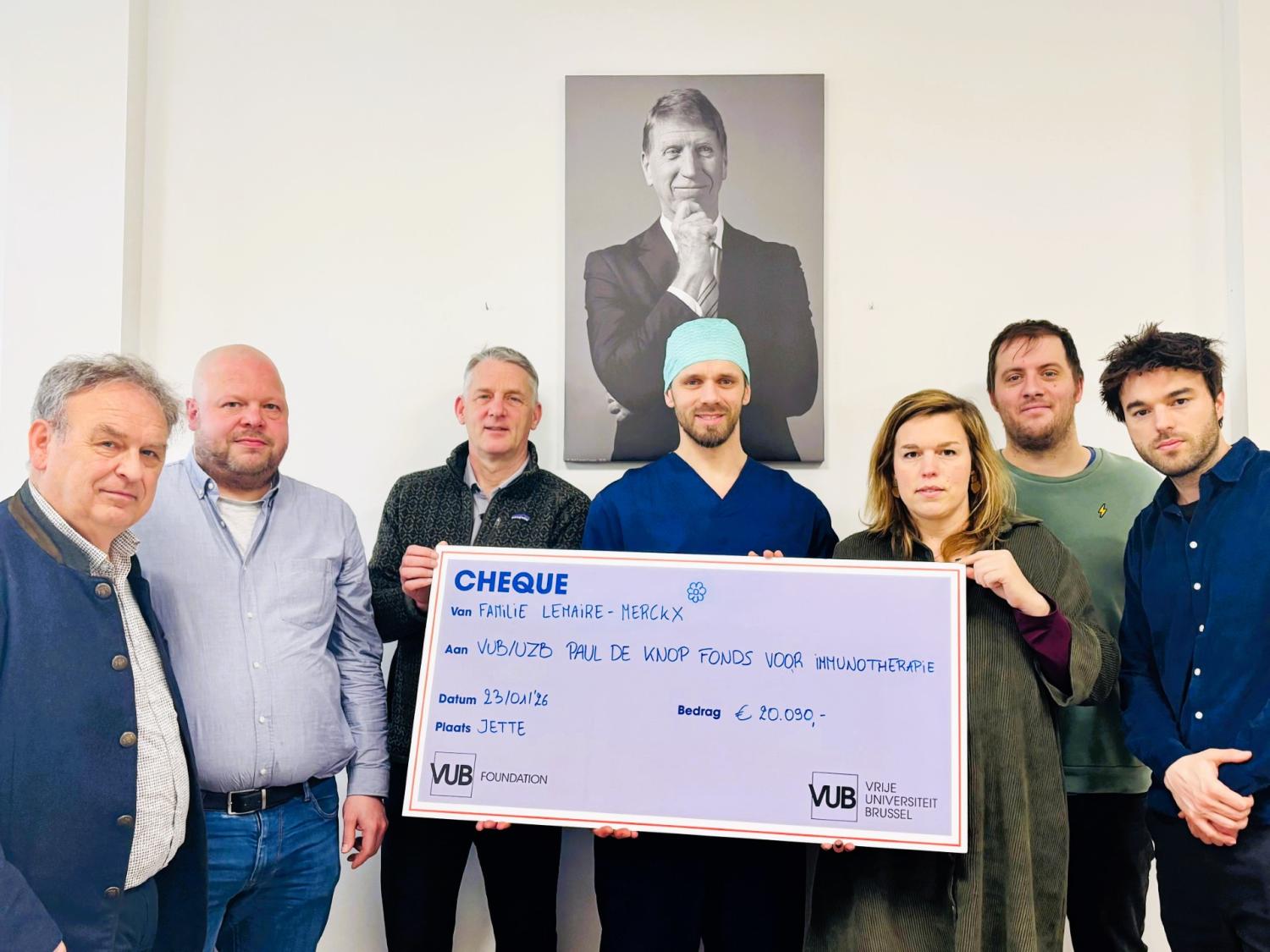
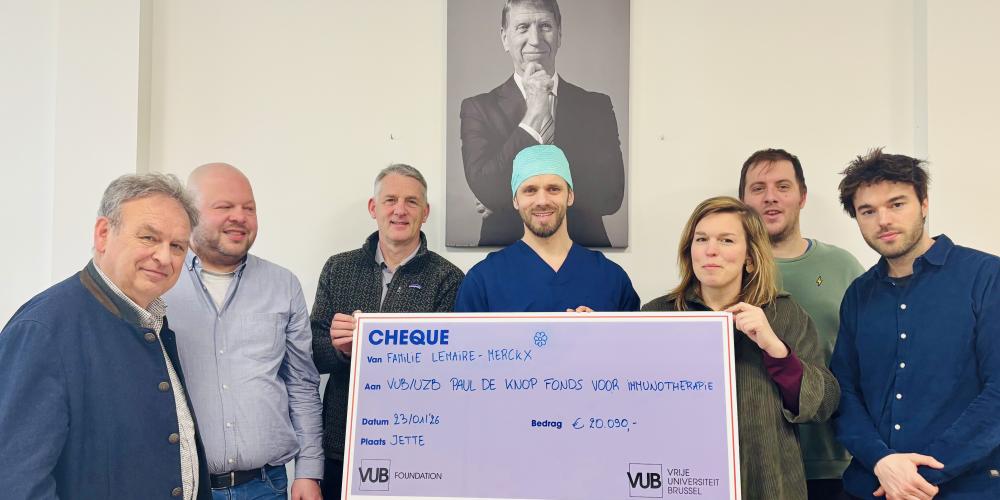


Brussels, 26 January 2026 – The research team of Prof. Dr. Bart Neyns and Prof. Dr. Johnny Duerinck (UZ Brussels) received a cheque for €20,000 for the VUB–UZ Brussels Paul De Knop Fund. The amount was raised through a flower campaign organised by Ellen Lemaire, in memory of her mother Ingrid, who passed away in 2024 from glioblastoma, the most aggressive form of brain cancer. The donation supports innovative research into immunotherapy for patients with aggressive and recurrent brain tumours, for whom treatment options remain limited today.
Support with a direct impact on patients
The Paul De Knop Fund supports research into innovative immunotherapies, which stimulate the body’s own immune system to recognise and attack cancer cells. At VUB and UZ Brussels, research is underway into the application of these therapies in various cancer types, including malignant brain tumours.
According to Prof. Dr. Bart Neyns, Head of the Department of Medical Oncology (UZ Brussels), such donations make a real difference: “They allow us to test innovative ideas more quickly and to further develop research projects, with the aim of better treatments and a higher quality of life for patients. Too often we encounter situations where existing treatments do not go far enough. In those moments, you cannot turn your back on these patients.”
Prof. Dr. Johnny Duerinck, neurosurgeon (UZ Brussels), adds: “Patients who suddenly receive a diagnosis of a brain tumour need perspective and hope. Our research aims to contribute precisely to that.”
Promising early results
Thanks to the support of funds like this one, researchers can set up safe patient cohorts, further refine the direct administration of immunotherapy into the brain, and prepare new studies in which treatments are introduced earlier in the care pathway.
Prof. Dr. Neyns explains: “Today, for the first time, we see in our study that five out of nineteen patients have remained relapse-free for more than two years, two of them even for more than four years. These are encouraging signs that show we are on the right track and that we need to accelerate.”
Personal commitment grows into support for research
Ellen Lemaire explains how the profound loss of her mother led to a strong personal commitment. She launched a flower campaign within a small circle, selling No Water Flower amaryllises. What began as a modest initiative grew into a broad act of solidarity: 1,400 flowers were sold by family, friends, fellow patients and supporters, resulting in a donation of €20,000.
Ellen Lemaire says: “The flower campaign not only raised funds for research. It also gave us the opportunity to talk about my mum during a time when we miss her enormously. Even now, we still receive photos every day of blooming amaryllises. That means a great deal to us.”