




At first glance, a meme may seem like nothing more than a joke flashing across your social media feed. But behind that single image lies a story about power, emotions, identity and community. It is precisely this cultural complexity that fascinates Astrid Luypaert. An art historian and PhD researcher at the Vrije Universiteit Brussel (VUB), she studies how people—and artists in particular—give shape to loss and grief. In doing so, she also examines phenomena that many would not immediately think of as subjects of academic research: internet memes.
A cultural historian's perspective
At VUB, Luypaert is affiliated with the BILD research group and the Educational Sciences programme. Her doctoral research focuses on how artists give shape to grief, with a particular interest in artistic mourning rituals in public spaces. Although her PhD centres on grief, she primarily sees herself as a cultural historian. "I trained as an art historian and archaeologist, but I'm equally interested in broader cultural processes. I want to understand the historical developments that have shaped the society we live in today and how culture continues to evolve."
That broad perspective also explains her fascination with memes. While studying in Leiden, she took a course on memes and digital culture. Since then, her interest has only grown. "I grew up with internet culture. For me, memes have always been there. But just like paintings, rituals or monuments, they tell us something about the world in which they are created."
What memes have in common with art
Many people see memes as little more than entertainment. Luypaert sees something much richer. "A meme is often more than just a joke. It emerges within a particular social context and tells us something about how people think, feel and view the world."
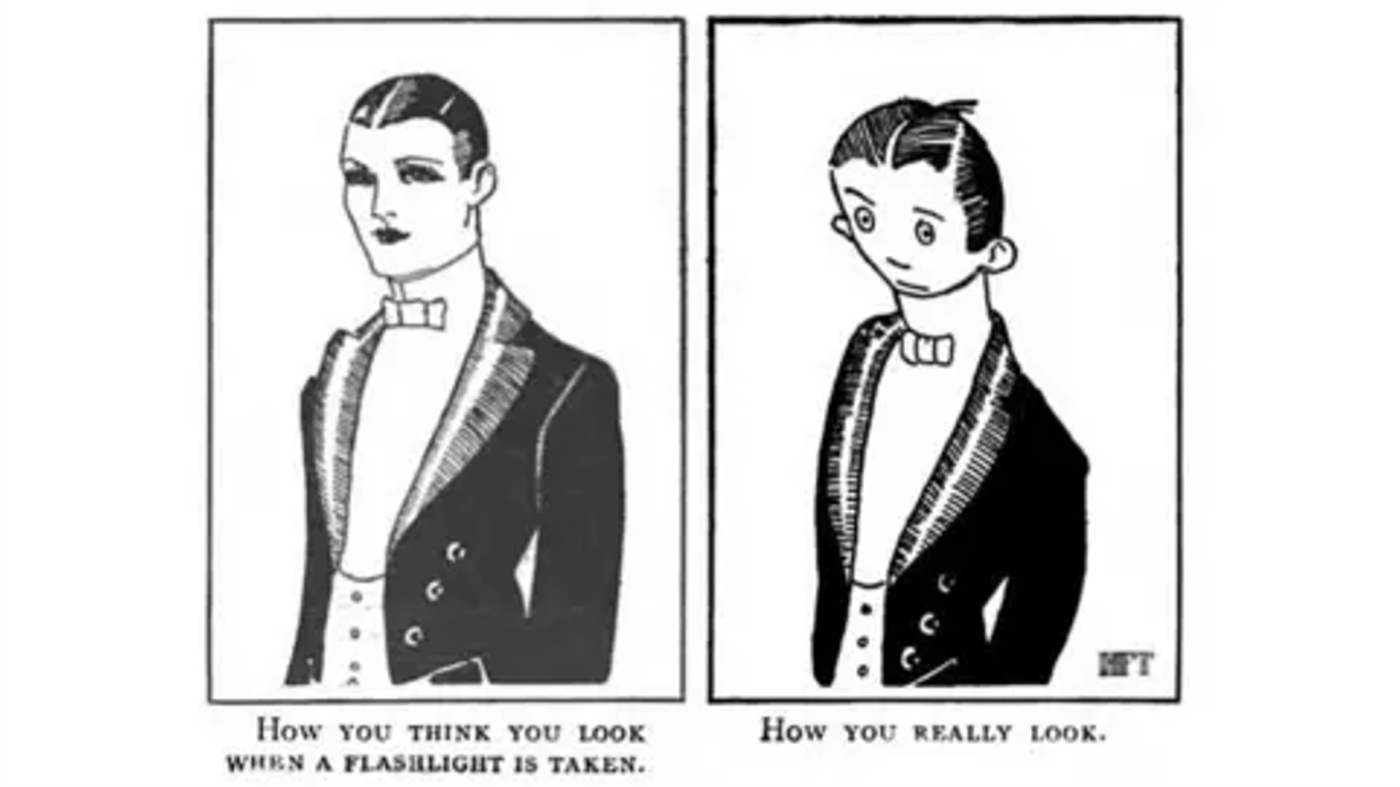
A cartoon published in The Judge (1921) shows that some meme formats are more than a century old.
According to Luypaert, memes share striking similarities with art from earlier periods. One key example is intertextuality: the way cultural expressions refer to and build upon other cultural expressions. "To understand a meme, you often need to recognise the original reference. We see exactly the same process throughout art history. Artists build on existing culture. They reuse images, adapt them and give them new meanings."
This mechanism long predates the internet. Luypaert points to a popular cartoon published in 1921 that plays with the contrast between expectation and reality. Its format bears a remarkable resemblance to modern "Expectations vs Reality" memes. "The format is simple, instantly recognisable and communicates its message at a glance. Those are also the qualities that still define internet memes today."
The first meme?
Perhaps surprisingly, the word meme did not originate on the internet but in biology. Evolutionary biologist and VUB honorary doctor Richard Dawkins introduced the term in 1976 in his book The Selfish Gene. "He wondered what, in culture, plays the same role that genes play in biology," Luypaert explains. "His notion was that ideas also spread, evolve and sometimes become dominant, much like genes."
Dawkins did not use the term to describe humorous internet images as we know them today. Instead, he used it to refer to cultural ideas, habits and beliefs that are passed from person to person. Religion was one of his best-known examples: a collection of rituals, stories and practices that spreads across generations while gradually changing over time.
Not everyone agrees with this interpretation. According to Luypaert, some scholars argue that Dawkins' definition is too broad because, by that logic, almost anything could be considered a meme. For her, the concept remains valuable as a way of thinking about how ideas, images and cultural practices spread, adapt and survive over time.
When a meme becomes more than a joke
Memes are not always harmless. They can also spread hateful messages or be used to manipulate public opinion. As an example, Luypaert refers to the Belgian Schild & Vrienden case, in which memes shared in private online groups sparked widespread public outrage. "People often respond by saying, 'It's just a meme.' But that argument can also serve as a smokescreen. A humorous format doesn't make a hateful message any less harmful. In fact, the context in which a meme is shared can reinforce that message."
Today, memes have also become a vehicle for political propaganda. Luypaert points to examples from the United States, where footage of immigration raids has been edited to the familiar Pokémon theme song Gotta Catch 'Em All. By combining humour, recognisable pop culture and emotional imagery, serious events are presented in a playful package while reducing human lives to a game.
"Even governments and political movements now actively use meme culture"
According to Luypaert, this illustrates the medium's unique power. Memes are fast, recognisable and emotionally engaging, allowing ideas to spread with remarkable efficiency. "Even governments and political movements now actively use meme culture. NATO, for example, is conducting extensive research into 'memetic warfare': the use of memes to influence public opinion during conflict."
What memes can teach us about grief
The connection between her research on grief and her interest in memes may not be as surprising as it first appears. "Grief is never just a personal experience. Ideas about whose lives deserve to be remembered and mourned are deeply embedded in society."
She draws on the work of philosopher Judith Butler, who explores why some deaths receive more public attention than others and what those differences reveal about how societies value human lives. Butler describes this as grievability: the idea that not every life is considered equally valuable or equally worthy of mourning. "Whose death receives attention? Who is remembered? Which losses do we consider important? Those are both political and cultural questions, shaped by deeply rooted social structures."
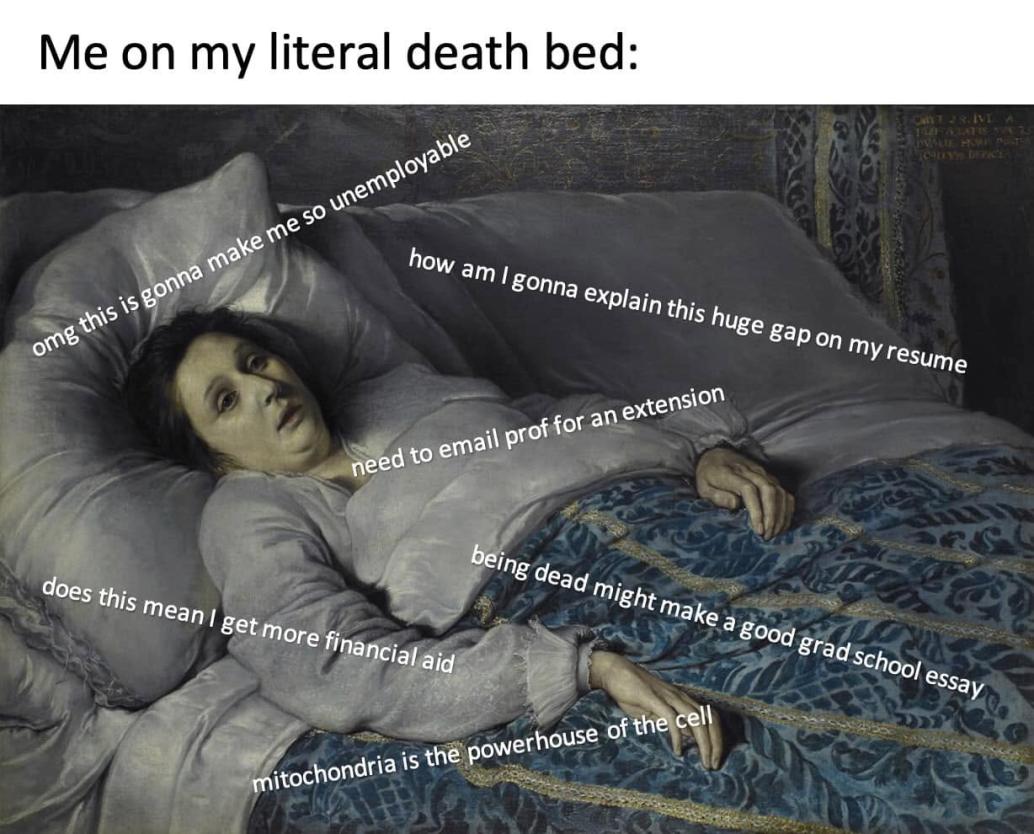
According to Luypaert, memes can make these dynamics visible. They reveal how people collectively process loss, sadness and uncertainty. "There are memes about climate grief, for example, or about the pressure to move on quickly after losing someone. They can act as a mirror, reflecting how we as a society deal with loss."
An archive of our time
When asked which meme future archaeologists absolutely need to discover, Luypaert hesitates. Rather than choosing a single example, she hopes future researchers will still have access to today's digital culture. "Memes often slip through the cracks. They circulate everywhere, but they're not always systematically preserved. Archiving them can reveal a great deal. It forces us to think about what we consider characteristic of our society and what we want to leave behind for future generations."
She likes to refer to Motel of the Mysteries, a satirical novel in which archaeologists from the distant future completely misinterpret everyday objects such as a toilet. "The book holds up a mirror to archaeologists. We often assume we understand the past, but in reality we're constantly reconstructing stories from fragments—and in doing so, we sometimes project our own contemporary assumptions onto history."
Perhaps the same will one day be true of memes. What seems fleeting and trivial today may become an invaluable key to understanding how we lived, laughed and grieved.
Bio
Astrid Luypaert is an art historian, archaeologist and PhD researcher at the Vrije Universiteit Brussel (VUB). She is affiliated with BILD (Brussels Research Centre on Innovation in Learning and Diversity), where she studies how artists give shape to grief and how art can create new forms of collective mourning. She has also been an active member of Studiekring Vrij Onderzoek for the past seven years.