

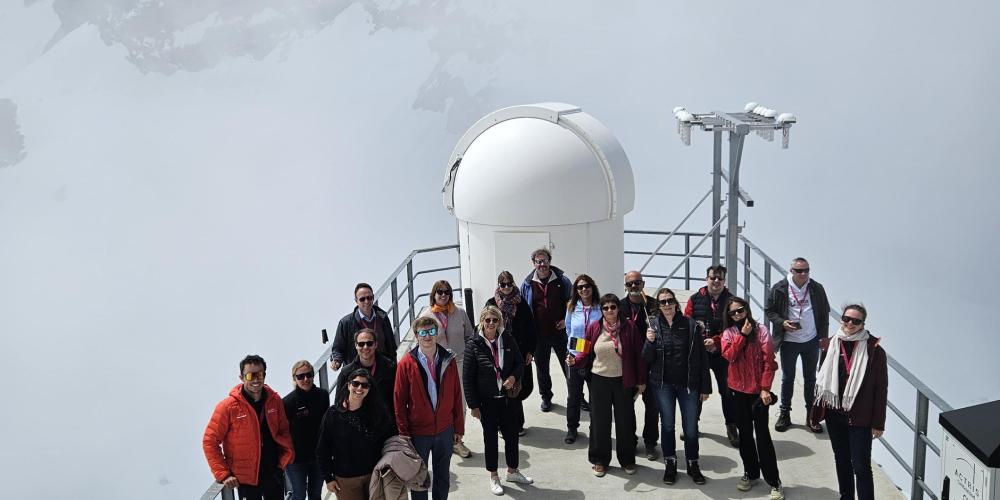


Vice-rector Karin Vanderkerken and Professor Lars De Laet (Architectural Engineering), spent two days in Switzerland at the end of May as part of an initiative set up by the Belgian Embassy in Bern to establish contacts between Belgian and Swiss universities.
The two-day event, hosted by H.E. Ambassador Patrick Van Gheel, included bilateral talks with universities, but also with Swiss researchers, who are looking at coming to Belgium on follow up visits. On the second day of the trip, the delegation visited the Jungfraujoch Sphinx Observatory. The objectives of the visit were to foster academic and scientific collaboration between Belgium and Switzerland; strengthen the Belgian network in Switzerland; support a balanced exchange of talent between the two countries.
The Belgian delegation included ULiege, UMons, UNamur, UCLouvain, KULeuven, UAntwerp, UGent, UHasselt, and VUB. The meetings were held at the Belgian Residence, and the programme included pitches by the Belgian universities explaining their unique selling points and expertise, followed by B2B meetings with their Swiss colleagues. After a networking lunch, the Swiss universities presented the Swiss academic landscape and their funding mechanisms. After a similar presentation from the Belgian side, case studies were presented of Swiss-Belgian scientific collaborations. The evening event on the first day included a BBQ where the Swiss and Belgian participants were joined by Belgian and Swiss students in Switzerland.
The second day was reserved for a visit of the High Altitude Research Stations Jungfraujoch and Gornergrat (HSFJG), followed by a tour of the research station and the Sphinx Observatory. The Jungfraujoch research station’s focus today is mainly environmental and on climate research. At 3,571m above sea level, the Sphinx Observatory is one of the highest observatories in the world. It includes two large laboratories, a weather observation station, a workshop, two terraces for scientific experiments, and an astronomical as well as a meteorological cupola. The astronomical cupola is equipped with a 76 cm telescope.
Collaboration between VUB and Swiss higher education institutes
VUB has already been working with a number of higher education institutions in Switzerland on research outputs, research activities, project collaboration (through programmes such as H2020, EUAR Fundamental research projects, and more individual cooperations) and student exchanges (via the Swiss-European mobility programme, or Erasmus+ KA131 Studies), and this across all of VUB’s faculties.
It is important to note that it is expected that Switzerland, like the UK, will participate fully in the Erasmus+ programme as of 2027, although at this point in time, this is not 100% guaranteed, as it will depend on the outcome of the parliamentary process for the 2027 budget, as well as decisions taken within the framework of the Bilateral Agreements III, which are scheduled for 2026. At present, Switzerland is classified as a third country not associated with Erasmus+. Under this status, Swiss institutions have been able to participate in selected Erasmus+ actions without requiring an Erasmus Charter for Higher Education (ECHE).
As mentioned, this visit of Belgian universities to Bern will be followed by a visit of Swiss institutions to Belgium. The aim is to continue to reinforce existing ties, and investigate further where opportunities lie to set up new ones.