

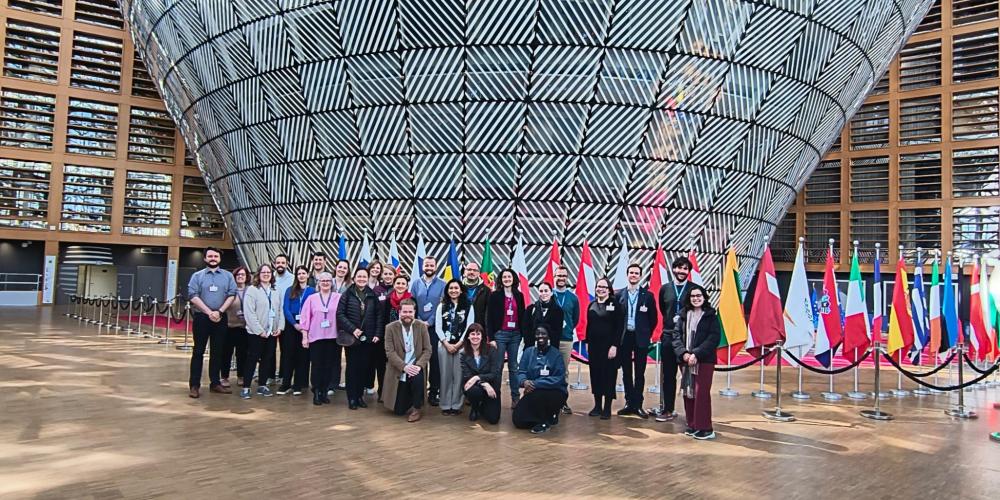


The Vrije Universiteit Brussel has established itself as a frontrunner in European cooperation, driven by the strategic evolution of the International Relations Office (IRMO) Erasmus+ project team. Over the current 2021–2027 programme cycle, the team has transitioned from providing general support to executing a data-driven strategy focused on increasing the volume, quality, and management of international projects. And who is that team? Jannes Motmans and Sushmita Bista, who help to explain a bit more of their work here.
A Record of Growth and Performance
The VUB’s commitment to expanding its international footprint is evident in its participation rates in Erasmus+ projects. During the current seven-year programme, the university has participated in 280 project applications, serving as either a coordinator or partner. This proactive approach has seen a surge since 2023, driven by internal "roadshows" across various faculties and wide-reaching info sessions. In 2024, a VUB-hosted session for the EUTOPIA alliance alone drew 90 participants.
In the 2025 call, the VUB participated in 107 proposals. However, this achievement has not always been easy; the team has had several challenges in the form of time and resources constraints, which meant they have almost had to run the gauntlet on getting to be effective, resourceful and helpful.
“Striking that balance has not always been easy, but our aim is to improve the application process and strengthen each applicant’s chances of being selected. We are especially working harder on providing immediate feedback to applicants, but with a small team and increasing applications, we are sometimes running against the clock. We are firmly committed to refining our processes to offer faster and more meaningful assistance whenever we can,” Sushmita Bista explains.
In reference to the Digitwater project, Dr Zainab Zomlot added: "The support from the VUB International Relations (IRMO) Erasmus+ project team made the difference through constructive feedback and practical recommendations. It helped us turn an initial rejection in 2024 into a strong proposal that obtained funding with a high score in 2025, allowing us then to build strong international partnerships and develop a project with real academic and societal impact."
Quality and Data-Driven Success
While volume is high, the Erasmus+ projects team focuses on quality, by offering specialised project-writing training and intensive proofreading services which focus on Erasmus+ priorities and project logic. The success rates have increased: for the 2025 call, the team reviewed between 25 and 30 proposals.
The data confirms this: “When a VUB researcher acts as a coordinator, they have a nearly 50% chance of achieving a fundable score. This has resulted in a stable output of 15 to 17 signed projects annually, placing VUB on equal footing with the largest institutions in Flanders. Underpinning this is a modern data management system implemented in 2023, which tracks everything from budgets to evaluation reports to allow for more targeted support and training”, according to Jannes Motmans.
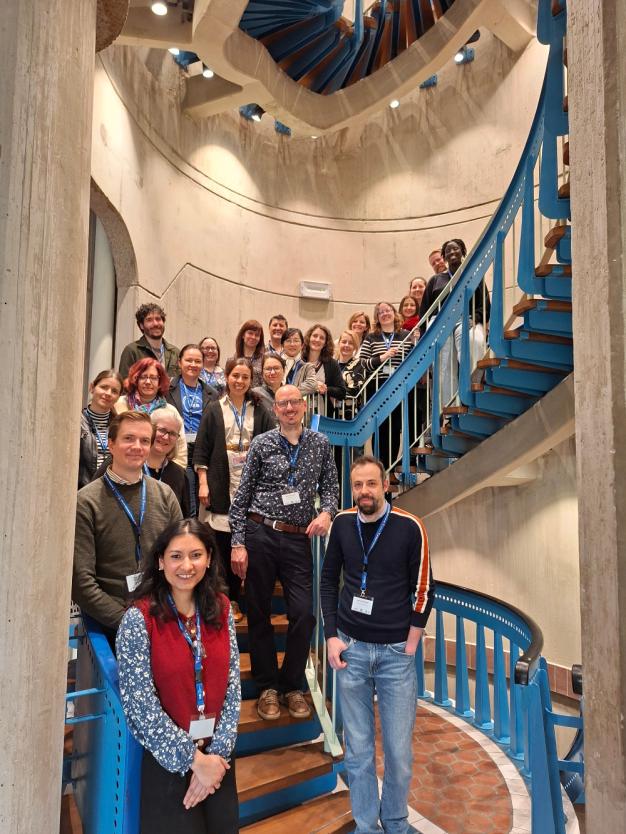
The VUB International Relations office Erasmus+ team, with representatives from the 20 partner universities at VUB's BREW week.
Shaping the Future: Erasmus+ 2028–2032
Building on this momentum, the VUB International Relations office last week hosted a milestone training week in Brussels, following a successful 2025 session at the University of Ljubljana. This event, fully funded through Babeș-Bolyai University’s Blended Intensive Programme (BIP), focused on the application and implementation of the upcoming Erasmus+ period (2028–2032).
The week brought together representatives from 20 universities across diverse alliances, including EUTOPIA, SEA-EU, and Una Europa. Taking advantage of the VUB’s strategic location in the heart of Europe, the agenda featured exclusive dialogues with EU policymakers. Participants engaged with representatives from the European Commission (DG EAC), the European Parliament, and the Council of the EU to share insights on the new programme's direction. Additionally, experts from ICF - the agency responsible for the interim evaluation of Erasmus+, and for the full evaluation of the Erasmus+ 2014-2020 programme - provided a critical "insider" perspective on performance trends.
Meanwhile, following the week’s training, the Erasmus+ project team has drafted a set of conclusions on the new Erasmus+ programme, based on last week’s discussions, together with their own experiences as day-to-day managers of the programme. These conclusions are shared with the EU speakers to help shape the future of the programme.
By bridging the gap between academic practitioners and European policymakers, the VUB is not just participating in the programme; it is actively helping to shape the future of European higher education and the labour market, by ensuring that learning pathways and training systems support the competitive skills agenda that is now at the heart of Europe.
Want to know more about the International Relations office’s Erasmus+ team and their work? Check out their webpage.
Contact them for more information on erasmusprojects@vub.be