

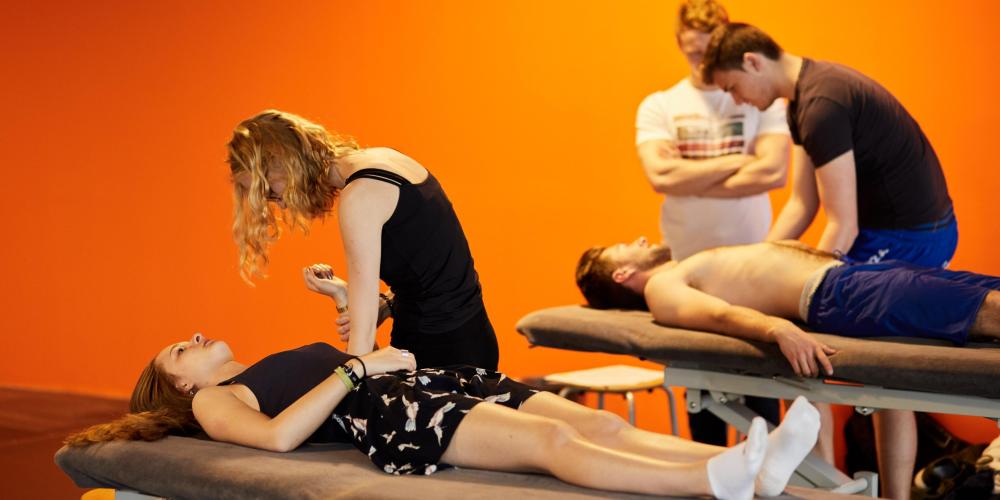


Students leaving the lecture hall during a class on female genitalia, or patients refusing care from a practitioner of a different gender. Professor of Rehabilitation Sciences and Physiotherapy Nele Adriaenssens encounters this regularly, both in her teaching and in practice. At the Education Conference on 26 May, she shares how strong intercultural competences can offer a way forward. “Very often, it comes down to misunderstandings or not knowing each other’s context.”
Education professional at VUB? Register for the Education Conference.
You were given a curriculum redesign mandate to implement intercultural competences within the Rehabilitation Sciences and Physiotherapy programme. What concrete challenges of a globalised society do you and your colleagues face?
Nele Adriaenssens: “Within physiotherapy, we have many practical classes. Students need to learn to inspect, palpate and mobilise. You cannot palpate someone’s back muscles if they are wearing a T-shirt. At programme board meetings, I hear that some students ask to form practical groups with only female students, sometimes even with only female lecturers.
In addition, our students—like those in Physical Education and Movement Sciences—have to complete physical tests. During Ramadan, that is not straightforward. In classes on gynaecology and pelvic floor muscles, it also happens that male students leave the lecture hall when female genitalia are presented. In practice—I work one day a week as a physiotherapist at UZ Brussels—I encounter similar challenges. I hear the same stories from students during placements. This curriculum redesign mandate has therefore grown directly from my own experiences, but also from the research of my PhD student Paula DiBiasio from Elon University in the USA.”
Nele Adriaenssens
How can greater diversity sensitivity lead to better study outcomes?
“As part of my curriculum redesign mandate, I am working on a tutor project in which senior students mentor first-year students with a similar profile. The idea is that experienced students share tips about barriers they themselves encountered. Take language challenges, for example. Students who have faced these can point first-years to components that require extra attention to language. That can have a significant impact on study success.”
"The way students interact today reflects how they will later interact with patients"
If female students only practise on women, for example, they build less confidence, gain less experience, and develop less clinical sensitivity in examining and treating male bodies. The same applies to interaction with men, while in professional practice they must be able to approach male patients confidently and without hesitation. The same principle holds for the broader learning environment: if you systematically let students work only with people from similar cultural or religious backgrounds, you deprive them of an essential part of their learning curve. It is precisely these encounters with different perspectives, habits and frames of reference that are crucial for developing intercultural competences. In this way, students learn not only to deal with differences in the lecture hall or practical classes, but also with the diversity of patients they will meet later in healthcare.”
How do you bring all students on board with decisions that may conflict with their norms and values?
“What does not work is labelling these students as problematic. An aggressive ‘take it or leave it’ approach does not help either. It is better to explore what lies behind such a request, to remain open, to listen and to engage in dialogue. You need to involve students. Very often, it comes down to misunderstandings or not knowing each other’s context—and a lot can already be resolved there. At the same time, we can be clearer during information days and at enrolment about what we expect from students, so that no false expectations arise. Conversely, we must also make it explicit that students can expect us to be inclusive and non-discriminatory.”
In what ways do you think education at VUB could become more inclusive?
“We like to think we treat everyone the same, but we are not always aware of our blind spots. Before working with real patients, healthcare education often uses paper-based case studies. What I see is that diversity is often presented in a stereotypical way: nine cases featuring highly educated white men with a strong socio-economic background, and one case about a Muslim woman wearing a headscarf who does not speak Dutch well and has limited financial means. Lecturers may think they are addressing diversity, but in doing so they reinforce stereotypes. Inclusive communication is also something we can still improve. My colleague Julie Bertone will go into this in more detail during the session at the Education Conference.”
Diversity extends beyond culture or ethnicity, doesn’t it?
“Absolutely. Some students need to work to fund their studies or have caring responsibilities within their families. Others cannot participate in certain components due to mental or other health issues. My colleagues Amber Werbrouck and Alessandra Blonda, who are also co-leading the session, have studied who uses the materials provided via Canvas. They linked this data to demographic information and study performance. Lecturers sometimes assume that it is enough to make everything available on Canvas. But some students do not have access to a computer, or they lack a stable internet connection, meaning videos constantly buffer.
We need to be aware of such barriers. We should not lower the bar or make exceptions, but the more aware you are of these barriers, the better. Sometimes it comes down to simple things like clear communication or providing study materials in different formats. The campus environment also plays a role: students need spaces where they can study in peace, relax or pray, and infrastructure where everyone feels welcome, such as gender-inclusive toilets. VUB already has strong examples of this, but it remains important to keep identifying where barriers still exist and how we can remove them.”
"We should not lower the bar or make exceptions, but the more aware you are of the barriers, the better"
How can greater diversity sensitivity lead to better study outcomes?
“As part of my curriculum innovation mandate, I am working on a tutor project in which senior students mentor first-year students with a similar profile. The idea is that experienced students share tips about barriers they themselves encountered. Take language challenges, for example. Students who have faced these can point first-years to components that require extra attention to language. That can have a significant impact on study success.”
Students need to be prepared for a diverse society and professional practice. How can they themselves develop greater diversity sensitivity?
“The idea behind the curriculum innovation mandate is to integrate these intercultural skills into the programme with increasing complexity. First comes awareness: understanding your own values and norms. Once you recognise that these do not apply to everyone, you are already a long way forward. Then comes theory (knowledge), followed by practising cultural skills during placements (skills and encounters). The final step is cultural desire: the intrinsic motivation to act in a culturally competent way. We aim to nurture that motivation by embedding intercultural skills throughout the entire programme and making them a natural part of everyday professional practice.”
What insight do you hope participants will take away from your session at the Education Conference?
“What I see time and again in practice is that we are all human, and that you often get far by asking simple questions: ‘How does this work for you?’ ‘Is it okay if I address you in this way?’ or ‘What makes you respond like that?’ These are simple questions, but they are often the most effective. Hearing from each other why something is the way it is creates understanding. I repeat that message to my students every day.
What moves me is when students return from placements and tell me how they handled such a situation in practice—by asking the right questions and listening. That makes me proud. Except, of course, when they ask a patient with a non-white skin colour who speaks perfect Dutch where they are from. That is not something you should do. Not every question is a good one.” (laughs)
Bio
Nele Adriaenssens is Professor of Rehabilitation Sciences and Physiotherapy (Revalidatiewetenschappen en Kinesitherapie) at the Vrije Universiteit Brussel (VUB), and is clinically active as the coordinator of cancer rehabilitation at UZ Brussel. Her research focuses on cancer rehabilitation, with particular expertise in exercise oncology and lymphology.
VUB Education Conference 2026
On 26 May, VUB hosts its annual Education Conference, where education professionals share new insights on innovation in education. In a plenary session, Vice-Rector for Education Nadine Engels will outline the challenges facing future-proof education and how policy, support and innovation can respond. Six parallel sessions will then focus on themes that impact study success: from ‘how to use AI as a learning partner’ to ‘how to ensure teaching materials and curricula are accessible to everyone’.