

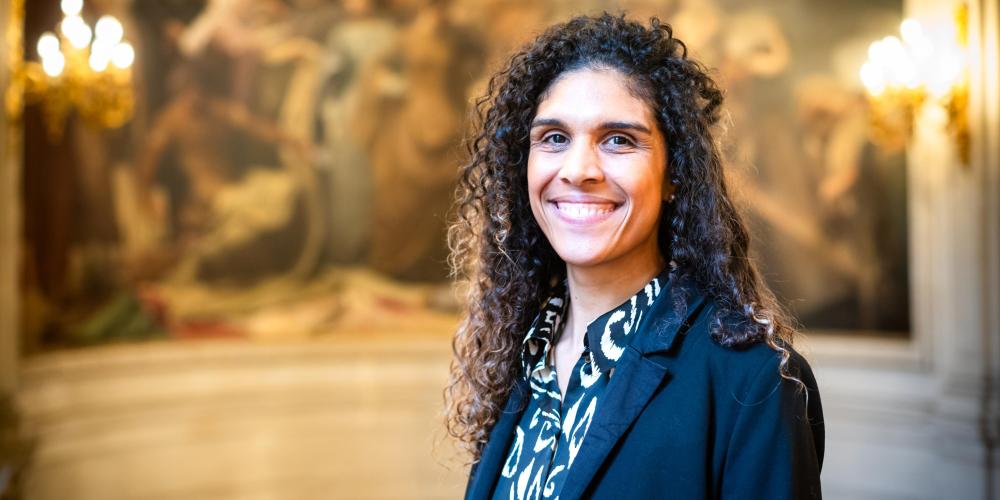


Queenie Swerts (35) graduated from the VUB as a commercial engineer, after which she deepened her academic path with an Advanced Master in European Economic Integration at the Institute for European Studies. Today, she works as a financial analyst at the National Bank of Belgium, where she helps safeguard the stability of the Belgian and European banking system. International experience, critical thinking and the confidence to speak up run as a common thread through her story.
Would you like to help build a strong and stable economy? Come and study at the VUB.
What does your current role involve exactly, and what interests you most about it?
Queenie Swerts: I currently work in the offsite supervision team at the National Bank of Belgium. I’m part of a team that supervises one large Belgian bank throughout the year. We monitor whether the bank manages its risks properly, complies with regulations and contributes to a stable financial system. My official title is therefore financial analyst. That differs from the role of an inspector, who temporarily — often for several months — works on-site at a bank around a specific topic and then drafts a report. In my role, I’m part of what is known as the ongoing supervision team: we take continuous responsibility for the same bank.
What interests me most is the multidisciplinary nature of the job. You’re not only looking at figures, but also at governance, different types of risk, processes and people. That means no two days are the same, and the work remains challenging — quite literally. Through an exchange scheme between the National Bank of Belgium and the European Central Bank, I had the opportunity to work at the ECB in Germany for three years. Such exchanges can last from a few months to several years, with the guarantee that you can return to your job afterwards. That period was incredibly enriching. You work in international teams and assess banks at the level of the entire euro area. It significantly broadened my perspective on the financial system and on cooperation within Europe.
What memories do you have of your time as a student at the VUB?
Above all, the people and the opportunities you’re given. The VUB offers plenty of scope to grow, both academically and personally. One experience that has stayed with me is a trade mission to Colombia. Together with a group of students, we represented Belgian companies on site. It was a unique combination of learning, gaining practical experience and building strong bonds with fellow students. It also gave me a concrete sense of what professional life after graduation might look like.
Are there connections from your student days that have remained important?
Absolutely. I’ve stayed in touch with some professors, including through LinkedIn. Professor Leo Van Hove supervised both of my theses and made a lasting impression. He really took the time to guide students, gave extensive feedback and was deeply engaged, both intellectually and personally. That approach not only shaped me academically, but also showed me how important commitment and mentoring are. I’ve also kept many friends from the VUB — including people who went to Colombia with me, but also others who studied different subjects. Two of them were even my bridesmaids at my wedding.
“The VUB offers plenty of scope to grow, both academically and personally”
Did you have a clear idea of what you wanted to do after your studies?
Not in detail. I didn’t have a tightly mapped-out career plan, but I did have a clear interest: I wanted to work in a European context. That’s why I also pursued the Advanced Master in European Economic Integration. The European Central Bank felt like a dream environment to me, as it brings together European decision-making and finance. Looking back, the fact that I later worked at both the National Bank and the ECB feels like a very fortunate alignment of choices and opportunities.
Like many people, I initially thought it would be quite a static institution. In reality, the opposite is true. It’s a highly dynamic working environment, with many international contacts, regular consultation with European institutions and plenty of room to move and grow internally.
Has the VUB influenced the way you think?
Absolutely. The VUB gave me a critical mindset. Daring to ask questions, weighing different perspectives and forming your own opinion are skills I use every day. For me, the “V” in VUB stands for freedom: freedom to think, to speak and to take a position. I carry that with me in my work every day.
Are things different for students today compared to when you were studying?
I think so, particularly with the rise of artificial intelligence. Everything moves faster and information is far more accessible. That offers huge opportunities, but also new challenges. Students need to learn how to use these tools without losing their critical thinking skills. During my studies, I wrote many papers. That taught me how to formulate a research question, analyse it and support it with arguments. Those skills remain essential, even in the age of AI.
How do you try to make a difference in society today?
Within my job, I’ve been involved in Diversity & Inclusion initiatives and wellbeing activities for colleagues. I think it’s important that people feel welcome, that knowledge is shared and that new colleagues quickly feel at ease. I’ve held various roles myself, both at the National Bank and at the ECB, so I know how overwhelming a new position can be. I try to pass that experience on to others.
What do you still aspire to in your career?
Alongside my professional career, I also have a strong artistic side. I enjoy acting, singing, dancing and musicals. My ambition is to combine that interest as much as possible with my professional life: to inform, inspire and engage people at the same time. Being on a stage and telling a story, as I am doing today, feels very natural to me.
Do you have a golden piece of advice for students graduating today?
Dare to be yourself. A professional environment can seem intimidating, but you are hired for who you are and what you bring. Ask questions — even the ‘simple’ ones — and don’t be afraid to speak up. That’s the fastest way to grow.
And specifically for students in your field?
Business economics and applied economics are very broad degrees. You learn economics, law, languages and analytical thinking. That combination makes you flexible and resilient. So never think you’re ‘not smart enough’ to learn something new. With commitment and curiosity, you’ll go further than you think.