

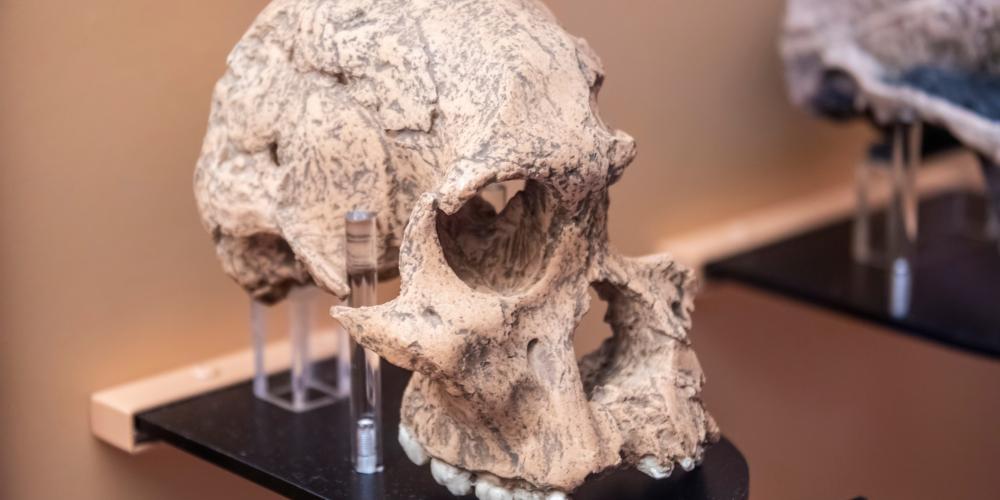


With the PLIODIS research project, paleoanthropologist Gabriele Macho is taking an ambitious new step in the debate on human origins. Thanks to a prestigious ERC Advanced Grant from the European Research Council, she is investigating how South African hominins from the Plio-Pleistocene fit into the broader narrative of human evolution. Since September, Macho has been working at Vrije Universiteit Brussel (VUB), where she is strengthening the Archaeology, Environmental Changes & Geo-Chemistry Research (AMGC) research group and building new scientific synergies around the analytical laboratories. Her arrival represents both a significant reinforcement for VUB and a renewed positioning of South Africa as a key region for research into the origins of the Homo genus.
With PLIODIS, Macho focuses on hominins that lived between approximately four and one million years ago, a crucial period in which multiple hominins coexisted and the foundations for later human evolution were laid. The project's central starting point is a fundamental yet persistent question: when and where did the genus Homo emerge, and under what ecological and evolutionary conditions did it evolve? Rather than searching for a single origin or a single explanatory model, Macho investigates the complex interplay of landscape, climate, anatomy, and behavior. "Evolution”, she emphasizes, "is not a linear process but the result of adaptation to constantly changing environments and competition, with room for variation, parallel developments, and also evolutionary dead ends."
What distinguishes the PLIODIS project is its distinctly inter- and multidisciplinary approach. Macho combines insights from geomorphology and landscape evolution with paleoclimatology, functional morphology, biomechanics, (zoo)archaeology, and evolutionary theory. By not only analyzing fossils anatomically but also systematically placing them within their ecological and climatic context, she aims to better understand how early hominins moved, fed, and adapted to their environment. This approach allows for the reconstruction of behavior and evolution beyond the confines of isolated fossil finds.
The ERC Advanced Grant, worth approximately €2.5 million and awarded for a five-year period, offers Macho the resources and freedom to pursue this high-risk but potentially groundbreaking research program. The grant is one of the most competitive research grants in Europe and is reserved for established researchers with an exceptional track record and an innovative vision. For Macho, the award means international recognition and the opportunity to pose fundamental questions that could permanently change the field of paleoanthropology.
This recognition builds on an impressive international career. Macho trained as a biological anthropologist at the University of Vienna and has worked at renowned institutions such as the University of Oxford, the University of the Witwatersrand in South Africa, and the University of Western Australia. Her strong ties to South Africa are essential: the country is home to some of the richest hominin sites in the world, but the significance of these fossils for the evolution of our own lineage Homo are usually downplayed.. With PLIODIS, Macho aims to redress this imbalance and broaden the debate, but without resorting to simplistic explanations.
Besides its scientific impact, the project also underscores the importance of top-tier international funding for the VUB and the Flemish research landscape. ERC grants are crucial for attracting top researchers, strengthening international networks, and training a new generation of researchers. With PLIODIS, Gabriele Macho aims not only to contribute to a more nuanced and robust understanding of our origins, but also to a research culture centered on collaboration, debate, and intellectual daring. She also intends to raise the awareness of our evolutionary history through public engagement.
More information:
Gabriele Macho: gabriele.macho@vub.be