


Practical
Monday, 4 May, 2026
- 17:00 until 19:00
VUB Main Campus Etterbeek
Pleinlaan 2
1050 Elsene
LIC Learning Theatre
Pleinlaan 2
1050 Elsene
LIC Learning Theatre
Free of charge
Registration until
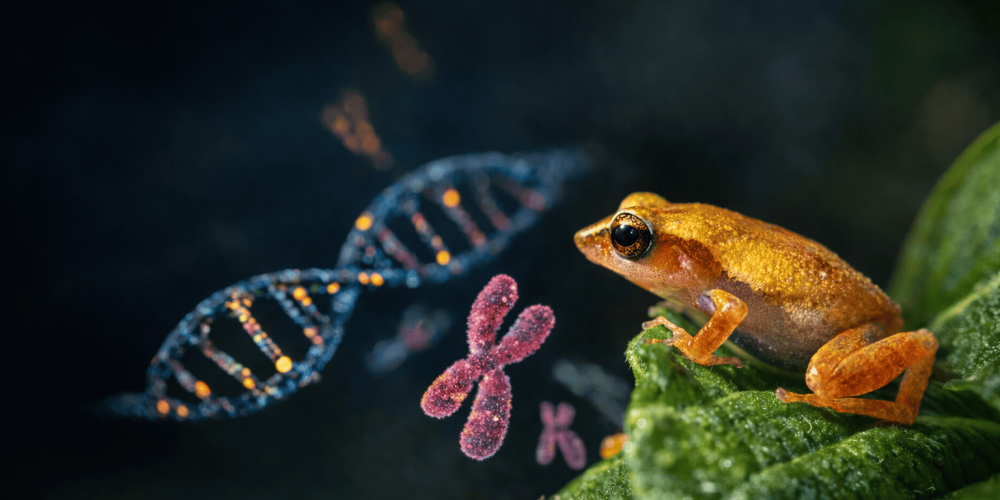
The Vrije Universiteit Brussel and Prof. Dr. Wen-Juan Ma invite you for the ERC inaugural lecture 'What the frog?! When sex chromosomes refuse to age'. You are kindly invited to join the celebratory reception following the lecture.
In mammals and birds, sex chromosome pairs appear old and “tired”. The sex-specific chromosome, such as the human Y, has degenerated: it has lost most of its genes and shrunk in size over more than 180 million years of evolution. Textbooks often present this decay as the inevitable fate of all sex chromosomes.
Yet across the Tree of Life, many species stubbornly refuse to follow this script. In most frogs, many fishes, reptiles and flowering plants, sex chromosomes may remain indistinguishable from the other chromosomes, and they are repeatedly re-evolving – new sex chromosomes are “born” while old ones “die” before they ever grow old. Why some sex chromosomes degenerate, while others stay young or keep turning over, remains a puzzle for evolutionary biologists and have wide-ranging implications for how species evolve and adapt.
In this lecture, Wen-Juan Ma will present her ERC project (FROGWY) on the evolutionary genomics of unconventional sex chromosomes, using frogs as a central model. She shows how we combine fieldwork, evolutionary genetics, developmental biology and comparative genomics to trace where sex chromosomes come from, how in some lineages Y chromosomes can rejuvenate while in others they are evolutionarily locked-in towards degeneration, and which evolutionary forces, mechanisms and genomic features affect the speed of their ageing.
These insights not only help us understand and conserve amphibian diversity, but also position frogs as an emerging model to understand the remarkable diversity of sex-chromosome systems across the Tree of Life – including what makes our own X and Y chromosomes so unusual.

About Prof. Dr. Wen-Juan Ma
Prof. Dr. Wen-Juan Ma is an evolutionary geneticist and genomicist, part of bDIV, the research Group for Ecology, Evolution & Genetics. Her lab (Evolutionary Genomics of Sex) studies what drives sexual dimorphism, and the genomic, transcriptomic and molecular basis underlying the differences between the sexes across the tree of life. Major research themes include evolution and origin of sex chromosome recombination suppression and degeneration, sex determination, and evolution and consequences of asexuality. Her lab integrates the cutting-edge OMICs approaches with natural variation, experimental evolution, and selection to study the relationship between genotype and complex sex phenotypes.
The world needs you
This initiative is part of VUB's public programme, a programme for everyone who believes that scientific knowledge, critical thinking and dialogue are an important first step to create impact in the world.
As an Urban Engaged University, VUB aims to be a driver of change in the world. With our academic edcuational programmes and innovative research, we contribute to the Sustainable Development Goals of the United Nations and to making a difference locally and globally.