

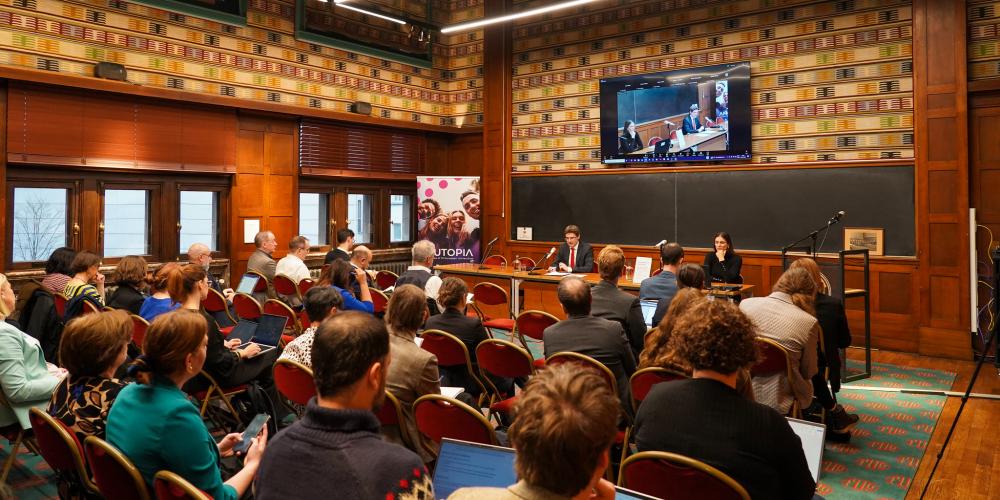


How can universities continue to work together globally in an era of geopolitical tensions and growing concerns about the security of scientific research? This question was at the heart of the EUTOPIA Responsible Internationalisation Summit, held on 28 November in Brussels.
On that day, representatives from universities, European institutions and international partners gathered at the University Foundation. The event took place against a backdrop of increasing geopolitical tensions and heightened attention to safeguarding scientific research. This does not only refer to physical safety, but also to preventing data theft, espionage and undue influence on research outcomes. It is about ensuring integrity and handling knowledge that could be misused with care.
The summit marked the culmination of a year-long dialogue within the alliance. EUTOPIA has been working towards a shared vision of responsible internationalisation – not reducing international collaboration, but approaching it more thoughtfully. It is about reflection and diligence, finding a balance between openness and protection, and recognising inequalities between partners.
In the run-up to the summit, EUTOPIA organised three international workshops. Stellenbosch hosted discussions on academic freedom in a world of geopolitical tension. Paris focused on the delicate balance between open science and the security of scientific research. Venice explored fair knowledge and technology transfer and its societal impact. These themes converged in Brussels, where the European Commission stressed in its opening remarks that responsible internationalisation is no longer optional, but essential.
Cultural change
Panel discussions made it clear that this is not just about compliance, but about cultural change. International collaboration requires conscious choices and weighing risks – not only of engagement but also of isolation. European university alliances can provide a stable framework for cooperation, but must remain alert to inequalities within and beyond their networks.
The summit concluded with the recognition that responsible internationalisation is an ongoing process. There is no fixed recipe, but a shared conviction that values, trust and transparency are key to sustainable collaboration.
Why is the security of scientific research important?
Scientific research generates knowledge of immense value – not only for science, but also for the economy and technology. That value makes research vulnerable. The security of scientific research is about protecting data, methods and collaborations from misuse, espionage or undue influence. It prevents sensitive information from falling into the wrong hands and safeguards academic freedom and integrity. In a world of geopolitical tensions and digital threats, this is not a luxury but a necessity.