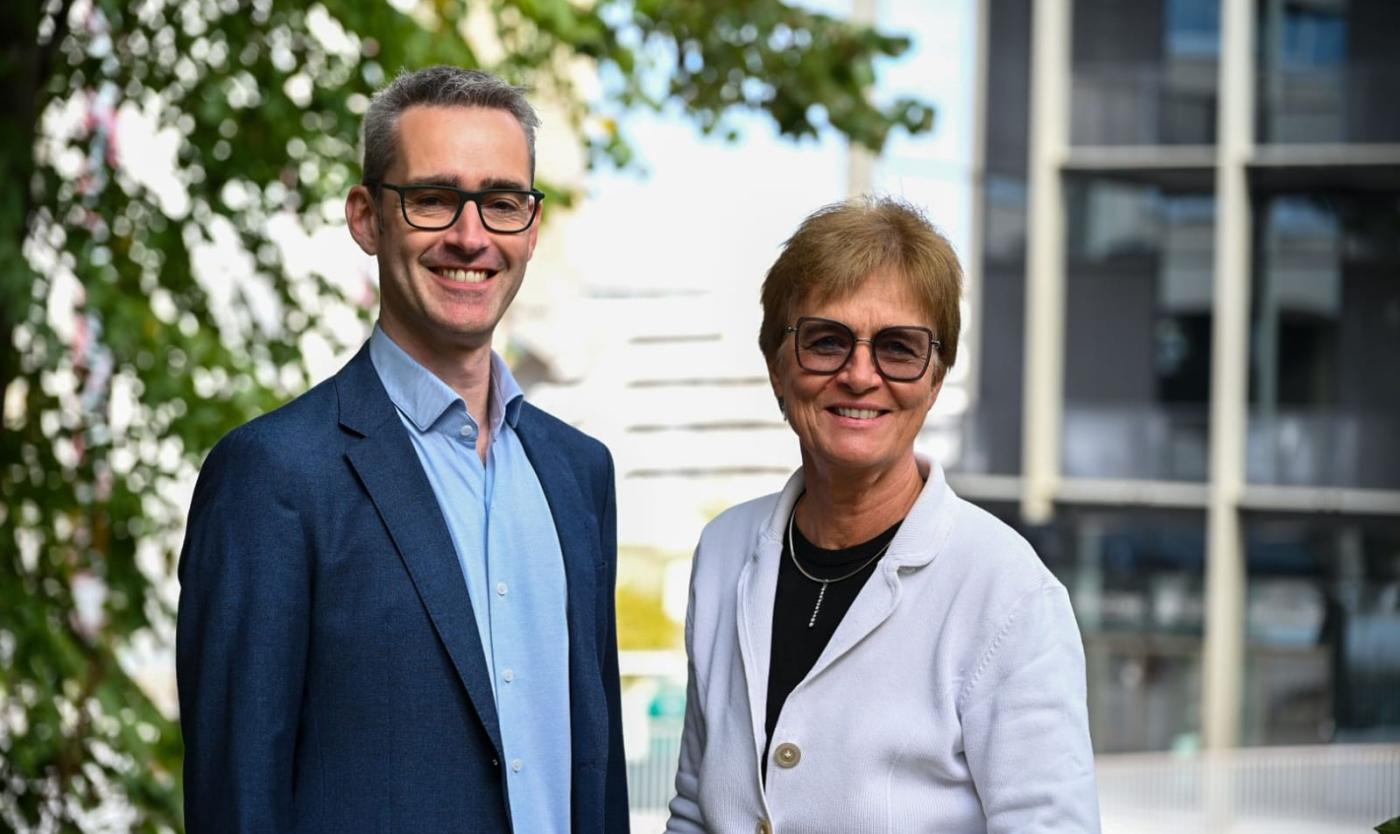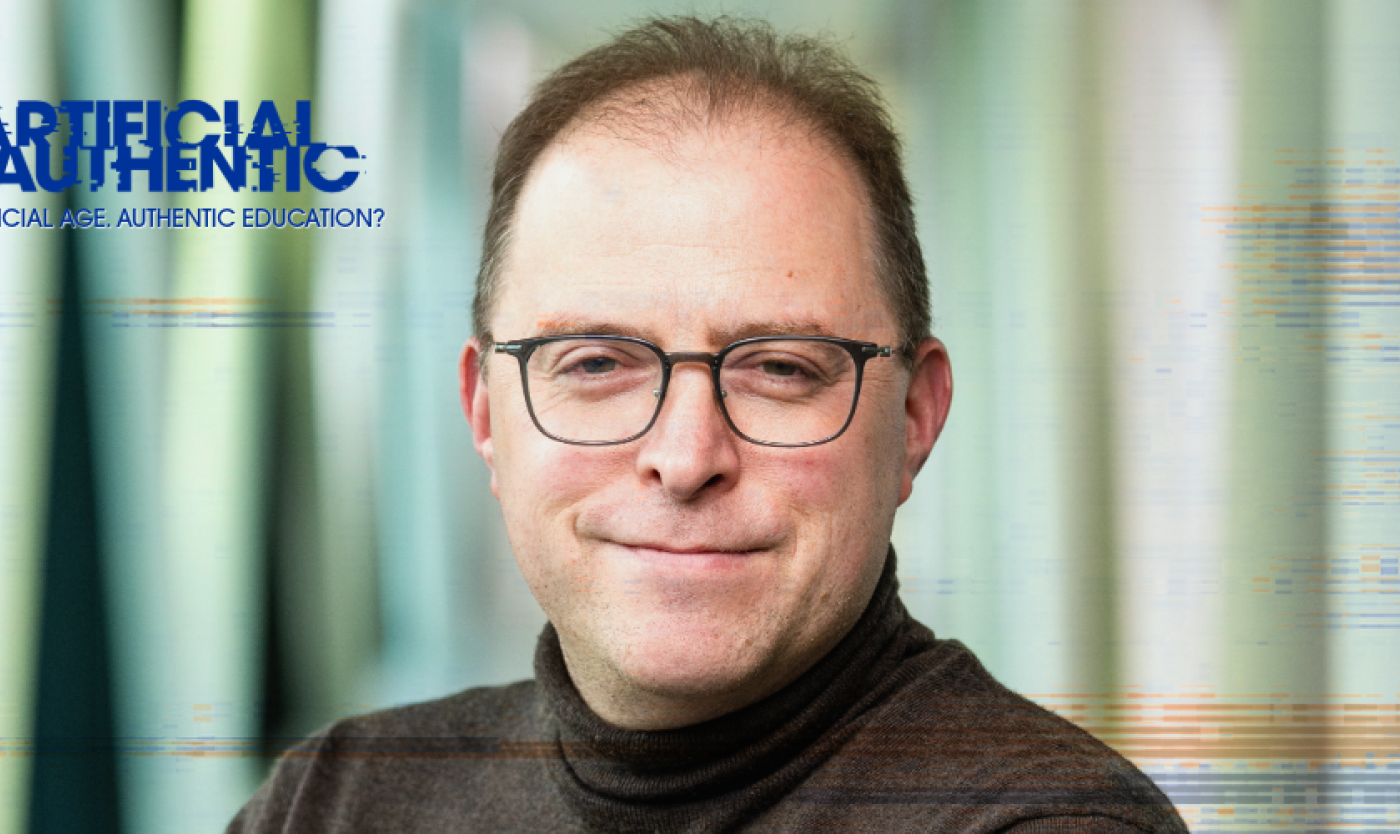
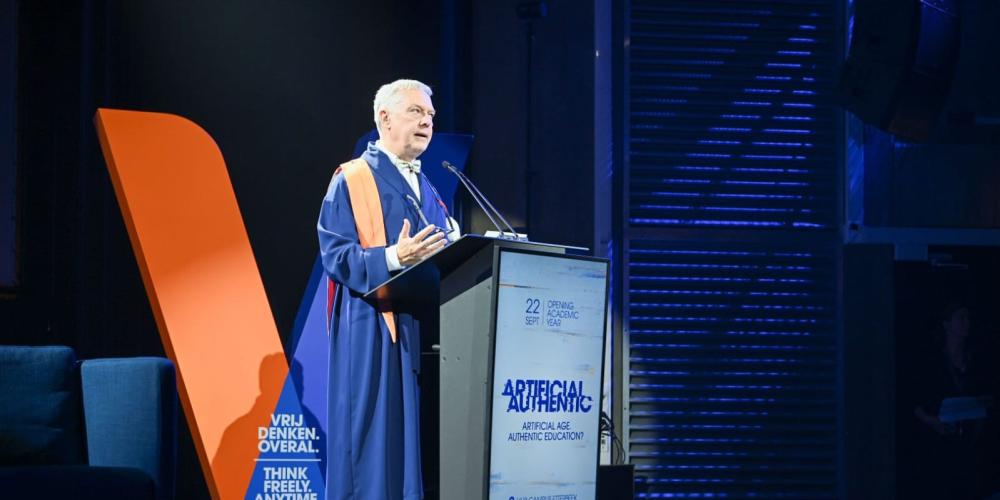


Rector Jan Danckaert’s office, on the top floor of the Braem Building, is bathed in sunlight. Coco, his daughter’s grey pug, does not leave his side for a moment and settles comfortably beside Danckaert on the sofa. “It is a case of co-housing,” he says. His daughter’s dog stays with him half of the time. And now it is his week. The interview took place on Friday 18 September, a few days before the academic opening and therefore also before his opening address today.
IN BRIEF
- A second term with a strong mandate, but also a €24 million cost-cutting programme.
- AI as a priority: AI literacy, AI in curricula and assessment that takes account of the learning process and students’ own input.
- Equal access to powerful AI models and personalised AI tutors for all students, with human responsibility and guidance.
- The campus is essential as both a learning and living environment.
- The VUB is growing, but funding and infrastructure are not keeping pace.
- The VUB is a pioneering university in the capital of Europe, with strong European collaboration, excellent research and equally strong spin-offs. The innovation ecosystem in Zellik is being developed further.
Jan Danckaert is beginning his second four-year term as Rector. He does so with a strong mandate, but also in particularly difficult financial circumstances. “I was elected to a second four-year term last spring, with a clear mandate from the university community and nearly 80 per cent of the vote. During the rectoral election, we already knew that we faced a difficult situation. On top of an ongoing €10 million cost-cutting plan came the Flemish Government’s cuts, which hit Brussels institutions, and the VUB in particular, hard. In total, we are on a €24 million cost-cutting trajectory, which we can spread over several years.”
“That is a particularly challenging context. But as I also said during the rectoral election: cuts in themselves are not a vision. We must put the VUB on a sound financial footing so that we can then continue building our project, “A pioneering university in the capital of Europe”. Our secular humanist values remain our compass.”
That changed context has not fundamentally altered his vision. It does, however, call for a new balance between building on what exists and renewing it. “There is always a combination of continuity and renewal. You can also see that in the management team: two vice-rectors are starting a second term and two are being replaced. That renewal is partly related to internal circumstances, but also to changing external factors.”
Coco, who now actively joins the interview and growls with delight as she seeks the Rector’s attention, is gently shown to the door. “That will be better,” Danckaert smiles, before immediately getting to the point.
AI: four commitments for the future
One external development forcing the university to adapt quickly is artificial intelligence (AI). In barely a year, the landscape has changed dramatically. For Danckaert, AI offers major opportunities for research, but the technology also requires the university to rethink its teaching thoroughly.
“My opening address will focus mainly on AI in education. That does not mean that AI is less important for research. On the contrary: AI is an enormous accelerator of scientific research. It helps develop cancer immunotherapies, new materials and batteries, better climate models… In some cases, it could even be unethical not to use AI, because the technology can accelerate social, economic and human progress. For researchers, however, the rule is: use AI transparently and check the results. Ultimately, researchers remain responsible for what they publish.”
“On the other hand, AI development is being driven by a small number of private technology companies. That shifts power over knowledge and infrastructure from public institutions to businesses. I find that worrying.”
“For education, I am putting forward four concrete commitments. First, every graduate must be AI-literate, whether they are a lawyer, engineer, doctor or psychologist. Everyone must be able to use AI correctly and ethically within their own field.”
“Second, we must integrate AI into courses. AI cannot simply be added on top, because that would make programmes that are often already demanding even heavier.”
“Third, we must adapt our forms of assessment. We must protect the value of our degrees and be able to assess students properly in an environment where AI is sometimes used invisibly. Merely checking how much of a text was generated by AI does not seem to me to be a sustainable solution. We must guide students through the preceding learning process, make their own contribution visible and establish whether they retain mastery of their work.”
“The fourth commitment, finally, concerns equal opportunities. AI risks creating a new inequality between students who have access to high-performing paid models and students who do not. That is why, at the Learning and Innovation Center, which we run together with ULB, we are working on an AI café where students will have access to those high-performing models.”
Assessment in the age of AI
At the same time, concern is growing about AI systems becoming more autonomous and harder to control. For Danckaert, the boundary lies with human responsibility. “That is a real challenge, and one that the companies themselves are also flagging. You could say that such warnings fuel the hype, but the problem does exist. Humans must always retain responsibility and be able to retain it. Systems must be developed so that humans make the final decision. That applies to researchers, who must be able to explain to their peers how their results were produced, but also to students.”
“Brussels remains an attractive city for international students and researchers to live, study, and work”
The challenge extends beyond detecting the use of AI. University education lies at the intersection of knowledge, independent thought and critical insight. That deeper learning process must also have a place in assessment. “I prefer to speak of knowledge and understanding,” Danckaert qualifies. “They belong together. You cannot develop an understanding of a field without sufficient background knowledge, but knowledge alone is not enough either. That is why we must not look exclusively at the end result. We must follow the learning process, see how the student develops and establish whether they remain the owner of that process. That is an important shift in our assessment policy and, at the same time, a challenge in programmes with large numbers of students. Many disciplines already have methods for following the process. In a bachelor’s or master’s thesis in a laboratory, for example, there are logs of the measurements. You can then see how a student collected, interpreted and presented results.”
The campus as a learning and living environment
AI is now also putting the traditional lecture with hundreds of students under pressure, with attendance sometimes falling as students seek other channels for obtaining information. Danckaert, on the other hand, sees opportunities to guide students much more personally. “During the rectoral campaign, I visited several large lecture theatres to encourage students to take part in the rectoral and student council elections. I was struck by how sparsely attended some lecture theatres were after the Easter holidays. Students are dropping out of that kind of class in large numbers. What I dream of is a personalised tutor in an AI environment for every student. Such an environment would know the student’s strengths and any gaps. Someone who, because of the teacher shortage in secondary education, went for months without mathematics or French could indicate this and receive targeted remedial support. Personal guidance for every student is impossible, but an AI environment can help. Human peer review remains necessary, however, to check whether the student and the system are on the right track.”
“There are also plans for such experiments in secondary and primary education. We can learn from projects in African countries, where, because of a lack of conventional resources but thanks to access to mobile technology and AI, such systems have already been tested.”
Empty lecture theatres inevitably evoke memories of the coronavirus period. Danckaert saw at close quarters how important both digital innovation and physical encounters are. “During the coronavirus period, I was Vice-Rector for Education and Student Affairs, and I experienced that period intensely. Week after week, together with those involved, the deans and the programmes, we decided which forms of teaching were possible. A student representative later said that studying had been a different learning experience for him every year: first during the coronavirus period, then in the post-coronavirus period with the rediscovery of physical interaction on campus, and subsequently with the arrival of AI. The coronavirus period moved us forward digitally by leaps and bounds, but the campus experience remains essential. Students learn not only from the professor or assistant at the front, but also from one another, by thinking together, discussing and seeking help. We must therefore invest more strongly in an authentic campus experience that is both a learning experience and a life experience.”
Internationalisation remains essential
The start of the academic year is overshadowed by the situation of students from Gaza who are waiting for a visa for Belgium. Danckaert is clear on this. “All Belgian rectors are united: we are angry and outraged. Links are being made with asylum, migration and family reunification, but those issues are not relevant here. These are thirteen students who have received a scholarship funded by Belgian development cooperation. Like everyone else, these students must submit a visa application, but because of circumstances beyond their control they are unable to do so in person. The Belgian Government must give them the opportunity to complete that application, so that they can take up their scholarship, study here and later put the knowledge they acquire at the service of their region, just like all those other students from other countries and regions who are given the opportunity to study here. That is the position of all Belgian rectors and of the other institutions involved.”
“It is a core task of a university to bring knowledge from research and laboratories to society”
In a broader international context, the VUB also wants to be a place of refuge for students and researchers from countries where free enquiry is under pressure. The international appeal of Brussels and the VUB remains strong. “That is difficult to deduce from the overall statistics. The VUB attracts students from more than a hundred nationalities, countries and cultures. Despite the Flemish Government’s decision no longer to subsidise non-European students, as a result of which we are gradually increasing tuition fees, we are once again seeing an increase in the number of non-EEA students. Brussels remains an attractive city for international students and researchers in which to live, study and work.”
“Two years ago, I called on researchers in the international media to consider Europe, and the VUB in particular, when their research is obstructed or their funding is withdrawn. With support from the Helios Foundation, we were able to select four researchers in climate and sustainability from around a hundred interested candidates. Two will work full-time on our campus; two will take up a 10 per cent appointment while also retaining a link with the United States.”
Growth, with an emphasis on STEM
The total student population also continues to grow. According to Danckaert, the provisional enrolment figures confirm the upward trend of recent years, although that growth is also putting additional pressure on finances. “These are provisional figures,” Danckaert stresses. “We appear to be growing again by around 5 to 6 per cent, a pace we have maintained for more than ten years. That shows that students find the VUB attractive. At the same time, that growth is one of the causes of our financial problems. Funding for additional staff and infrastructure follows only after a long delay and only in part. That is why we were already implementing a €10 million cost-cutting plan: our costs, and staff costs in particular, were rising faster than our income. We are trying to shield the academic domains of education and research as much as possible and are focusing on more efficient administrative and technical support.”
The VUB wants to build on its strength in STEM disciplines. For the time being, the picture of that growth is mixed. Some programmes are gaining students, while others are losing ground. “Based on the provisional figures, I do not yet see a clear turnaround. Some STEM programmes are growing, including within faculties offering healthcare programmes and with a strong STEM foundation, while other science programmes are declining. My impression is that in Flanders and Brussels we are not managing to enlarge the pool of STEM students. Gains in one programme often seem to be accompanied by losses in another. STEM programmes at university colleges, however, are reported to be growing strongly. For the VUB, the picture is mixed; I do not see an overall increase.”
Falling Flemish scores in international education surveys (PISA) are fuelling concerns about the prior knowledge of students starting university. Danckaert warns against hasty conclusions, but does see a pronounced metropolitan challenge. According to the Rector, it is still too early to draw conclusions: “It is also too early to see the impact of recent policy in such scores. To do so, we would have to look at the results of entry and calibration tests over a longer period. I cannot offer an evidence-based conclusion on that at present. What we do see is that, in the metropolitan Brussels context, students score lower on average in entry and calibration tests than students from other regions. This is probably related, among other things, to the teacher shortage and the large differences between schools. We see that metropolitan context first and most strongly in Brussels, but it is also becoming visible in Antwerp and other large cities.”
Money, new opportunities and structures
Another difficult issue for the Rector and the University is the financial restructuring that is already well under way. Its consequences are not always visible from the outside, but according to Danckaert they are already directly affecting the university’s operations and staff. “Staff savings mainly affect administrative and technical personnel. The minister has given us five years, but we do not want to spread the intervention fully over that period. The emphasis is on the first two years. It concerns €14 million and has a major impact. We are working with natural attrition and a recruitment freeze. In addition, an offer of voluntary departure runs until the end of September, also linked to a recruitment freeze. Unfortunately, we have already had to say goodbye to people because we are discontinuing activities, carrying them out with fewer staff or organising them more efficiently.”
“We must collaborate across internal structures. Structures within a university are strongly attached to their independence, but as a result the same work is sometimes carried out in different places. We must examine how we can work together more effectively across those structures.”
In four years’ time, Danckaert will assess his second term primarily on the VUB’s financial health. For him, that is not an end in itself, but the condition for the university to remain pioneering. “I want to put the VUB on a sound financial footing, because only then can we continue to pioneer. My policy plan is about a pioneering university in the capital of Europe. That pioneering takes place in education, including through the four commitments on AI, but also through the programmes we offer. The VUB was the first to offer several programmes, from computer science and criminological sciences to the recent bachelor’s programme in AI. We must preserve that pioneering character.”
The Brussels context also remains important: “By saying ‘in the capital of Europe’, I am positioning the VUB not only in Brussels, but also in the European space that is very tangible here. The EUTOPIA alliance plays an important role in this. We must operate on a European scale, in both education and research. Our researchers are already doing particularly well in European projects and ERC grants. In the latest round, we were awarded five Starting Grants. That means we are performing extremely well compared with Flemish and European partners and competitors.”
Pioneering must lead to economic and societal impact. “That is not merely an ambition; we are already actively engaged in it. The Research Park in Zellik is a good example of that societal impact. We recently laid the foundation stone for a high-tech building where Siemens Benelux will establish its headquarters. Siemens wants to be part of such an innovative ecosystem and regards the university as an important partner. A core task of a university is to bring knowledge from research and laboratories into society. Even before the development in Zellik, the VUB already had spin-offs that grew into leading companies, such as Collibra, Ablynx and SoftKinetic. We are proud of that kind of economic impact through spin-offs.”
“Take part in campus life”
Further rounds of cuts by the Flemish and federal governments could make the financial task still more difficult. Danckaert is particularly concerned about fiscal support for research, development cooperation and pension reforms. “That concern is widespread. Federal measures can also affect universities. For example, there is a tax scheme under which we may retain part of researchers’ payroll tax and reinvest it in research. Proposals have been made to exclude certain disciplines in the humanities from that scheme. The rectors opposed this. That specific proposal seems to have been dropped, but other cuts may follow.”
“We are also concerned about pensions. If we want to keep academic careers attractive to professors and highly qualified technicians, we must be able to offer a pension that is sufficiently comparable to that in the private sector.”
“As far as the Flemish Government is concerned, I want to hold Minister Demir to her word that there will be no further cuts to education. We also hope that Minister Diependaele, who is responsible for Research and Innovation, will protect research and innovation. They are engines of economic growth. If we want to keep cuts manageable, the economy must grow more strongly, and innovation can drive that growth. Universities want to contribute to this. That is why I call for no cuts to research and innovation.”
At the end of the conversation, Danckaert addresses students directly. They too face cuts and stricter rules on study grants and study progress. “The university is not the only one affected by cuts. Students also feel the consequences of stricter rules for Flemish study grants and of stricter measures on study progress. That study progress is important and, as a university, we have no leeway: the rules are imposed by decree.”
“I therefore call on students to come to campus and attend classes, and to take a full part in campus life. That is not only a learning experience, but also a life experience. At the same time, we have consolidated and redirected our own study-financing mechanisms, so that we can help students who fall through the cracks as effectively as possible to continue their studies.”