


The new General Strategic Plan is currently being developed and sets out the future direction of the VUB. It will be presented to the world at a strategic seminar in December 2026. Faculties and directorates will then translate these university-wide ambitions into their own sub-policy plans. This involves more than simply deciding what we want to achieve. Equally important is the question of what people and organisations need to turn those ambitions into reality. Natasja Amys (HR Business Partner at HR & Organisation) and Virginia Geeraerts (Deputy Director of HR & Organisation) explain how HR & Organisation supports this process.
What kind of university do we want to be in eight years’ time? What challenges do we face in a world that is changing at breakneck speed? And how do we tackle those challenges? The new General Strategic Plan ASP6 will set out the VUB’s university-wide strategy. The plan has two strands: a long-term vision with strategic objectives for the next eight years (from 2027 to 2034), and the policy priorities for Rector Jan Danckaert’s second term of office (from 2027 to 2031). The faculties and directorates are responsible for translating this overarching vision into concrete sub-policy plans.
Natasja: “Each faculty and directorate has its own context, ambitions and challenges. The sub-policy plans must therefore leave sufficient room for individual choices and priorities where these add value in the specific context of a particular entity. At the same time, we want to foster connections between entities dealing with similar issues. This allows faculties and directorates to retain ownership while avoiding a situation in which everyone tries to solve the same challenges independently.”
Developing sub-policy plans is not new to the university. What we want to do differently with ASP6 is how we incorporate the human and organisational perspective into those plans. Faculties and directorates translate the strategic ambitions into the results they want to achieve. HR & Organisation wants to help them ask a second question at the same time: what do our people, our collaboration and our organisation need to make these ambitions a reality?
Virginia: “For every strategic ambition, we want to explore a second set of questions together. What does this choice mean for people’s work? What expertise and capacity do we need? How do roles, collaboration and decision-making need to evolve? What kind of leadership will this require? And what do staff and teams need to help make this ambition a reality? This is how we connect strategic ambitions with the associated organisational and people-related changes.”
“Partnering around what is truly needed”
Natasja Amys, HR Business Partner, HR & Organisation

The process starts with the specific context of each faculty or directorate. HR & Organisation does not provide a standard package to be applied in the same way everywhere. The HR Business Partner first helps policymakers and managers identify the impact of their ambitions on people and the organisation. Together, they then consider which choices should be included in the sub-policy plan, what support is needed and which issues would benefit from collaboration with other entities.
Natasja: “Our role is not to write the sub-policy plan on behalf of the entity. We bring a people and organisational perspective to the table and help ensure that the right questions are asked. Sometimes it becomes clear that an ambition primarily requires new skills. In other cases, it is about collaboration, leadership, the division of responsibilities, capacity or the way work is organised. By identifying these aspects early in the process, we can build them into the plan from the outset rather than having to address them afterwards.”
Based on this analysis, the HR Business Partner connects the entity with the relevant expertise within HR & Organisation. Training, wellbeing support, leadership development, feedback, organisational development and internal mobility are not starting points in themselves, but potential solutions to specific challenges identified in the sub-policy plan. People- and organisation-focused policy is therefore not a separate component alongside the strategy. It helps create the conditions needed to turn that strategy into reality.

“Sometimes the key lies with people. Sometimes with the organisation.”
Virginia Geeraerts, Deputy Director of HR & Organisation
The people- and organisation-related challenges that emerge from the sub-policy plans will vary from one entity to another and from one ambition to the next. Sometimes the key to change lies with people, sometimes in how work or the organisation is structured, and often several dimensions come into play at once. HR & Organisation helps identify where the need for change lies and where its expertise can add value.
This support can take different forms. For example, a strategic ambition may require new expertise or additional capacity. Strategic workforce planning helps link future staffing needs, talent and skills more explicitly to the strategy. In other cases, the ambition may call for a different allocation of roles and responsibilities, stronger collaboration or greater decision-making autonomy. Within Leaders@VUB, we therefore look not only at leadership development, but also at the organisational conditions that enable leadership and collaboration.
Virginia: “This is a good illustration of what we mean by a people- and organisation-focused approach. Sometimes the key to change lies in people’s skills or development; sometimes it lies in how teams work together or how roles and responsibilities are structured. Often, several aspects come into play at once. We want to work with the entity to identify where the real need for change lies and then determine which approach is likely to make the greatest difference.”
“Wellbeing is an important dimension”
Natasja Amys, HR Business Partner, HR & Organisation

Feedback and development can also be levers for change. The VUB is continuing to build a development-oriented feedback culture in which attention is paid not only to results, but also to collaboration, leadership and personal growth. HR & Organisation supports this shift through learning programmes and practical guidance for managers and policymakers.
Virginia: “That is why HR & Organisation offers specific learning programmes and practical tools for managers through VUB-LRN. In collaboration with the Strategy Unit, we have also developed a comprehensive programme on strategic policymaking for policymakers. This brings together support from different areas of expertise within HR & Organisation. In doing so, we strengthen managers and policymakers in their roles and help them translate the ambitions of ASP6 into everyday practice.”
Wellbeing is another important dimension. YANA for Staff, launched on 12 October, makes the range of wellbeing support more visible and emphasises that staff and managers are not alone when it comes to wellbeing concerns (“You Are Not Alone”). Here, too, support cannot be separated from the context in which people work: leadership, collaboration and the way work is organised are all part of the broader picture.
Natasja: “The expertise we bring in therefore depends on the needs identified in the sub-policy plan. The HR Business Partner helps clarify those needs and then, where necessary, brings together the right expertise.”

“Learning and innovation are in our DNA”
Virginia Geeraerts, Deputy Director of HR & Organisation
What kind of university would Natasja and Virginia like to see emerge over the next four to eight years?
Natasja: “First and foremost, I hope we will become an agile university that can adapt quickly and make efficient decisions when opportunities arise. Agility will be the key to the future, both for the organisation and for its staff. We also want to become a learning organisation where people feel confident enough to try new things.”
Virginia: “Learning, research and innovation are already deeply embedded in the VUB’s academic DNA. We want to harness that strength across the entire organisation. The sub-policy plans offer an opportunity not only to define what we want to achieve, but also to consciously develop the people, collaboration and organisational structures needed to make it happen.”
About GSP6 – VUB’s new General Strategic Plan
From autumn 2026 onwards, the Rectorate will work step by step with policymakers from all levels of consultation and decision-making – including Vice-Rectorates, faculties, central services and councils – to develop a shared vision for VUB’s future: GSP6.
GSP6 is the new General Strategic Plan. It sets out a long-term vision and strategic objectives for the university for the period 2027–2034, and translates these into policy priorities for Rector Jan Danckaert’s second term of office (2027–2031). In this way, GSP6 sets the strategic direction for our university and provides a shared framework for future policy decisions.
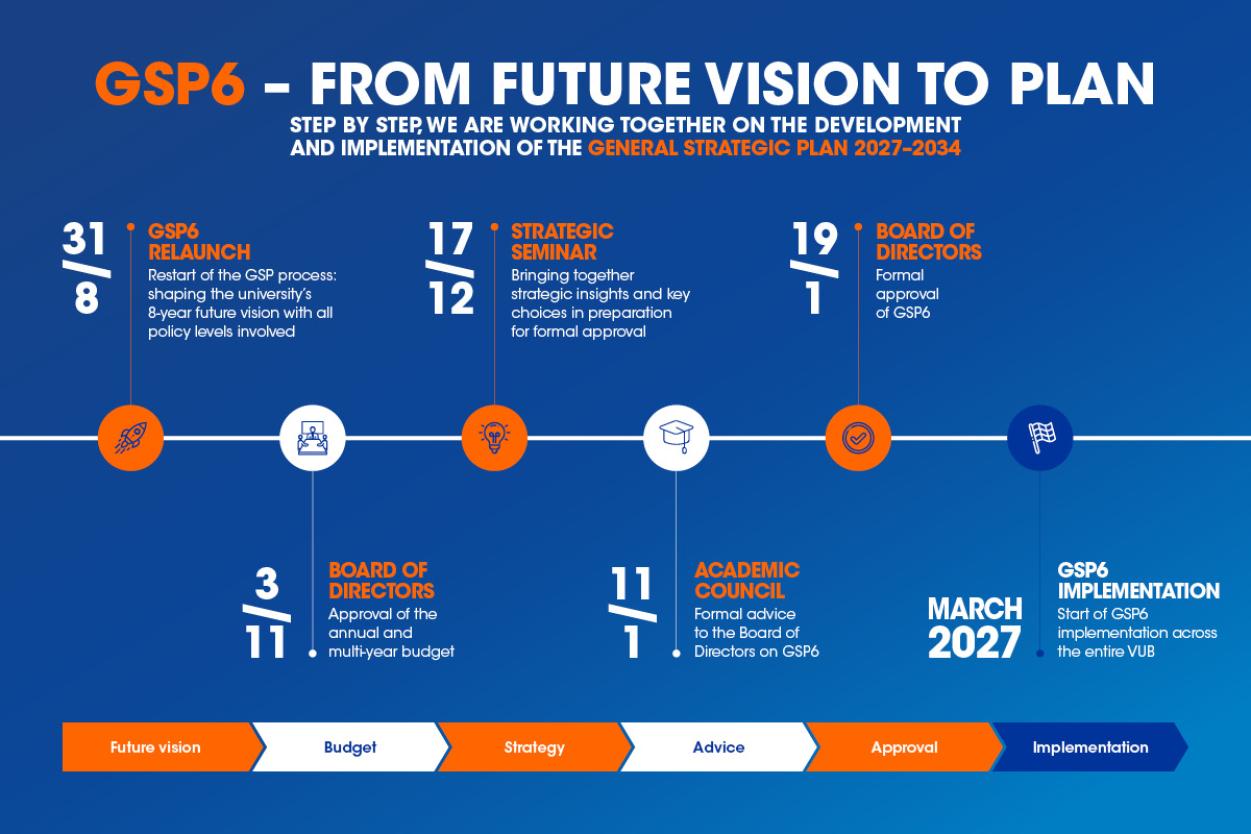
Timeline GSP6 (1st fase)
The first draft of GSP6 will be submitted to the relevant councils at the beginning of 2027. Once approved, the plan will come into effect in March 2027, with its strategic priorities then being translated into policy across all areas of the university..
Want to stay fully up to date with GSP6? You can do so via SharePoint


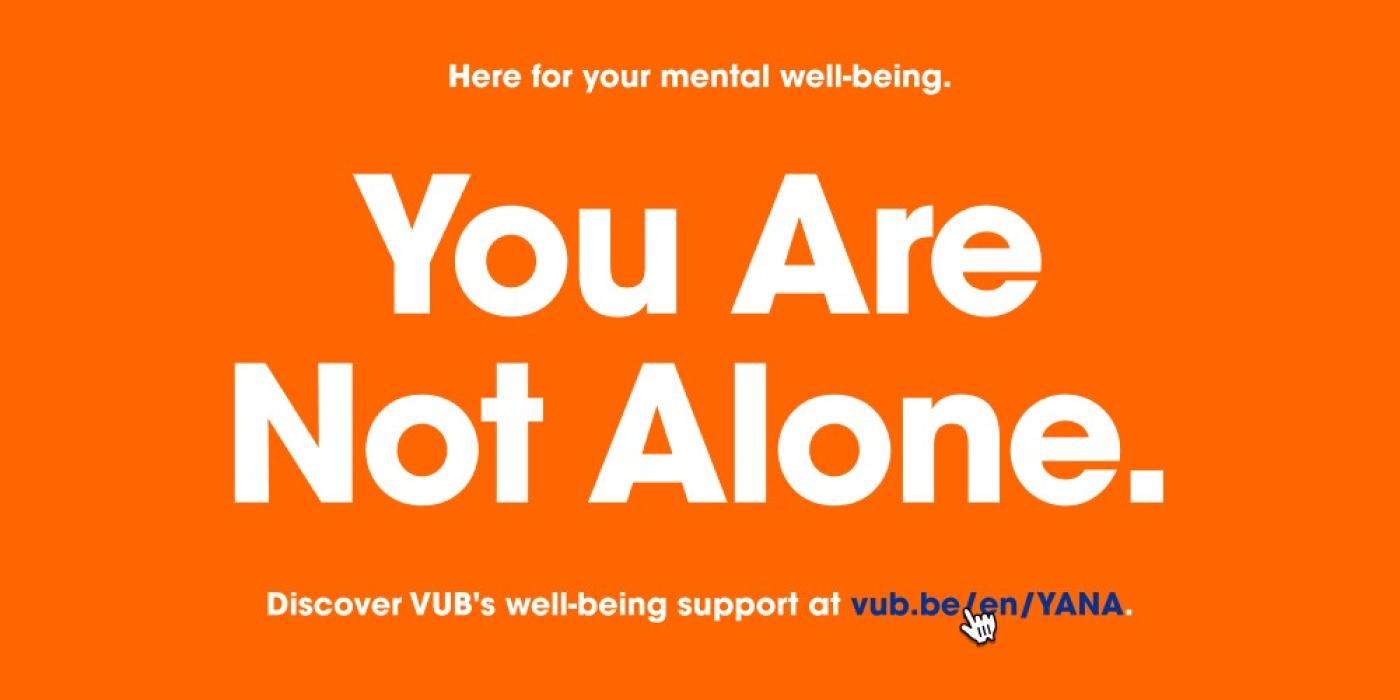
You Are Not Alone
Well-being is about more than feeling good at work. It is also about feeling safe and supported, having room to grow, being heard and looking out for one another.
At VUB, we want caring about well-being to be second nature. Through YANA, we are making our existing psychosocial support services easier to find and access.