

Jan Danckaert’s second term as rector runs until 2031, but his team is already looking beyond those four years. With the General Strategic Plan (GSP6), the rectorate, together with policymakers at every level of consultation, is developing a long-term vision for the period 2027–2034. GSP6 will serve as the compass for a journey that promises to be turbulent. We discuss the plan with Rector Jan Danckaert and General Manager Nic Van Craen.
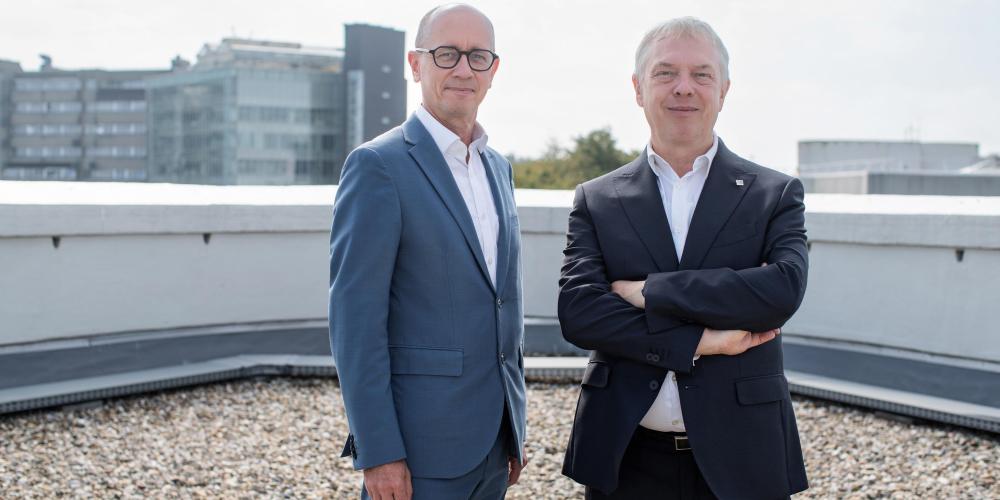
For the photograph accompanying this article, the rector and general manager head up to the roof of the elliptical Braem Building. Architect Renaat Braem described the ellipse as the most fundamental form in nature and science, and therefore a fitting symbol for a university as a place where people search for the ‘ultimate truth’. Today, however, the iconic building brings to mind a large ship setting out on a voyage across turbulent seas. The waves it faces include geopolitical tensions, ecological challenges, artificial intelligence, social polarisation and budget cuts. It is an analogy the rector rather likes.
Jan Danckaert: “I could easily add a few more waves to that list. Take the way science itself is coming under fire today, for example. That was one of the four policy principles I put forward during my campaign for rector: embracing science as the foundation of progress. Taken together, all these challenges threaten to create a perfect storm. There is just one part of the analogy that does not quite work: the idea of one large ship.”
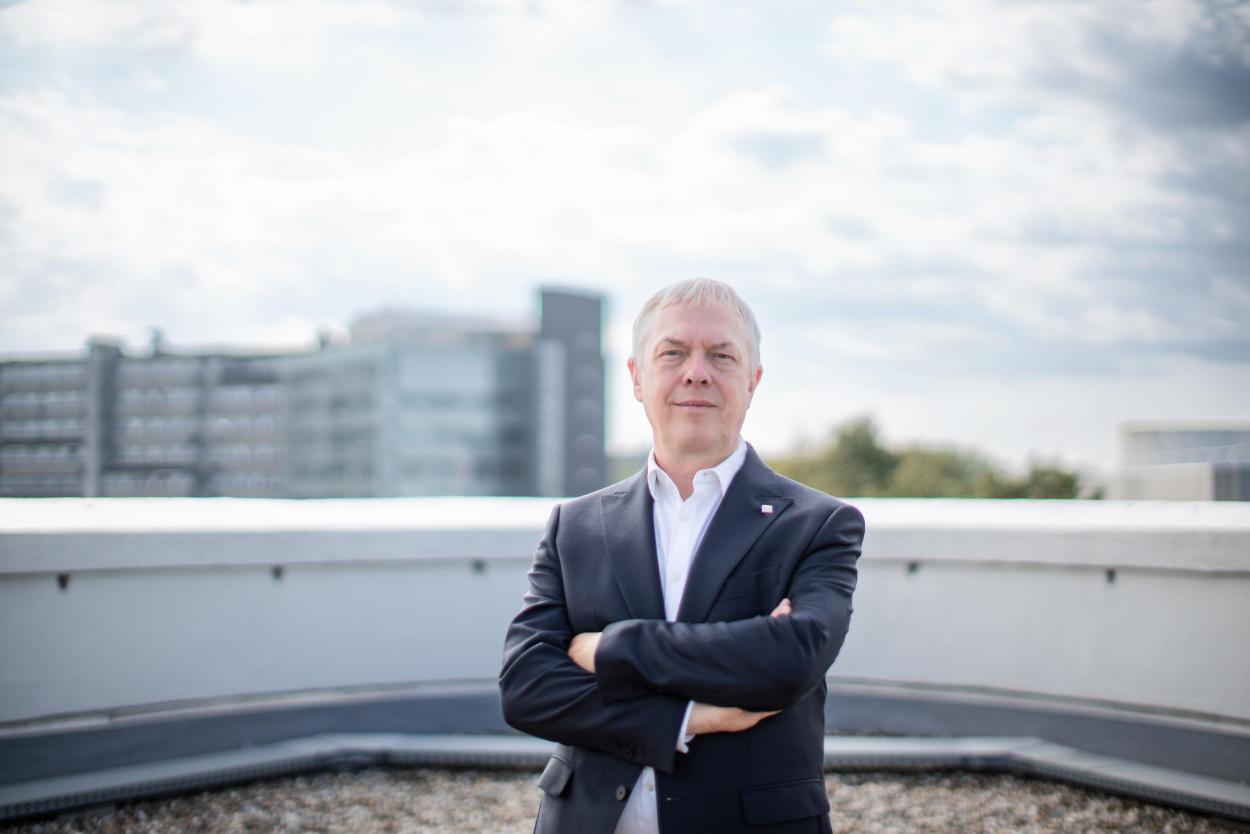
Jan Danckaert
So how do you see the university?
Jan Danckaert: “More as a fleet of larger and smaller vessels. The challenge is to stay together and sail in the same direction, preferably without colliding. That is precisely what GSP6 is for. The General Strategic Plan is based on a thorough analysis of our operating environment and will serve as a compass, helping us stay on course and adjust our direction where necessary.”
A perfect storm sounds ominous. Yet you often point out that VUB is, in fact, a success story.
Jan Danckaert: “It absolutely is. Our growth has been remarkable. Just look at the number of unique students: today, we have 23,000, or 17,300 if you count bachelor’s and master’s students only. We also punch above our weight when it comes to research output. We should not lose sight of that: we are a successful, growing university. We want to sustain that growth and continue developing.”
Infrastructure is struggling to keep pace with that growth.
Jan Danckaert: “We have no plans to build new lecture theatres; that simply would not fit with the current financial climate. Besides, if we started building them now, they would be ready in five years’ time. What will our teaching look like by then? Will lecture theatres still be full, or not? Rather than simply getting bigger, we need to think smarter. We need to be more agile. And that applies to our infrastructure too.”
What does that mean in practical terms?
Nic Van Craen: “Many of our buildings date from the 1970s and 1980s, with a second generation dating from the 1990s. Maintaining them is an ongoing challenge. They not only need to be made more sustainable, but also adapted to increasingly hot summers. Government funding is not keeping pace, so we finance a large share of our renovations and upgrades ourselves. We are not going to add many new square metres. Instead, we will make better use of the space we already have and respond flexibly to changing circumstances. The new LIC is a textbook example of architectural flexibility: it will be easy to adapt to new needs.”
Lecture Theatre Q and the Willy Van Der Meeren student residences are textbook examples too… from the 1970s.
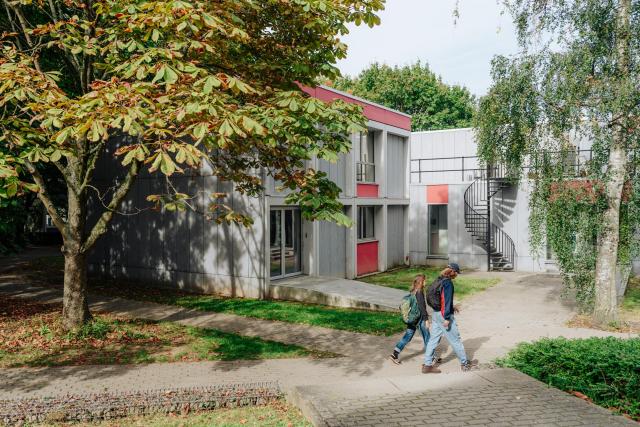
Nic Van Craen: “I admire the vision of those architects. Lecture Theatre Q consists of four smaller lecture theatres that can be transformed into one huge auditorium thanks to a system of rotating walls. It was visionary and remains unique in Europe, just like the modular Willy Van Der Meeren student residences. The Department of Architecture has converted parts of the complex into laboratories, demonstration spaces and teaching rooms, among other things. It was a sustainable intervention. New construction would have been cheaper, but this approach allowed us to save and reuse a great deal of concrete and other valuable building components that would otherwise have been demolished. And that is before you even consider the heritage value.”
“A green campus encourages people to meet and provides natural cooling”
Air conditioning will only be installed where the academic context requires it, such as in laboratories.
Nic Van Craen: “That has indeed been our approach in recent decades. The LIC, for example, does not have air conditioning but uses an air-cooling system instead. It responds to outdoor temperature cycles. With the recent heatwaves, however, we have noticed that the system is reaching its limits. In a few locations, we use geothermal energy for heating and cooling. In the Braem Building, air conditioning was ruled out in any case because of its heritage status. Hence the ‘natural’ cooling.” (points to the open window)
Fortunately, the trees help keep things a little cooler.
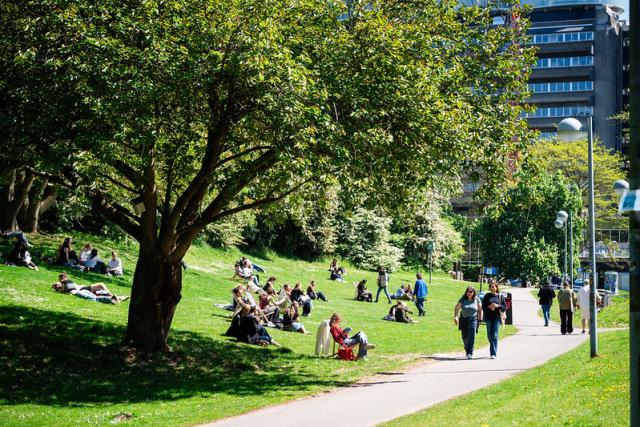
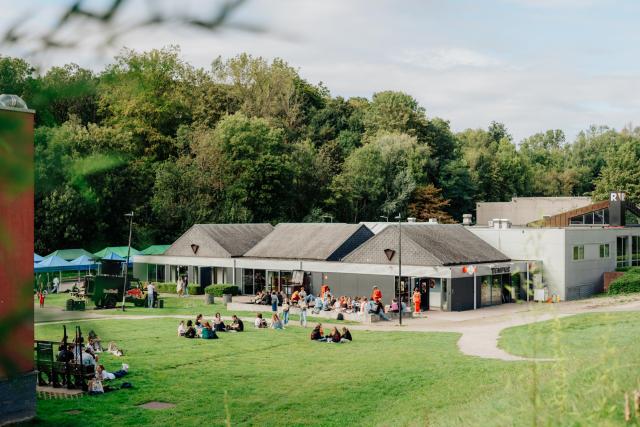
Jan Danckaert: “We keep our campuses in Ixelles, Jette and Zellik as green as possible. That sets us apart from many other universities. All that greenery can quickly make a difference of several degrees and makes the campuses more comfortable during heatwaves. It also helps absorb rainwater, keeping it out of the sewer system. At least as importantly, the park-like setting creates a unique campus experience, particularly as digital technology becomes ever more dominant in our lives. Here, students can meet one another in person, engage in debate and learn from each other. That is part of learning too, even if it cannot be expressed in figures. I believe very strongly in that. Learning is about more than studying.”
What is one particularly important development in terms of infrastructure?
Nic Van Craen: “For research, it is the Green Energy Park in Zellik: an innovation hub where researchers, businesses and public authorities work together on energy, climate and mobility, health, and platform technologies such as AI and robotics. We really want it to bridge the gap between fundamental research and its economic application. This site will be hugely important to the university’s strategic development.”
Jan Danckaert: “And we should not forget our Health Campus. VUB and UZ Brussel work there alongside Erasmushogeschool Brussel, and a new Dentistry programme is being launched. We are continuing to develop that location too, creating a place where students and staff can enjoy a genuine campus experience.”
“I believe in personalised AI tutors that help students build their knowledge step by step”
Earlier, the rector wondered whether our lecture theatres will still be full five years from now. What impact will AI have on our education?
Jan Danckaert: “Knowledge is available everywhere, at any time. That does not mean artificial intelligence can simply replace the learning process. But AI can play a useful role in helping students build their knowledge step by step. I believe in personalised AI tutors that support students individually, taking into account their level and any gaps they may have in particular subjects. A digital study coach like that could answer questions about course material, provide additional explanations of difficult concepts, guide students through exercises, give feedback on assignments and help them plan their studies. A pilot project involving this kind of AI tutor is already under way in Law, among other areas.”
What role does the lecturer still play in this scenario?
Jan Danckaert: “The human element remains just as important as before. AI-powered study support simply adds another layer alongside other forms of teaching. It must, of course, be used responsibly, with due attention to critical thinking and academic integrity.”
What if AI is nevertheless ‘misused’ to take shortcuts or even to cheat?
Jan Danckaert: “Our methods for assessing examinations and final projects will need to be made AI-proof. Several pilot projects are already exploring that too.”
“AI can free staff from repetitive, routine work”
The main difficulty with AI seems to be that it is hard to know what exactly we should be preparing for.
Jan Danckaert: “When these large language models were launched at the end of 2022, nobody anticipated just how capable they would become. Not even AI experts. And I see no sign of that acceleration slowing down. New chips will make these models even more powerful. So yes, we are dealing with a moving target. That is precisely why agility is so important.”
Can we handle this?
Jan Danckaert: “Who is better placed to do so? As a knowledge institution, surely we have no choice but to embrace the very best that science and technology have to offer, to be among the first to put it into practice, and to find out what works, what does not, and how it can be improved.”
What will artificial intelligence mean for administrative and technical staff?
Nic Van Craen: “AI can free staff from repetitive, routine work, leaving more time for substantive tasks and personal interaction. Have an AI tool running during a meeting and, as soon as it ends, you can have a report complete with action points and conclusions. That represents an enormous saving in time.”
Another example?
Nic Van Craen: “AI can provide support with procedures brought by students before the appeals committee. We deal with around 400 of these cases a year, and they have to be processed within a very short timeframe. We have also screened more than 4,000 course-unit descriptions to assess how AI-proof their examination methods are. Doing that manually would have been an enormous undertaking. The final decision will always remain a human responsibility, but AI can greatly speed up both the preparatory work and subsequent processing.”

Nic Van Craen
“Making the cuts more quickly would not be desirable from a human perspective”
We have not yet discussed the biggest wave of all: the tsunami of budget cuts.
Nic Van Craen: “There are several factors at play. The first is VUB’s rapid growth, both in student numbers and in research activity. And that growth has taken place across units of different sizes, with different processes and needs – the fleet of larger and smaller vessels the rector referred to earlier. To make all of that manageable, we invested in additional administrative and technical staff. As a result, administrative and technical staff now account for a larger share of our workforce than at other universities.”
So what happens now?
Nic Van Craen: “We have to achieve the same with fewer resources. We are approaching these savings objectively, transparently and on the basis of data, including through natural attrition, a recruitment freeze, internal mobility and the discontinuation of certain services. That exercise is still ongoing, incidentally, because higher inflation means staff costs are rising faster than initially anticipated.”
Government cuts have recently been added to the savings plan that was already under way.
Nic Van Craen: “That was a setback. The Flemish and federal governments are themselves cutting spending and have reduced funding as well. This has resulted in an overall savings plan. Our aim is to save €24 million over five years, €14 million of which will come from staffing costs. We do not yet have the Flemish Government’s final figures, so we will have to wait and see whether our current scenarios still hold.”
Five years is a long time to operate in a climate of spending cuts.
Nic Van Craen: “Moving faster would be preferable in terms of avoiding reorganisation fatigue, but it would also be less humane.”
It all sounds rather bleak…
Nic Van Craen: “It is not all doom and gloom. That is precisely why GSP6 is so important. The strategic plan gives us a clear vision and contains many positive elements. It also provides a framework for achieving financial sustainability and investing in a targeted way, so that we can turn our strategies for the future into reality.”
Jan Danckaert: “The years ahead will be turbulent, but fascinating. And through it all, we are – and will remain – a growing university.”
About GSP6 – VUB’s new General Strategic Plan
From autumn 2026 onwards, the Rectorate will work step by step with policymakers from all levels of consultation and decision-making – including Vice-Rectorates, faculties, central services and councils – to develop a shared vision for VUB’s future: GSP6.
GSP6 is the new General Strategic Plan. It sets out a long-term vision and strategic objectives for the university for the period 2027–2034, and translates these into policy priorities for Rector Jan Danckaert’s second term of office (2027–2031). In this way, GSP6 sets the strategic direction for our university and provides a shared framework for future policy decisions.
The first draft of GSP6 will be submitted to the relevant councils in early 2027. Following approval, the plan will come into effect in March 2027, with its strategic priorities then translated into policy across all areas of the university.
Want to stay fully up to date with GSP6? You can do so via SharePoint