


Over the coming months, the Rectorate and VUB’s other policymakers will be putting their heads together to work on GSP6, the General Strategic Plan for the 2027–2034 period. They are not doing this alone. Behind the scenes, the Strategy Unit and M&O provide support and inspiration, including through VUB LRN sessions: internal opportunities for learning and exchange. Chris Beirens, Head of the Strategy Unit, and Sarah Inghelbrecht, HR Adviser for Learning & Development, explain the approach and timeline.
The new strategic plan is taking a two-track approach. The two tracks will run in parallel, but they have different time horizons. The first is linked to Jan Danckaert’s second term as Rector, from 2027 to 2031. The second – GSP6 – looks ahead to 2034 and asks a fundamental question: what kind of university do we want to be eight years from now? As Chris Beirens explains, responsibility for the content of this process lies with the Rectorate, the Vice-Rectorates, the mandate holders and policymakers at all levels of consultation. They discuss, make decisions and shape policy.
Sarah: “Our role is to guide this process. We provide the tools and set out timelines so that they can carry out this exercise in a structured way. Together with VUB LRN, we have developed a learning programme for this purpose. More specifically, it consists of internal learning and exchange sessions, with modules that bring senior management and policymakers together around topics such as strategic thinking, policy development, organisational change and participatory leadership.”
For this learning programme, VUB is working with Gingko, an external partner specialising in leadership and change management, with experience in the higher education sector.

“We will teach, conduct research, study and work differently in the future”
Chris Beirens
Head of the Strategy Unit at VUB
During the LRN sessions, possible future scenarios are put on the table, exploring what the world might look like in one, five or ten years’ time. The next step is to consider what role the university can play and what choices we need to make today to develop a robust, future-oriented plan. Terms such as ‘black swans’ – rare, unexpected events with a major impact, such as Covid-19 – and ‘grey rhinos’ – major, visible risks heading our way but sometimes underestimated – soon enter the discussion.
Chris: “Artificial intelligence could be considered a grey rhino. Not because we underestimate its importance, but because we do not yet know exactly what impact it will have on our research, education and operations. That is precisely why, during the previous policy term, the Rector appointed Professor Vincent Ginis as the mandate holder for Artificial Intelligence. An environmental analysis that we commissioned in preparation for the GSP6 process has already made one thing clear: AI will change the way we teach, conduct research, study and work.”
“We can already take steps to prepare for possible future scenarios.”
Chris Beirens
Head of the Strategy Unit at VUB

Artificial intelligence is not the only challenge. The university has been operating in a rapidly changing environment for some time now, and this is unlikely to become any easier in the future. How should universities position themselves in a changing education landscape, where an increasing number of organisations outside higher education are also offering educational programmes? And how can the university safeguard its academic freedom in an increasingly turbulent geopolitical context?
Chris: “We are not going to find ready-made answers to these questions straight away. But GSP6 is an opportunity to step outside our comfort zone and think about these issues broadly and deeply. We are questioning our business model and looking at where the greatest challenges lie. We then consider the ‘no-regret moves’ we can make now. These are sensible steps that will be useful whatever the future holds and that can already prepare us for possible future scenarios.

“We want to build support among students and staff”
Sarah Inghelbrecht
HR adviser for Learning & Development
The strategic plan must not become a dead letter, gathering dust in a drawer until the next strategic exercise. This requires broad support. So how do you build that support?
Chris: “By communicating regularly throughout the entire process. But that alone is not enough. We are committing to clear results, with defined objectives linked to the people, time and resources available. We will monitor progress through action plans with clear milestones, budgets and indicators. This will allow us to closely track implementation. This way of working also responds to an explicit request from the Academic Council and the Board of Governors.”
Sarah: “At M&O, we are developing a framework to support the organisation in its business processes. We are taking a people-centred approach. Through VUB LRN, we will also offer workshops from spring 2027 onwards, where the management teams of faculties and central departments will work on translating the policy into a concrete approach for their own unit. We want everyone on board.”
About GSP6 – VUB’s new General Strategic Plan
From autumn 2026 onwards, the Rectorate will work step by step with policymakers from all levels of consultation and decision-making – including Vice-Rectorates, faculties, central services and councils – to develop a shared vision for VUB’s future: GSP6.
GSP6 is the new General Strategic Plan. It sets out a long-term vision and strategic objectives for the university for the period 2027–2034, and translates these into policy priorities for Rector Jan Danckaert’s second term of office (2027–2031). In this way, GSP6 sets the strategic direction for our university and provides a shared framework for future policy decisions.
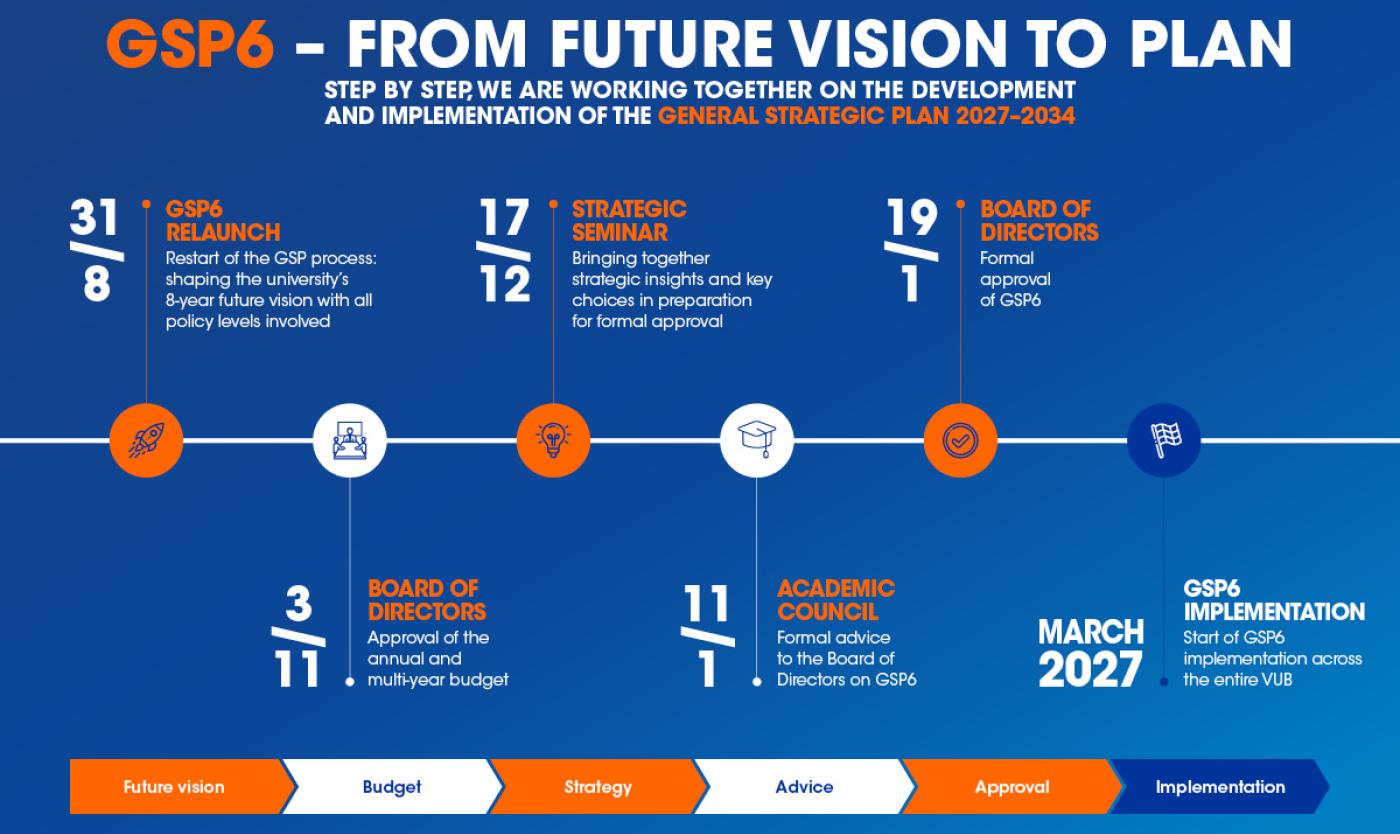
Timeline GSP6 (1st fase)
The first draft of GSP6 will be submitted to the relevant councils at the beginning of 2027. Once approved, the plan will come into effect in March 2027, with its strategic priorities then being translated into policy across all areas of the university..
Want to stay fully up to date with GSP6? You can do so via SharePoint