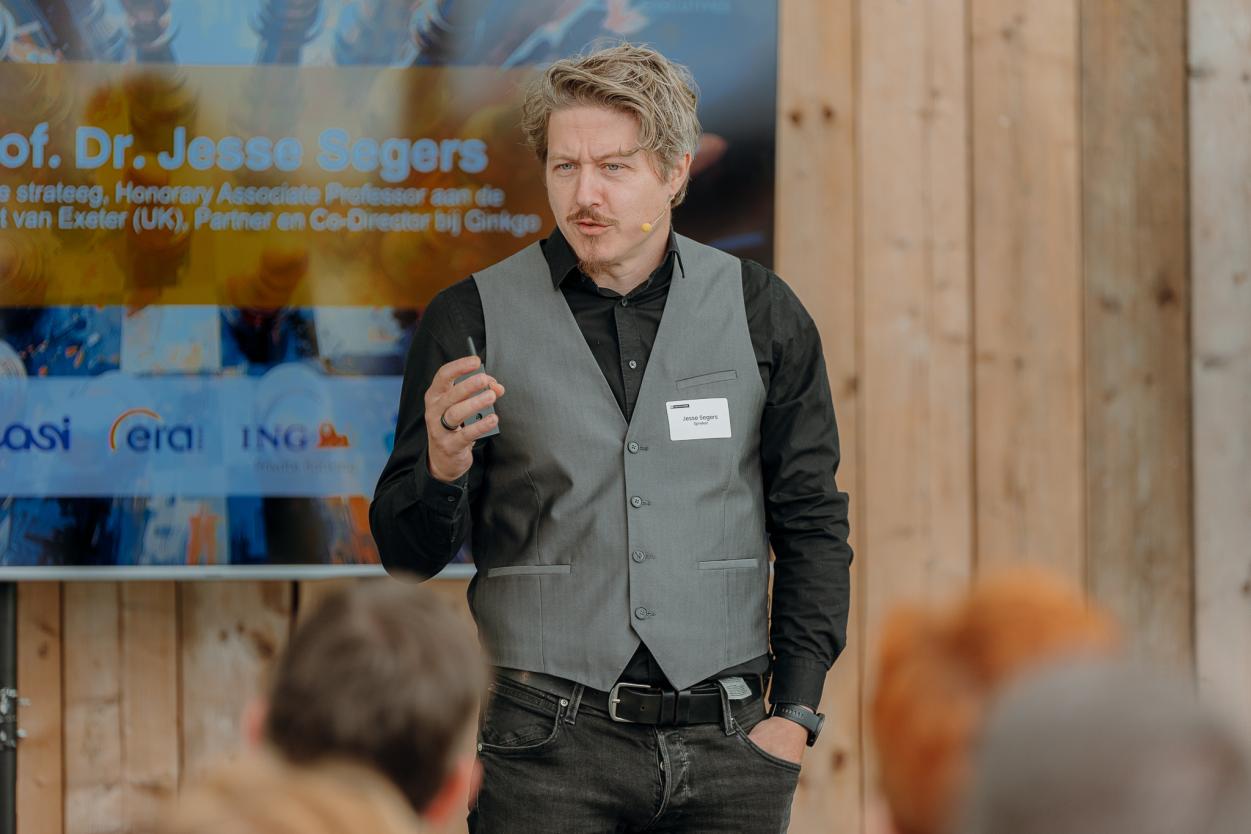
VUB’s Rectorate and other university leaders are working together on GSP6, the General Strategic Plan for 2027–2034. Throughout this process, the Strategy Unit and People & Organisation (P&O) provide inspiration and guidance, including through the VUB LRN programme on strategic policymaking, organised in collaboration with consultancy firm Ginkgo Consulting. We speak to Professor Jesse Segers of Ginkgo about leadership in an era of profound change. On Monday 23 November, from 14:00 to 17:00, Jesse will deliver the opening keynote at Engaged Leading Week.
‘Everything flows’, the ancient Greek philosopher Heraclitus is said to have declared. The essence of his thinking is that nothing stays the same; everything is constantly changing. What would he have made of the world today? Change is happening at such a pace and on such a scale that it is shaking society to its foundations. Universities are feeling the tremors too. Having navigated globalisation and the Covid pandemic, they now face artificial intelligence, geopolitical shifts and deep budget cuts. How does an expert in change management make sense of it all? By breaking change down into three manageable categories: first-, second- and third-order change.
Jesse Segers: “First-order change means doing things differently within the existing framework. Making things faster, better, cheaper or more efficient. When that is no longer enough, you move to second-order change, which transforms the system itself. You question the rules and assumptions and look for solutions beyond the familiar framework. It is about thinking differently. Third-order change goes beyond the boundaries of your own organisation, involving an entire ecosystem or network. It also means recognising your own frames of reference and regularly questioning your beliefs and ways of working.”
Why across-the-board cuts are a missed opportunity
First-order change is nothing new. But with today's technological and societal upheavals, the need for second- and even third-order change is greater than ever.
“We don't need to move from A to A+, or even from A to B. We need to move from A to God knows where. Right now, there are far more questions than answers. It's a difficult puzzle, particularly for VUB, which faces specific challenges as a university in Brussels and has been hit especially hard by budget cuts.
What you shouldn't do is approach second- and third-order change as though it were first-order change. By that I mean the familiar approach of making cuts across the board. Trim a little everywhere, ask people to work a bit faster and spread the pain over five years to make it more bearable. Et voilà.
I think that approach would be a missed opportunity. Instead, the organisation needs to ask itself: if we're going to work with fewer people, what will we continue doing, what will we do differently and what will we stop doing altogether?”
“If we're going to work with fewer people, what will we continue doing, what will we do differently and what will we stop doing altogether?”
GSP6: what kind of university does VUB want to be in 2034?
GSP6 aims to address these and other questions. The new strategic plan has two strands. The first is linked to the Rector's term of office, from 2027 to 2031. The second looks ahead to 2034 and asks what kind of university VUB wants to become over the next eight years.
“That long-term vision, the university's ‘dream for the future’, is absolutely vital. The shorter-term plan maps out how to get there. The two need to be closely connected. That's not easy, because all the uncertainty means that less and less of our strategy can actually be planned in advance.
To make these uncertainties more tangible, we're using scenario planning as part of the VUB LRN programme. Before the summer, we held a workshop with the Board of Governors, and this autumn we've been working with the deans, directors and vice-rectors.”
During the workshops, participants jointly developed four scenarios representing possible future worlds, based on the uncertainties we face today. They then explored potential no-regret moves: sensible decisions an organisation can make now that will prove worthwhile regardless of how the future unfolds. All the while, they recognised that none of the four scenarios is likely to materialise exactly as imagined. After all, predicting the future has rarely been more difficult.
“These decisions are a kind of test of resilience. They need to align with what the university wants to be in eight or ten years' time and remain valid under as many different circumstances as possible.”
Leadership means having the courage to make choices
People & Organisation (P&O) offers training programmes to prepare VUB leaders for the changing world ahead. What those leaders need to know and do depends on the type of change they are dealing with.
“First-order change – making processes better and faster – is best left to project managers and technical experts. Senior leaders may be tempted to get involved because it allows them to solve concrete problems. You can see the KPIs turn from red to green. But that's not really the job of senior management. Second-order change is.”
Clear push and pull communication is essential when dealing with second-order change. Push communication explains why change is necessary. What external pressures are pushing us in a particular direction? What internal problems are we facing? Why do we need to change now rather than in two years? What happens if we don't? Pull communication focuses on the future we want to create and the results we hope to achieve.
“Alongside communication, and just as importantly, there's the need to create a shared understanding of what the change means. Senior management must make it clear to middle managers what the new criteria for success are and what they mean for their jobs. Otherwise, tensions will arise at that level.
Take a hypothetical educational institution, for example. Should it focus on attracting as many students as possible or on recruiting students with strong academic potential? The director of education will probably be thinking about master's programmes and rankings, and will favour academic quality. The finance director, meanwhile, might be looking for funding for a new building. They would prefer to see more students enrolling, along with the tuition fees they bring, even if not all those students perform as well academically as the institution might hope.
So which priority wins? To put it bluntly, who has the most power at the table? Those are the kinds of decisions that senior leadership needs to make.”
Experimentation is essential. Even when it fails.
Third-order change, Jesse explains, means creating room for experimentation across organisational boundaries. Enterprising staff should be encouraged to set up pilot projects and try out new ideas, without being tied to performance targets. The goal is to learn what the future might look like. One example is the development of an AI tutor to support VUB students in their studies.
“With experiments like these, senior management shouldn't set targets or expect specific results. If a project fails or runs into difficulties for whatever reason, you have to be prepared to accept that loss. As long as something is learned along the way.”
‘At VUB, I was allowed to be difficult – and still be accepted’
For Jesse, the GSP6 project marks a return to his alma mater: he earned his master's degree in Work and Organisational Psychology at VUB. How does he look back on his student years? And what does he make of VUB's culture?
“I actually started my studies at KU Leuven. It's obviously an excellent university where many people feel very much at home and do outstanding work. But I never quite found my place there. I'd grown up in Leuven and didn't really connect with the students who had come from elsewhere. I also found it difficult to connect with the professors.
Looking back, I understand why. There were 600 of us in a lecture theatre. By the time I'd made my way down to ask a question, the professor had already disappeared. Besides, I was a rather headstrong student with dreadlocks and a piercing. (laughs)
A friend's mother wanted to have a chat with me. She was Professor Ingrid Ponjaert, then Dean of VUB's Faculty of Psychology and Educational Sciences. She told me that VUB was precisely the kind of university that welcomed independent thinkers who challenged dogma, enjoyed debating with professors and weren't afraid to express their own views in academic papers, however unpolished those views might still be. That was 23 years ago, of course, when class sizes at VUB were still smaller.”
For Jesse, it was exactly what he needed. Despite having to repeat a year at the start of his master's programme, he graduated with the highest distinction.
“Without VUB, I'm certain I would never have finished university. Here, I was allowed to be a bit difficult, and people still liked me. I was looking for that rebellious spirit, which fits so well with the urban character of Brussels.
It always reminded me of that famous Apple advertising campaign: ‘Here's to the crazy ones. The misfits. The rebels. The troublemakers.’ That's what VUB meant to me.”
Bio
Professor Jesse Segers holds a master's degree in Work and Organisational Psychology from VUB and a PhD in Applied Economics from the University of Antwerp. He previously served as Vice-Dean for Education and Master's Programmes at Antwerp Management School and as Rector of SIOO, the Dutch interuniversity centre for organisational and change management. Today, Jesse is a partner at Ginkgo Consulting, where he supports organisations in leadership development and organisational transformation. He is also a Full Professor at the University of Exeter in the United Kingdom. Last year, he co-authored Leading from the Top with fellow Ginkgo partner Daan Sorgeloos.
About GSP6 – VUB’s new General Strategic Plan
From autumn 2026 onwards, the Rectorate will work step by step with policymakers from all levels of consultation and decision-making – including Vice-Rectorates, faculties, central services and councils – to develop a shared vision for VUB’s future: GSP6.
GSP6 is the new General Strategic Plan. It sets out a long-term vision and strategic objectives for the university for the period 2027–2034, and translates these into policy priorities for Rector Jan Danckaert’s second term of office (2027–2031). In this way, GSP6 sets the strategic direction for our university and provides a shared framework for future policy decisions.
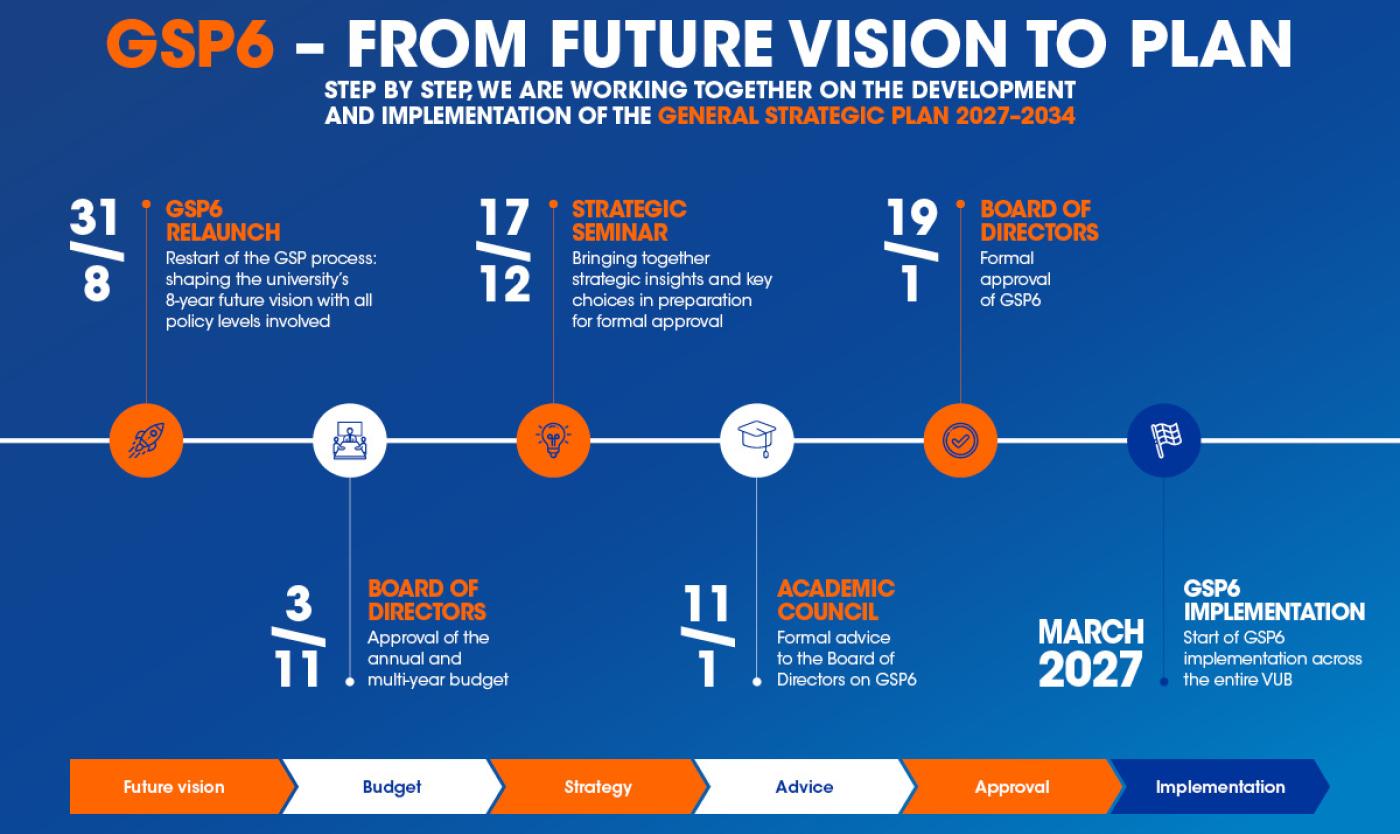
Timeline GSP6 (1st fase)
The first draft of GSP6 will be submitted to the relevant councils at the beginning of 2027. Once approved, the plan will come into effect in March 2027, with its strategic priorities then being translated into policy across all areas of the university..
Want to stay fully up to date with GSP6? You can do so via SharePoint