

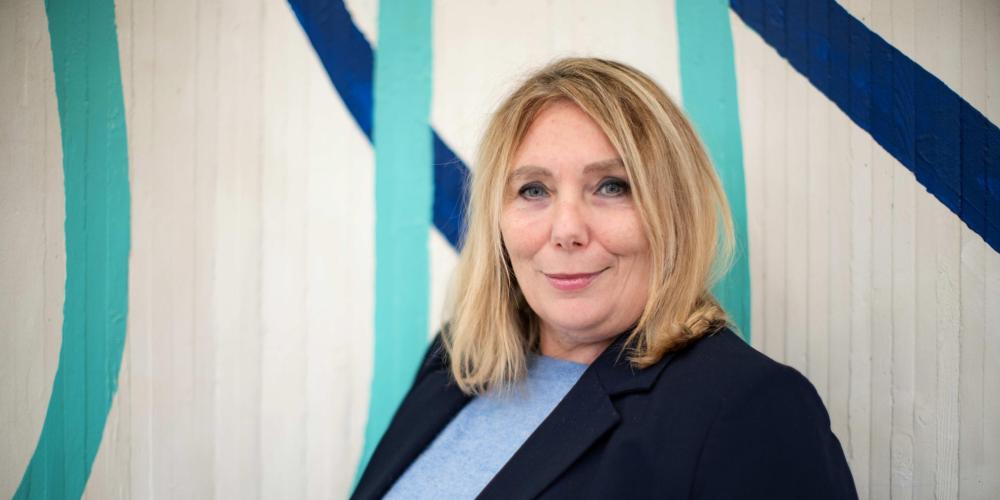


On 1 March 2026, director and MarCom phenomenon Ann Van Driessche will retire. “AVD and rest” — for us as colleagues, it feels like an unusual and slightly disorienting combination. Yet it is so. After 11 whirlwind years at VUB — from WeAreParis to Women shaping science, from olive green to orange-blanc-bleu, from Cinquantenaire to the Royal Circus — our boss is closing the door behind her. “Big, bigger, grand” was the motto. Just as the VUB must dare to be. What began for us as a special interview became a powerful farewell conversation. And holding back? We both left that behind.
You’re ending your career with Women shaping science, a campaign you clearly felt you had to see through. You yourself have often fought as a woman in male-dominated worlds — politics, the UZA, and yes, even the VUB. A statement?
Ann Van Driessche: “Absolutely. And there was a very concrete trigger. On 4 December, during the honorary doctorate ceremony, a dean said to me: ‘Ah, you’re leaving now. Your successor will be lucky to earn less.’ There was no response. And I thought: would he have said this to a man? It wasn’t just that one comment in itself, but the mechanism behind it: suddenly, you’re on the defensive again. You weigh up whether to respond, to nuance, to smile. That moment contributed to the idea. When I proposed the campaign to Rector Jan Danckaert and Vice-Rector Pieter Ballon, they immediately agreed. It’s still needed. An institution like the VUB prides itself on equality, and at first glance, gender doesn’t seem to be an issue. But if you dig deeper, you see that women still don’t always get the same opportunities, or that their approach is judged differently. It rarely involves big, obvious things. It’s often in small reflexes: being interrupted more quickly in a meeting, having to be stricter to be taken seriously, being assertive and then being called ‘difficult’, while a man is seen as ‘strong leadership’. They’re details that seem harmless, but they accumulate. Sometimes it’s simply annoying, and over time it becomes exhausting.
That’s why Women shaping science is a statement for me — but not finger-pointing. It simply means: science has a female face, as natural as a male one. The campaign aims to make visible the expertise and leadership among women, while also inviting everyone to stay alert to those small mechanisms that determine who is given space, who is believed, and who is seen as the ‘norm’. So yes: even in an environment with the best intentions, we have to work on this consciously. Equality does not happen automatically.”
“The fuss around the Academic Opening can be maddening, but it’s also a moment when you feel: we’re really doing this together”
Ambition is a word that has probably been worn down on our ears like a scratched record. To us, you were a visionary communications professional who, like a whirlwind, propelled the MarCom machine forward at breakneck speed. How would you like us to remember you?
Ann Van Driessche: “I hope that, besides what you mentioned, I’ll also be remembered as someone who sets the bar high. Not to overwhelm people, but because I truly believe that you strengthen people by challenging them. I believe strongly in growth, in making mistakes, in moving forward. At the same time, I hope to be seen as someone who gave opportunities, inspired, instilled confidence, and genuinely believed in everyone’s abilities. And yes, I know, I often move at a fast pace — sometimes faster than people can keep up. I realise that. Looking back, I think I sometimes pushed people beyond their limits. I hope they mainly remember that I believed in them, even when they couldn’t see it themselves. The common thread I hope remains is that it was never about being ‘hard for the sake of being hard’. It was about creating something together that we could be proud of. And the team standing here today — I am genuinely most proud of that.”
The university places great importance on the Academic Opening. Sometimes, it seems as if that’s the only thing on which the MarCom team is evaluated. In your last Academic Opening, you returned to the campus after years of prestigious locations in Brussels. A full circle? Which AO sticks with you the most?
“The hardest and most stressful was the first one in Bozar with the bicycles, but the one we managed to hold simultaneously across five locations during the COVID period was the most useful. The 50th anniversary in the blazing sun at the Cinquantenaire was the most challenging. In the stately hall of the Gare Maritime, the most beautiful. At the Anderlecht slaughterhouse, the coldest and yet the warmest, with the farewells to Paul and Caroline. In the European Parliament, the most international; in the Royal Circus, the most open-minded. In short, each had a different dimension. Returning to the campus was always the plan, and showing all the new research infrastructure this year was proof that VUB hasn’t been standing still. Honestly, the AO fuss can be maddening at times, but it’s also a moment when you feel: we’re really doing this together. And I’ve always loved that.”
"Free thinking, for me, also means: being able to accept that someone disagrees with you. That may be the hardest form of freedom today"
In recent years, there have been numerous campaigns around our V — our liberal-humanist values: Vrij om, Feest van de Vrije Geest, and Vrij denken. Needed in the world today? Or was it that blue-liberal streak in your heart?
“Both, I think. But apart from political colour, I strongly believe in a certain view of humanity — in self-determination, in freedom, and in the idea that people should, as much as possible, be able to shape their own lives. And today, in this geopolitical chaos, that is really needed. I don’t like to coddle — except when necessary, of course, because then I can be very caring. But I think a university must also be a place where people learn to think, learn to choose, and learn to take responsibility. Perhaps that is more necessary than ever. Free thinking, for me, also means being able to accept that someone disagrees with you. That may be the hardest form of freedom today.”
VUB Tomorrow was another initiative you wanted to launch. How does VUB look tomorrow? What would you like to leave us with?
“You must dare to go all in with communication. An organisation is only as strong as the way it presents itself. If you don’t tell the story well, you can do all the fantastic work you like — no one will see it. I felt we needed a thematic vehicle. Hence VUB Tomorrow. It may not be perfect, because it exists outside the main website, but integrating it into the website was simply not affordable. And then I’m pragmatic: better something that works and is visible than to keep dreaming of the perfect solution that never comes. I’ve never believed in communication just to ‘dress things up’. I believe in communication that is relevant. If we don’t do that, we shortchange ourselves. Thematic communication is necessary when you have so much content. Otherwise, it seems like there’s no thread in what we tell. With the daily newsletter VUB Today, that’s not an issue because it has the theme of current affairs. But there was a need for structure and recognisability.”
You started with WeAreParis, then came De Wereld Heeft je Nodig. You renamed the department Marketing, Communication & Engagement. Why the focus?
“Because engagement is something you have to feel. It has to be lived. Engagement is certainly not just volunteering, politics, or having strong opinions. For me, it’s mostly about walking the talk. Don’t just say what you stand for — live it. And I wanted to encourage that in our community. It’s difficult to unite everyone around a connecting theme, but with climate we managed quite well. I’m glad we made that theme visible ten years ago. The number of VUB researchers active in climate and sustainability is overwhelming on our scale. And they’re doing fantastic work. Perhaps the most beautiful thing about a university is that you’re surrounded by people who are not only smart, but driven by something larger than themselves. That makes me genuinely proud.”
You quickly returned to the orange-blanc-bleu house style after a period of protest and olive-green nostalgia. Now everyone has embraced it. You’ve always paid great attention to the visual identity on campus. A conscious choice?
“Yes. I care a lot about the environment I’m in. The environment sets your mindset — that’s really true. A cheerful environment that showcases a ‘can-do’ attitude is simply more inspiring than one that’s grey and neutral. It may seem like a detail, but on a campus where thousands of people walk around every day, it makes a real difference. I’ve always thought a university should not look like it’s apologising for existing. And the orange-blanc-bleu, for the historian in me, was simply a must.”
“My grandmother used to say: I’ll have plenty of time to rest once I’m no longer in this world”
You had a special bond with Paul De Knop and Caroline Pauwels. Tell us about it.
“I had the chance to work closely and pleasantly with three different rectors. That was something special. I had known Paul for a long time. His way of working closely matched how I like to work: no-nonsense, focused on moving forward. I was always well-prepared. I would walk in with: this is what I want to do, it will cost this much, and this is what I need from you. When I brought the same preparation to Caroline, it was immediately clear that it wouldn’t work the same way. My agenda items didn’t even get addressed, because Caroline had just as many ideas as I did. Sometimes Rob would be in the meeting too, and I could see the despair growing in his eyes. But it was certainly inspiring. The clash of ideas simply made everything better. When COVID made the Graduation Ceremony impossible, Caroline and I came up with a major event at the King Baudouin Stadium. The mayor then suggested the Grand Place. Rarely have I been able to realise something so impactful. Caroline was without a doubt one of the most inspiring people I’ve had the privilege to work with.
And now I work with Jan. He’s a different person, but undoubtedly the man with the greatest boldness. I admire his courage to challenge sacred cows, to push forward even when the time isn’t fully right. That takes character.”
“A MarCom department that isn’t under fire is often an irrelevant department”
The leader and her people. At your MarCom farewell party, the banner read: ‘It’s been beautiful.’ It was a wonderful ride, but also a challenging one. Some are relieved to have crossed the finish line and are still catching their breath.
“Is that so? (laughs) I know I often have that effect on people. I set the pace, yes. I push forward. And yet, the harder I move ahead, the more I realise: sometimes you also need to walk alongside people. But rest is not exactly what I aspire to — although I’ve grown into it somewhat in recent years. My grandmother used to say: I’ll have plenty of time to rest once I’m no longer in this world. Something like that. So yes, I have drive. And I’ve never really been able to hide it. At every farewell party in my career, that’s been the recurring theme.”
Communication — everyone does it and thinks they can do it. Yet few can truly master it. You could. MarCom often faces misunderstanding within the university because few fully grasp it. What’s your perspective on this? Will MarCom ever receive full respect, or will it always be like this?
“There is genuine respect for what we do. But at the same time, there’s a lot of misunderstanding. And honestly, I don’t worry much about that. A MarCom department that isn’t under fire is often an irrelevant department. It keeps us on our toes. MarCom costs a lot of money, and rightly so — it should be scrutinised. But criticism should be substantive, based on collaboration and a shared goal. Ultimately, we don’t do this for ourselves, but to make the university stronger. Sometimes we had the image of only doing ‘pretty things’, but communication is also about care — care for context, reputation, and connection.”
“The people. Always the people. I am proud of the team that stands here today, of how we’ve evolved. But also of the many people at VUB, not just MarCommers. It’s a privilege to work in an environment where people are intelligent, where ideas circulate, where there’s drive. And there’s one more thing: the rector said in his speech that I’ve shaken up the Calimero mindset at VUB. That touched me, because that’s always been my belief too. Departure from your own strengths. Don’t pretend others always know or can do better. We can be proud of who we are and what we can do. That’s something I hope sticks. I’ve always believed you can be humble without selling yourself short. That’s something else entirely.”
What would you have done differently?
“In recent years, I’ve tended to avoid social contact and many events. My hearing problem often made those gatherings a trial. But networking is important. Being present is important. And there, I fell short. That’s something I now think I would have approached differently. Maybe not attend everything, but consciously choose the moments that really matter.”
"I’m taking a master tailor course. You work with detail, attention, patience — it’s almost like a new language for me"
And now? What are you looking forward to? What will you do after retirement?
“I will slow down. Really. First, do nothing. No deadlines, no projects, no Academic Openings. Just make space in my mind and see what naturally emerges. I also want to get my body strong again, because I’ve neglected it for far too long. A colleague recently said to me: ‘You need to dance.’ And I thought immediately: yes… she’s right. Moving, dancing, coming back into my body. That’s high on my list. And above all, I feel a desire to be creative — to make things, to create things. I’m learning ceramics now, hands in the clay. It’s both calming and challenging. And alongside that, I’m taking a master tailor course. It challenges me in a completely different way — working with detail, focus, patience. It’s almost a new language to me.
Whether I’ll return to the wondrous world of marketing and communication, I honestly don’t know. Maybe yes, maybe no. But first, I want to truly close this door. And then see which other door opens. And above all, I’m looking forward to reconnecting with my family — my partner, my children, and now also my three granddaughters. You sometimes underestimate how much you miss when you’re always switched on. So yes, this is a new chapter. A very beautiful chapter.”
Final words?
“I’m not ready to say them yet. I plan to say a lot more. But for VUB: thank you for everything. It has been a challenging journey. I’ve learned a lot here, had a lot of fun, and, together with my team, realised beautiful things. All the best!”
With the campaign Women shaping science, the Vrije Universiteit Brussel (VUB) puts its female researchers firmly in the spotlight. The highlight is a photo exhibition featuring twenty striking portraits of scientists, created by photographer Lieve Blancquaert. In addition, the VUB publishes a series of stories about leading female researchers and provides an expert list of female scientists.