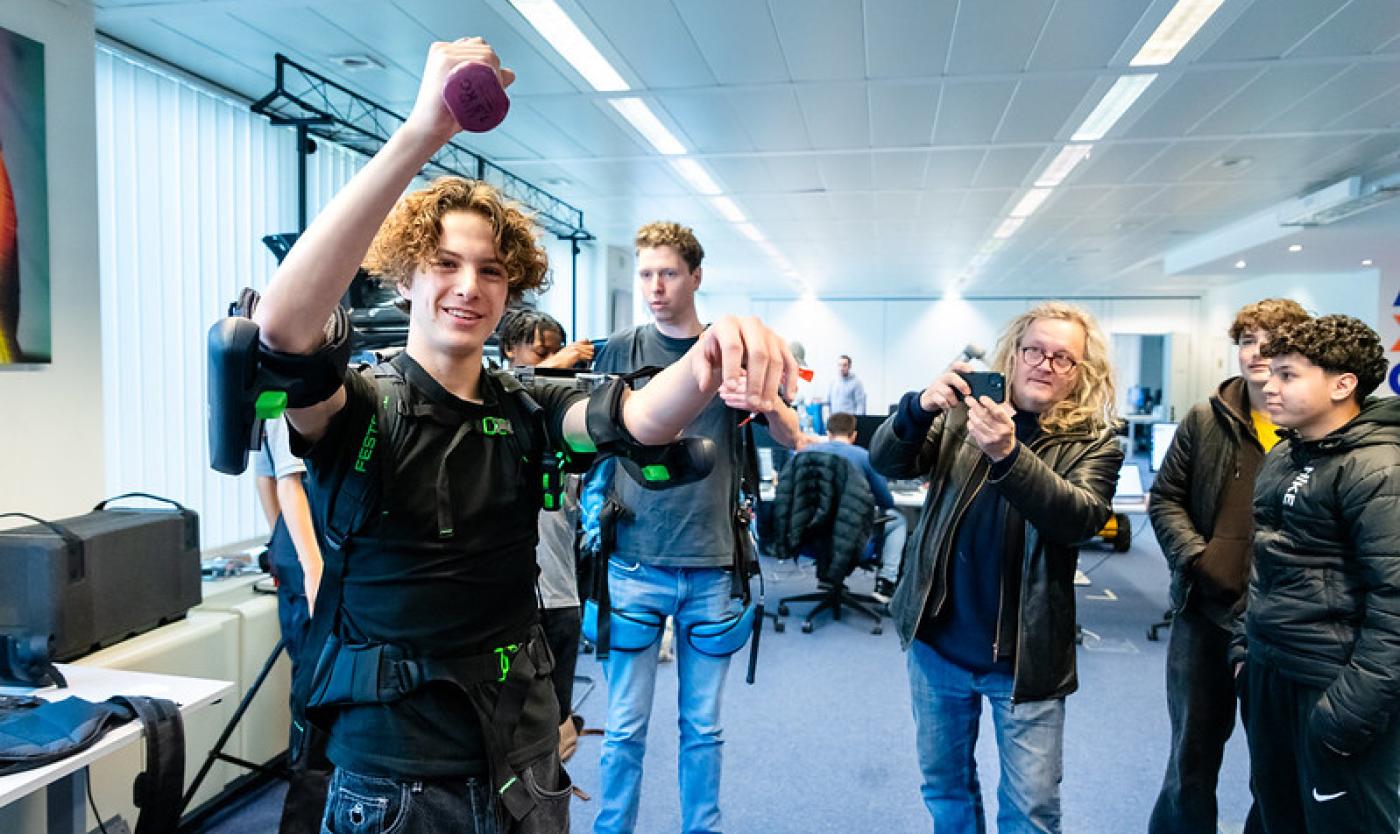


Encouraging young people to choose a STEM pathway or a training programme in healthcare – that’s the aim of the educational activities at the Green Energy Park in Zellik. But sometimes things take a different turn, and suddenly a group of twenty learners with an entirely different background find themselves marvelling at the innovative and sustainable technologies on display.
“Hands in your pockets!” call Marc and Frans, two teachers from the Victor Horta School in Evere, to a handful of pupils about to step inside a small container. You’d expect the opposite instruction, but here it’s crucial that they don’t touch anything. The container is packed with battery cells that power a number of buildings at the Green Energy Park. One wrong move could bring everything to a halt.
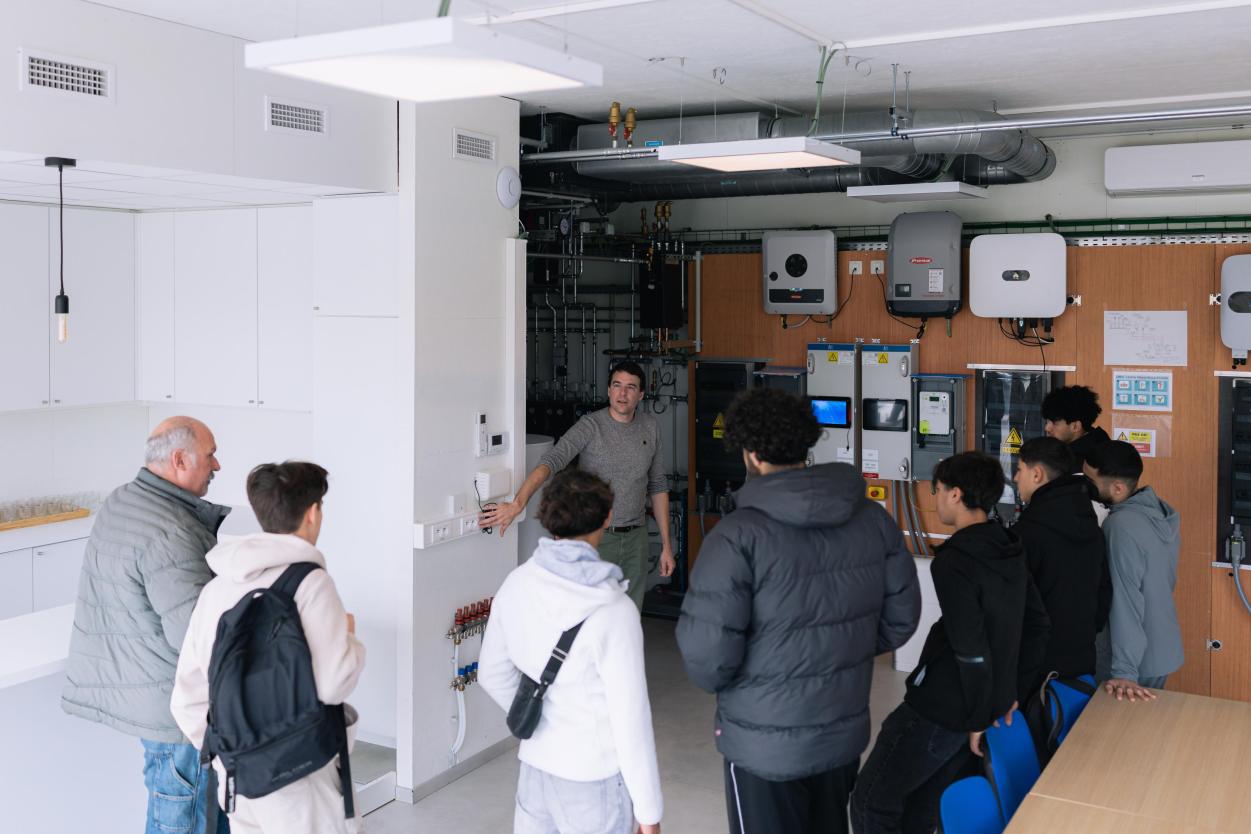
A peek inside this “super-battery” is part of the tour the pupils follow through several buildings and installations on the industrial site in Zellik, which now serves as a living lab for new sustainable energy technologies. Tours like this are one of the educational activities organised by the Green Energy Park research hub, a collaboration between VUB and UZ Brussel.
Today’s visiting group is made up of pupils from the second stage of electromechanical techniques and the third stage of electricity – both vocational or mixed programmes. Not the type who usually head to university after finishing secondary school, but definitely the future professionals who will soon ensure our buildings run on sustainable energy.
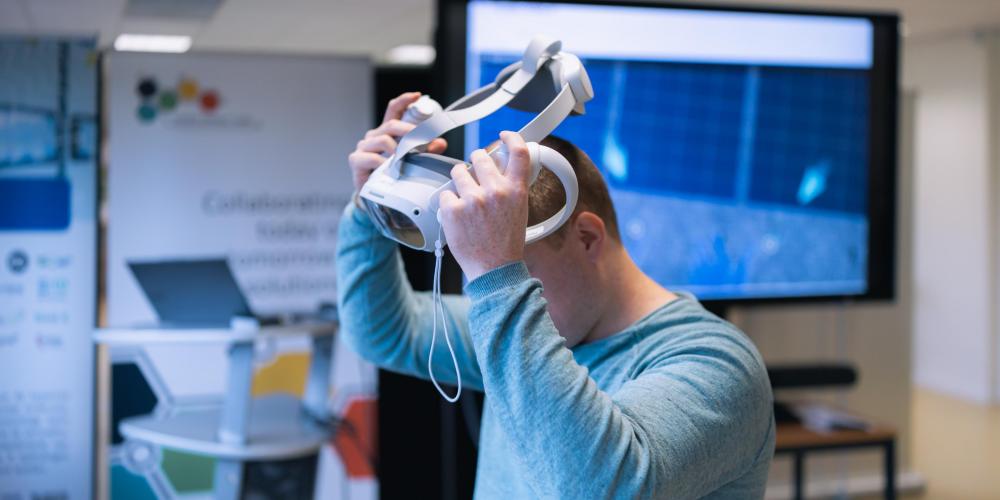
VR headsets
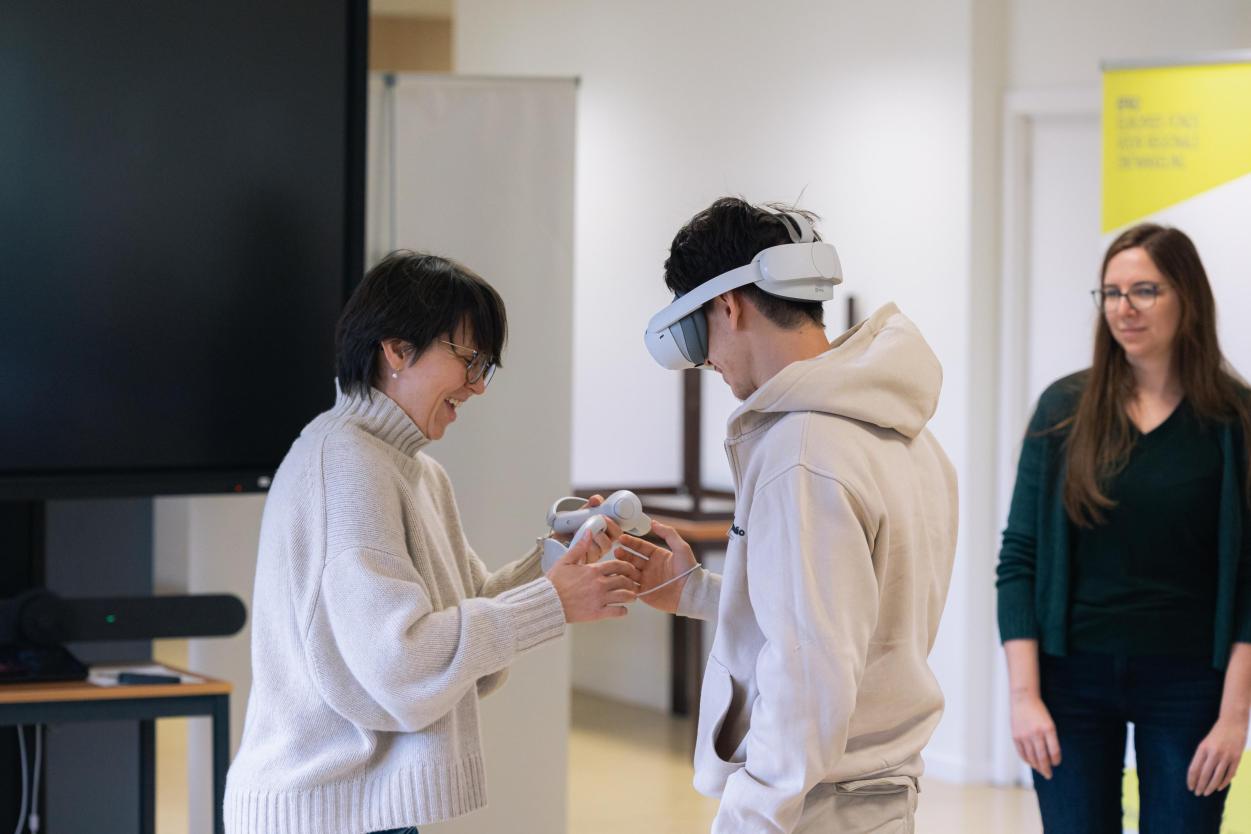
By the time the tour begins, the pupils have already had a compelling morning. Among other things, they explored innovative energy technologies through VR headsets.
For Ali, one of the pupils from the Victor Horta School, it was a great start:
“Those VR headsets were really impressive. But the best part was seeing things in real life that we only hear about at school. We don’t have the latest gadgets there, of course.”
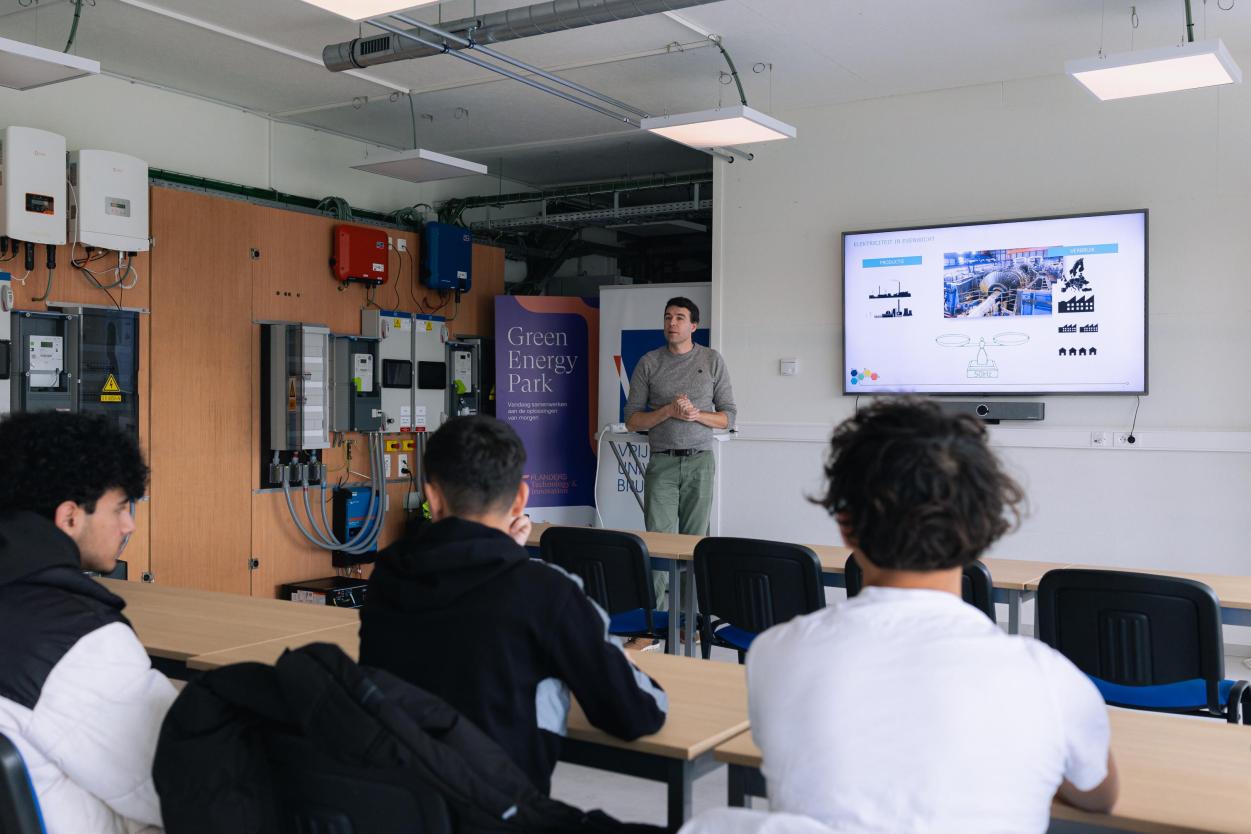
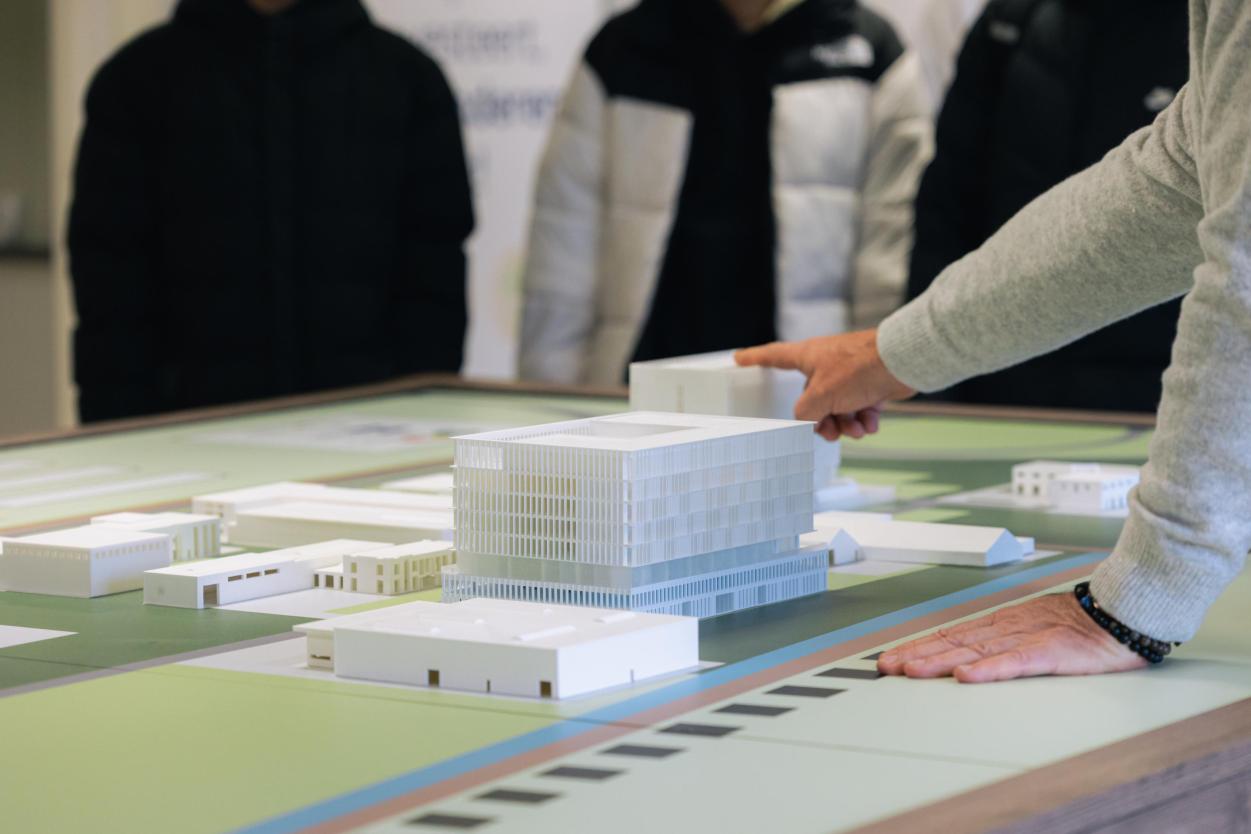
Later that morning, they were also introduced to the Smart Village Lab: six buildings that exchange electrical and thermal energy via a Smart Energy Grid. Here, solar panels can be linked to an electric car, a home battery, a washing machine, a heat pump, and so on. For budding technicians, the future becomes very tangible indeed.
“That was interesting, yes,” says Mohammed, another pupil. “We saw new materials and got loads of information – about solar panels, heat pumps, and much more. I also picked up quite a bit about safety.”
Solar-powered supercomputer
After the battery container – where hands definitely had to stay put – it’s time for various types of charging stations for electric vehicles. These are explained by Lenni Debraekeleer, Living Labs Energy & Mobility Manager and, together with project officer Anna Yastrebova, guide for the day. Charging stations clearly hit the mark with these pupils; they listen quietly and attentively – no small feat for a group of teenage boys. They’re engaged, ask smart questions, and want to know more.
Next up is the data centre, where soon the first supercomputer in Flanders will be unveiled – although this doesn’t leave much of an impression on the group. Calculating the output of the solar panels on the south side of the building also proves to be a bit tricky.
But Lenni knows his audience. Whenever attention begins to slip, he immediately highlights what matters most to them: the practical side of all this tech.
“You need people to develop these technologies, sure. But they’re useless without people to lay the cables, install the solar panels, connect everything safely and efficiently. These are the tasks you’ll build your careers on,” he tells them regularly. And that message clearly lands.
Broadening their horizons
“The goal of most educational projects we run is to spark interest in STEM or healthcare training,” says Danny Dewit, programme coordinator and head of the educational activities. “That’s why we mainly organise visits for pupils in the first and second stages. Today was a bit different; the aim here was to show these learners that they can work on fascinating projects if they complete their training. We also wanted to broaden their horizons – show them there’s much more than what they see at school.”
Training programmes – especially technical ones – inevitably lag behind the latest developments. And what happens in a high-tech environment like the Green Energy Park is usually several steps ahead of the market again. “Visits like this let us show very concretely the world they’ll soon enter, and the role they can play in it,” says Danny.
The educational team at the Green Energy Park works with both technical and healthcare study pathways – sectors that desperately need well-trained staff. For pupils in healthcare programmes, they try to link the visit with one to UZ Brussel, although that’s not always easy to organise. “You can promote these pathways through campaigns, but a visit to a place like the Smart Village Lab has far more impact,” Danny says.
Quick dash to the bus
As the tour progresses, it becomes harder for the boys to stay focused, but they remain polite and do their best not to distract Lenni.
At the final stop before returning to the starting point – the former Roularta building, where one of the largest MRI scanners in Europe will soon be installed – their attention hits a low. But Lenni points out that such an advanced machine only works if the building is properly cabled and cooled. That will create a significant number of jobs for people with technical skills. A few ears perk up, and one pupil even asks about internship possibilities once the project starts.
After a final short stop – this time focusing on sustainability in construction – the visit wraps up. While the teachers, who also learned a great deal themselves, continue to fire questions at Lenni, the boys make a beeline for the bus taking them back to Evere. A visit to the future is fun, but there’s still plenty to explore in the present.