

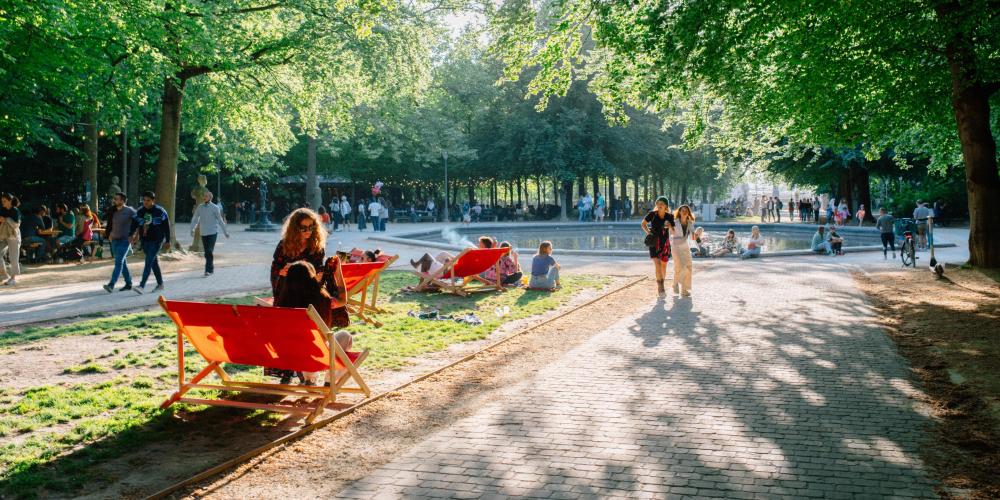


Why does it feel uncomfortable when someone sits down next to you on an otherwise empty train? Why do we almost automatically keep to the right on a busy pavement? According to VUB researcher Mattias De Backer, we are constantly following an invisible “code” in public spaces. In his book The Code of the Street, he explores how people behave in cities, the social rules that govern those behaviours, and why public space is far less chaotic than we tend to think.
What exactly do you mean by ‘the code of the street’?
Mattias De Backer: “By that code, I mean that behaviour in public space is much less chaotic than it appears. There are all sorts of invisible social rules that shape how we interact with strangers. Nobody explicitly teaches us these rules, yet almost everyone understands them intuitively. “Take walking down the street. When two people cross paths, they continuously adjust their speed and trajectory to avoid getting in each other’s way. It happens almost automatically.”
What kinds of rules are these?
“One important rule is what sociologists call civil inattention. You pay attention to other people without staring at them. You scan your surroundings to anticipate the movements of other pedestrians, but then quickly look away again. As soon as you maintain eye contact for too long, things become uncomfortable. After around eight or nine seconds, it can even start to feel impolite.”
Are these rules culturally determined?
“Absolutely. Queuing is a good example. In Britain, people often queue in a very strict and orderly way. In other cultures, things work differently. Before the Olympic Games, China even launched campaigns to teach people how to queue in a more ‘Western’ manner because international visitors had different expectations. It shows just how relative these rules are.”
Has this code changed in recent years?
“Digitalisation has had a huge impact. People are constantly looking at their smartphones or wearing headphones. Many of these social rules depend on paying continuous attention to your surroundings. If you spend all your time looking at a screen, that becomes much harder. “I’m convinced that people bump into one another more often today than they used to, simply because we are so absorbed by our phones.”
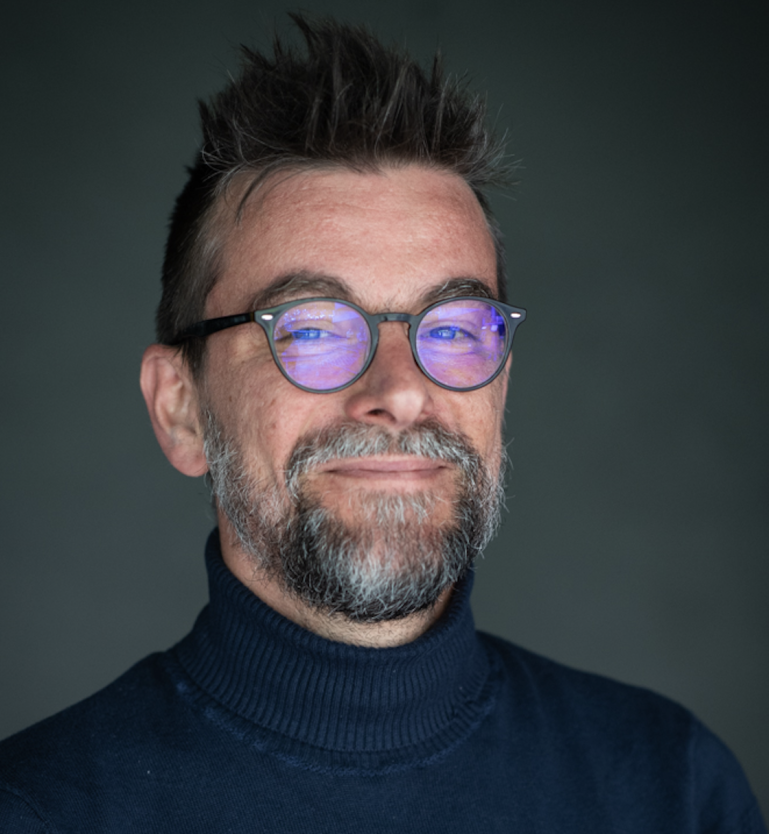
Mattias De Backer
“People like watching other people. That may well be the most important activity in public space”
Does the code work differently in a city than in a village?
“Yes, because public space in a city is much more anonymous. In a village, you regularly encounter people you know. In a large city, you mainly move among strangers, which is precisely why these implicit rules become so important. Yet you also see similar patterns outside cities. For example, I strongly suspect that people in continental Europe naturally pass one another on the right-hand side of the pavement, whereas in England people tend to keep left, just as they do in traffic. There is no official rule, but we do it nonetheless.”
You have researched young people hanging around in Brussels. How do they affect this code?
“As soon as people move around in groups, they tend to pay less attention to their surroundings. Think of tourists who suddenly block an entire pavement. With young people, there is also an element of performance. They use public space as a place to be seen. Interestingly, young people are drawn to the same kinds of locations as adults: places with plenty of footfall, good visibility and lots of activity. People enjoy watching other people. That may well be the most important activity in public space.”
What role does urban design play?
“A huge one. Architecture has a profound influence on how safe or comfortable a place feels. Think about street lighting, visibility and blank walls. Women in particular are often much more conscious of safety in public spaces. They are constantly making calculations: should I cross the street here? Should I avoid that dark passageway? Designers can take this into account by creating environments with good visibility and natural surveillance.”
“We have a tendency to organise everything too rigidly, but public space also needs places that people can temporarily appropriate and transform”
A recent VUB study used the Moment app to examine how safe people feel in specific locations across Brussels. The preliminary conclusion was that context plays a greater role than gender in perceptions of safety. Does that surprise you?
“No, not at all. Of course there is a gender dimension, but context is enormously important. What does a place look like? Is it well lit? Are there other people around? Factors like these strongly influence how safe people feel. That is why this type of research is so valuable: once you link perceptions of safety to specific places, you gain a much better understanding of why certain spaces are experienced as unsafe.”
In your book, you also discuss ‘loose spaces’ or ‘third places’. What are they?
“These are places without a fixed purpose or programme. Spaces where it is not predetermined what you are supposed to do. Such places are becoming increasingly rare. One wonderful example is a cul-de-sac in New York where children spontaneously played on a large pile of mud left behind by roadworks, while their parents sat nearby chatting. It was actually a brilliantly functioning public space. The main attraction was simply a mound of mud. Today, unfortunately, we tend to organise everything very tightly: playgrounds, squares, shopping areas. But public space also needs places that people can temporarily claim and transform.”
Why are these ‘loose spaces’ so important?
“Because they create opportunities for creativity and social interaction. Young people in particular need places that are not completely controlled or programmed. That is why temporary uses of former industrial sites can be so valuable.”
What do you see as the biggest threat to public space today?
“The combination of digitalisation, securitisation and commercialisation. City centres are becoming cleaner, more predictable and increasingly tailored towards tourists, shoppers and events. As a result, some groups feel less welcome. At the same time, we are spending more and more of our lives online. That inevitably affects how vibrant public space will remain in the future.”
“What really matters for safety is informal social control: people paying attention to one another”
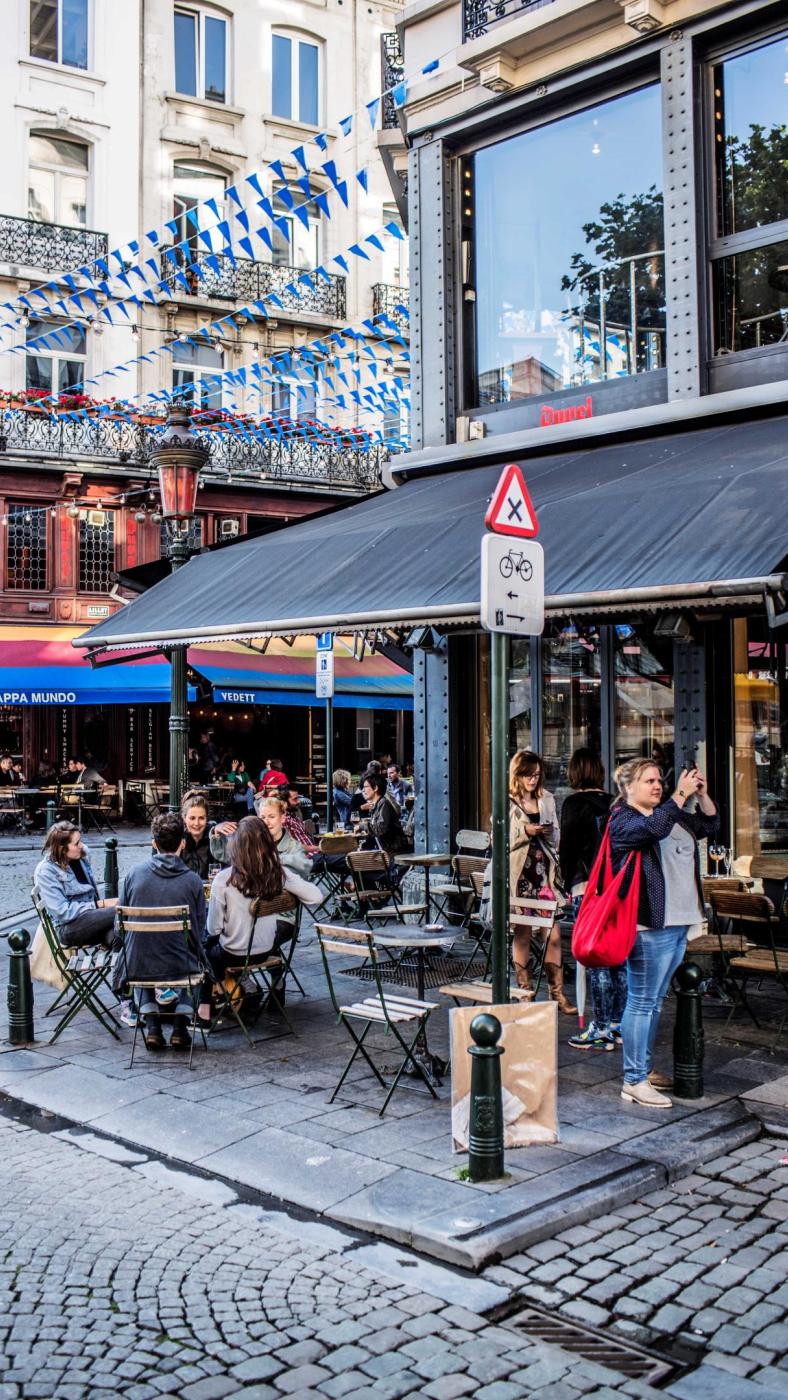
(C) visit.brussels-Marin Driguez
Are you pessimistic about that future?
“I do think public space will be used less intensively than it was in the past. Young people go out less, and a growing share of our social lives is moving online. That worries me because public space remains essential for social interaction and informal social control.”
What misconception about public space would you most like to challenge?
“The idea that public space is inherently chaotic and unsafe. In reality, it is full of subtle forms of order and cooperation. Another misconception is that places with graffiti or litter are automatically dangerous. What really matters for safety is informal social control: people paying attention to one another.”
Does Brussels have its own ‘code’?
“Brussels has a very particular dynamic because of its extraordinary diversity and institutional complexity. That can sometimes create chaos, but it also generates creativity and improvisation. That makes Brussels both frustrating and fascinating at the same time.”
“Research can help us better understand how people actually use public space, and why certain places work while others do not”
What role can universities such as the VUB play in rethinking public space?
“Universities can above all play a connecting role. There is a tremendous amount of expertise spread across different disciplines — criminology, architecture, sociology, mobility studies — but too often these experts work alongside one another rather than together. At the VUB, we try to bring those different perspectives together. Public space is complex: you cannot understand it from the perspective of a single discipline alone. That is why universities should not only conduct research, but also connect researchers, policymakers and city users. Research can help us better understand how people actually use public space, and why certain places work while others do not.”
The Code of the Street
The Code of the Street is the new book by VUB researcher Mattias De Backer. In it, he explores how people behave in public spaces such as streets, squares and railway stations. The book examines social rules, safety, urban design, young people in the city and the future of public space in an increasingly digital society.
Bio Mattias De Backer
Mattias De Backer is a research professor in the Department of Criminology at Vrije Universiteit Brussel and a postdoctoral researcher. Trained as a philosopher and urban geographer, he completed his doctorate at the VUB with research on young people hanging around in public spaces in Brussels.