

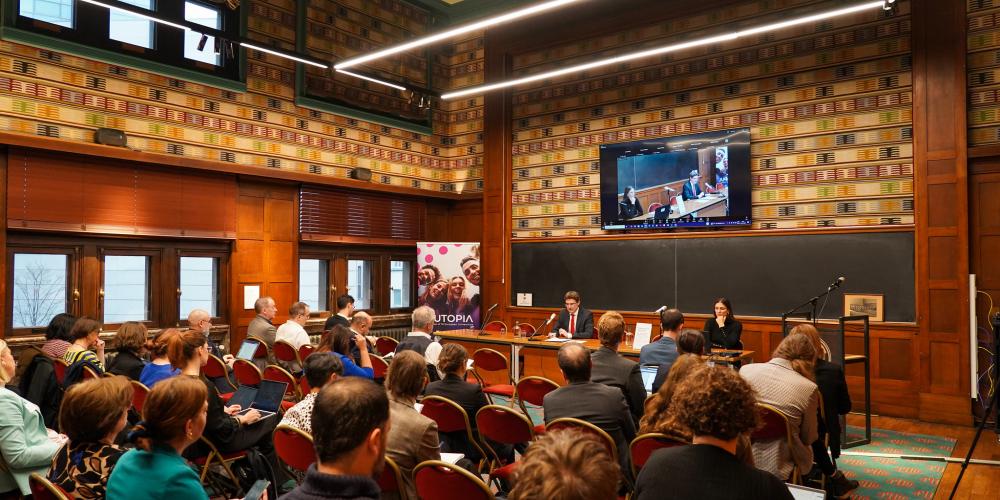


Today’s world is marked by geopolitical tension, growing concerns around research security, and renewed attention to equity in international partnerships. This means universities must rethink how they engage globally. On 28 November 2025, EUTOPIA brought these questions to the forefront at its Responsible Internationalisation Summit, gathering EUTOPIA members, global partners, EU institutions, and representatives from other European University Alliances in a wood-panelled hall of the University Foundation in Brussels.
The summit was not a standalone event. Rather, it marked the culmination of a year-long collective process through which EUTOPIA has been developing a shared understanding of what responsible internationalisation means and how it can be implemented across learning and teaching, research, innovation, and knowledge transfer.
For EUTOPIA, internationalisation has always been central to its mission. However, as global uncertainties intensify, the message emerging from across the Alliance is clear: openness remains essential, but openness without reflection, safeguards, and fairness is no longer sufficient. Responsible internationalisation requires universities to be both principled and proactive, and to recognise the growing interconnections between internationalisation, science diplomacy, and research security.
The summit was preceded by three thematic workshops held between March 2024 and April 2025, each co-designed with European and global partners, and involving experts from outside the Alliance. The first workshop, organised in March 2024 at Stellenbosch University, focused on defining responsible internationalisation and exploring fair partnerships and academic freedom in contexts of geopolitical tension. The second workshop, hosted by CY Cergy Paris University in November 2024, examined responsible research, with particular attention to the balance between openness and research security. The third workshop, held at Ca’ Foscari University of Venice in April 2025, addressed responsible knowledge and technology transfer, exploring questions of equity, social impact, and the ethical management of emerging technologies.
These three strands came together at the Summit. Opening remarks from the European Commission set the tone by emphasising that responsible internationalisation is now essential rather than optional. Europe’s commitment to openness remains strong, but it must be accompanied by trust, due diligence, and shared values. Science diplomacy and research security were presented as mutually reinforcing ways of sustaining meaningful global engagement.
Across panels, participants converged on several core messages. Responsible internationalisation is not primarily about compliance, but about institutional culture change. It is not about doing less internationally, but about doing internationalisation better with intention, reflection, and responsibility at its core. Risk management must be balanced against the risks of disengagement and isolation. European University Alliances can provide stable, values-based frameworks for long-term cooperation, particularly in times of crisis. However, they must also remain attentive to inequalities within alliances and design global partnerships that do not disadvantage under-resourced partners.
The summit reaffirmed the Alliance’s commitment to continuing this work as a collective and evolving endeavour. Rather than offering a fixed template, EUTOPIA aims to translate shared values into practical tools, guidance, and communities of practice that support responsible global engagement across diverse contexts.