



The Vrije Universiteit Brussel conference Medical World Congress on May 9 places aesthetics firmly on the agenda. Not only because the demand for cosmetic procedures is peaking, but especially because there is a need for clearer training and legislation. Plastic surgeon and initiator Ben De Brucker: “Aesthetic Medicine requires specific knowledge and experience.”
Which challenges within aesthetic surgery do you want to address at Medical World?
Ben De Brucker: “Today we see a proliferation of centers and doctors performing aesthetic treatments without sufficient training. That is still legally allowed, but we notice the consequences every day in practice. At the Medical World Congress, we therefore focus not only on techniques, but also on a fundamental question: who is allowed to perform which cosmetic procedure? There is a lot of uncertainty about this, both among doctors and patients. Although there has long been talk of an additional training in Aesthetic Medicine, unfortunately it still does not exist. As a sector, we want to make it clear that aesthetic medicine requires specific knowledge and experience.”
What are the most popular aesthetic procedures today?
“Aesthetic Medicine procedures can be divided into two groups: non-invasive and surgical treatments. Among the non-invasive procedures, botox, fillers, and microneedling remain the most popular, precisely because they are minimally invasive. Botox relaxes the muscles and is mainly used for crow’s feet and forehead and frown lines. Fillers work differently: they add volume where it has been lost. There is often confusion about that. Both treatments work particularly well in an early stage of skin aging, but they have their limits. In cases of pronounced skin laxity, due to age or weight loss, they are no longer sufficient and you move toward a facelift or volume correction with the patient’s own fat tissue. Within surgical procedures, eyelid surgery remains the most common intervention, followed by breast augmentations and face and neck lifts.”
“A clear trend is the shift toward treatments using the patient’s own tissue rather than prostheses.”
What developments do you see today in aesthetic surgery?
“A clear trend is the shift toward treatments using the patient’s own tissue instead of prostheses. This is called lipofilling. Fat is removed, for example from the abdomen, purified, and reinjected to create volume. We use this technique for breast augmentations, but also in the face. The major advantage is durability: after three months the result is stable and, with a constant weight, in principle permanent. In addition, we are seeing more and more non-invasive methods to improve skin contour, such as cryotherapy and other lipolysis techniques that break down fat cells. These yield good results, but only in the right patients: slim individuals with limited fat deposits or skin laxity.”
There is a lot of debate about starting botox too early. Is that harmful?
“Not necessarily. In young patients with clear mimetic wrinkles, early treatment can actually prevent wrinkles from deepening. This is also supported by research. But the message is not ‘start botox at 20.’ Rather: take care of your skin quality. Healthy eating, hydration, not smoking, maintaining a stable weight, and sun protection remain the foundation. A sunscreen with SPF 50 not only protects against skin cancer, but is also one of the best ways to slow down skin aging.”
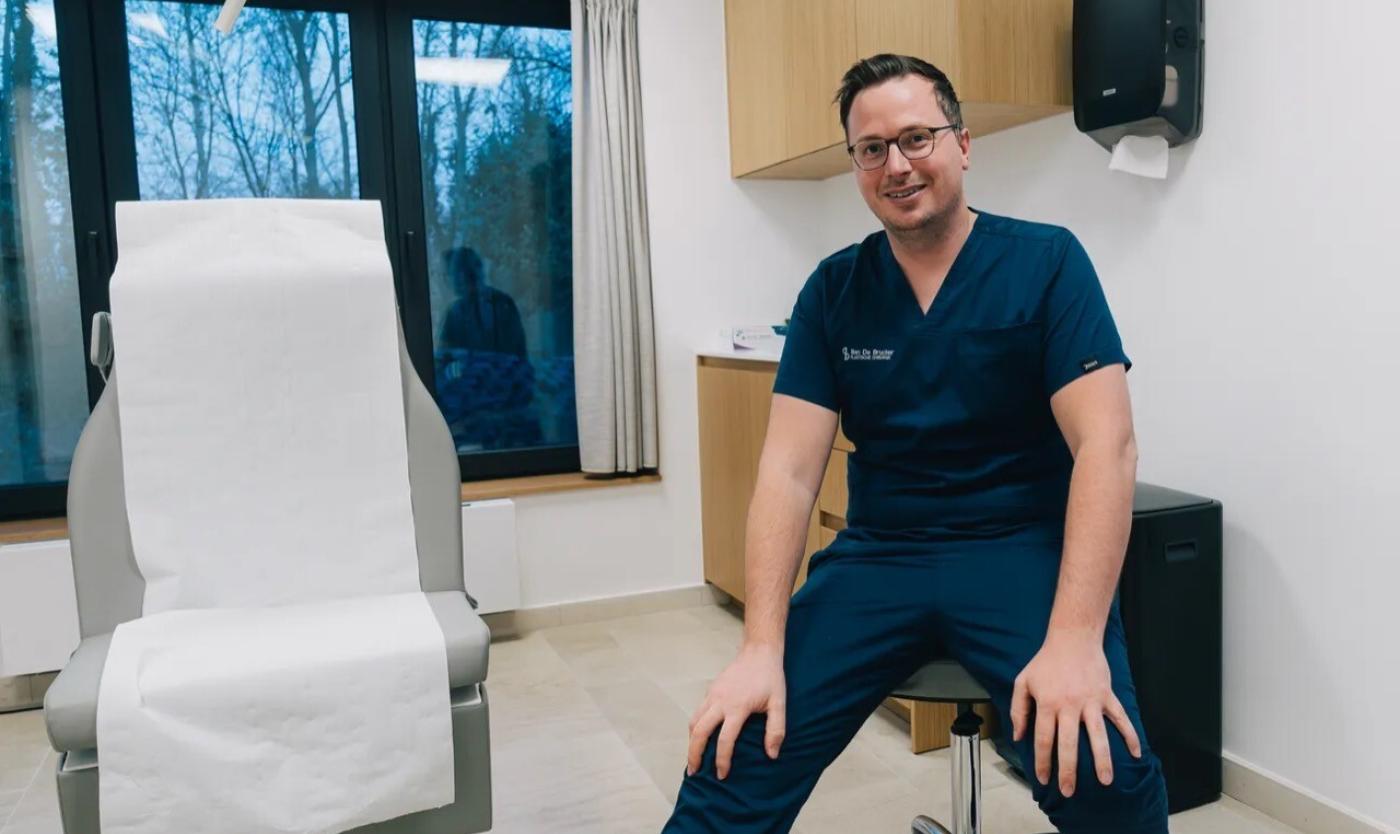
Ben De Brucker: “Many problems arise due to a lack of expertise.”
What health risks are associated with aesthetic procedures?
“Complications in non-invasive treatments are rare. With botox, you occasionally see an allergic reaction or resistance, meaning the product becomes less effective. With fillers, complications are also rare, but more serious. If the product enters a blood vessel, it can lead to tissue necrosis. In exceptional cases, even blindness and death have been reported. That is why it is essential that these treatments are performed by doctors with the right training and experience. Many problems arise from a lack of expertise. With surgical procedures, the risks usually involve classic complications such as bleeding, infection, or poor wound healing, especially in patients who smoke, have Diabetes, or another underlying health condition. Rare but serious is nerve damage after a facelift. With the MACS facelift, the technique I use, that risk is below 3%. In most cases, the nerve damage resolves spontaneously after a few months.”
How sustainable are aesthetic procedures?
“That depends strongly on the treatment. Botox has to be repeated every four to six months, fillers about once a year. A facelift sets someone back ten to fifteen years, but it does not stop the natural aging process. An eyelid correction rarely needs to be repeated. And the idea that breast implants need to be replaced every ten years is also incorrect. Many manufacturers today offer a 20 to 30 year guarantee. Whether you can keep them for life cannot be promised. A breast augmentation at age 20 obviously evolves differently than one at age 50.”
Many people associate plastic surgery with beauty. What is the difference with functional aesthetic surgery?
“In Belgium, about 70 percent of Plastic Surgery is reconstructive. These are procedures that restore function, reduce complaints, and allow people to lead a normal life again. Think of breast reconstruction after breast cancer, but also breast reductions, abdominal wall repairs after major weight loss, and trauma surgery after accidents, burns, or diabetic foot problems.”
“Patients often experience more self-confidence and a better self-image afterwards.”
Where is the boundary between functional surgery and cosmetic enhancement?
“That boundary is not always clear-cut. An abdominal wall correction after weight loss may have an aesthetic effect, but in many patients the excess skin hangs over the pubic area, causing infections, odor issues, and mobility limitations. So the aesthetic aspect is not the main reason for the procedure. The same applies to breast reduction for severe neck and back pain: that has little to do with aesthetics. You always have to look at the context.”
How important is the psychological effect?
“Extremely important, especially in reconstructive surgery. Research at Vrije Universiteit Brussel shows that breast reconstruction after cancer has a clear positive impact on quality of life. But aesthetic surgery can also mean a lot. Patients often experience more self-confidence and a better self-image afterwards. Being able to play a role in that remains special.”
Will plastic surgery ever become completely normal?
“The taboo is smaller, but not gone. Media clichés like ‘botox women’ and ‘frozen foreheads’ do not help. We know from statistics that one in three adults is engaged with aesthetic procedures: far more than people think. At the same time, there is still a clear gender gap: four out of five patients are women, one out of five men.”
Is it true that once you start, you can’t stop?
“There are no hard numbers on that. We do see that the threshold becomes lower once someone has taken the first step. That is also related to the trust relationship between patient and doctor: patients more quickly ask about possibilities. Technically we can do a lot, but not everything. A facelift does not stop time, and genetics cannot be erased. There is also an ethical limit. It is the doctor’s responsibility to push back when expectations go too far. Some patients appreciate that, others look for another doctor. Most people are not aiming for perfection, but for a fresher version of themselves. The best procedure is the one you can hardly see.”
What does Medical World mean to you?
“I started Medical World Congress thirteen years ago as a final-year medical project with a few fellow students. Today, the congress is an established event with about 1,300 participants and 70 speakers. The students of Vrije Universiteit Brussel organize the congress together with a permanent board. It is of great value for the visibility of the VUB Health Campus. Something we can be very proud of. For me personally, it is a way to stay connected to the VUB and University Hospital Brussels. That combination of care, education, and entrepreneurship remains fascinating. What I especially want to convey to young doctors? That besides technical knowledge, ethics and communication are essential. You don’t learn those in textbooks. Especially in Aesthetic Medicine, you must not let yourself be influenced by what patients ask for. You must always remain critical: is this necessary, responsible, and scientifically sound? That reflex is crucial.”
Bio Dr. Ben De Brucker
Ben De Brucker is a plastic surgeon with a particular expertise in breast reconstruction and aesthetic breast and facial surgery. At University Hospital Brussels, he serves as a consultant for breast cancer patients. In addition, he is head of the Department of Plastic Surgery at CHU Tivoli in La Louvière and founder of Sano Clinic in Meise. At the beginning of 2026, he was elected Secretary-General of the Federatie Medisch Specialisten (FMS), where he represents the interests of medical specialists in negotiations with the government.