

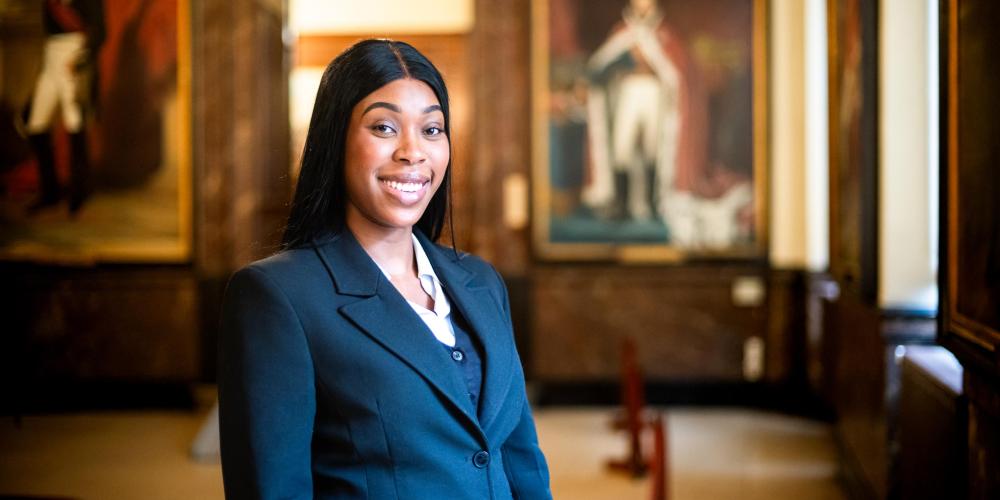


Christil Asamoah (28) works as Decolonisation Coordinator at 11.11.11, where she helps drive structural change within the organisation. Alongside her role there, the Political Science alumna also supports smaller companies and organisations on issues of equality and inclusion. “For me, freedom of thought only becomes truly meaningful when it goes hand in hand with equality.”
What exactly does your current role involve, and what interests you most about it?
Christil Asamoah: “In my main role, I work as Decolonisation Coordinator at 11.11.11, where I guide organisational change processes focused on equality and inclusion. I help rethink how we can make our organisation more open and fair — not only in terms of vision, but also in structures and decision-making. One example is the work we are doing to give our international partners a stronger voice at a strategic level. Alongside that, I work independently with smaller organisations on similar themes. What fascinates me most is seeing how small shifts in mindset and ways of working can create a real and lasting impact.”
“The VUB gave me the space to take a stand and engage in dialogue”
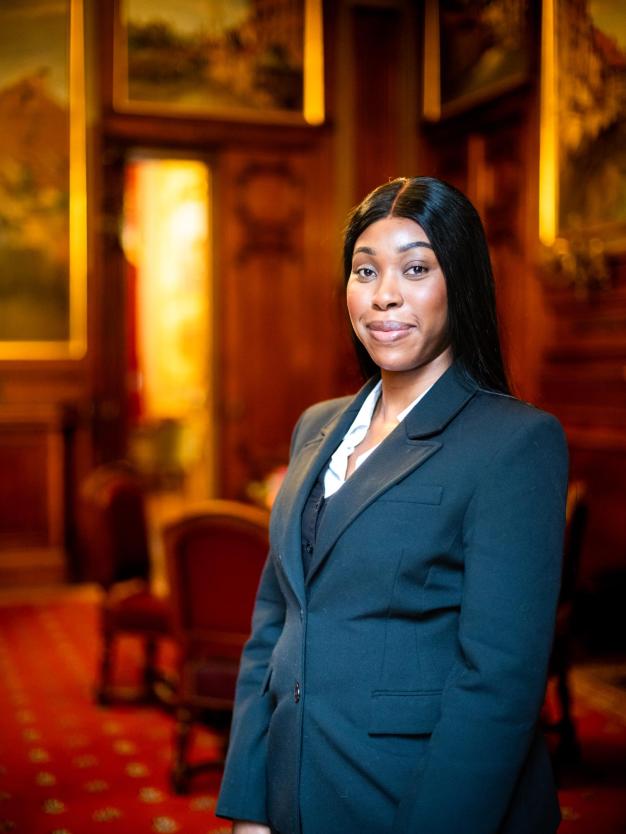
What memories do you have of your time studying at the VUB?
“I look back on my student years with great warmth. When I started Political Science, I was still searching for who I was and what I stood for. During my years at the VUB, I truly got to know myself. The conversations with professors, the debates in lecture halls, and even the difficult moments while studying all shaped me. Year after year, my confidence grew and I learned to use my voice more strongly. The VUB gave me the space to take a stand and engage in dialogue.
One particularly meaningful memory is my collaboration with Professor Vjosa Musliu, who supervised my thesis. Her critical and analytical approach to teaching, combined with warmth and openness, deeply inspired me.”
Did you already have a clear idea of what you wanted to do after graduating?
“Not at all. Political Science is a broad field, and at the time I had no clear plan. I even considered continuing my studies because I was unsure which direction to take. Through my thesis, I had the opportunity to contribute to a pilot project on decolonisation at the university. It was initially meant to last just one year, but in the end it laid the foundations for the work I do today.
At first, I doubted whether I really wanted to focus on themes such as diversity and decolonisation, because those topics were far less established at the time. But thanks to the support I received, I discovered how deeply this work resonated with me, both intellectually and personally. In the end, it became my professional path.”
“Differences do not make people opponents; they make conversations richer”
Has the VUB strongly influenced the way you think?
“Absolutely. The VUB taught me that freedom of thought goes hand in hand with recognising different perspectives. During classes and debates, I was encouraged not only to form my own opinions, but also to listen to others. I learned that someone who thinks differently is not necessarily standing against you. Differences do not make people opponents; they make conversations richer. That is an attitude I try to carry into my work today: creating space for diverse voices without immediately trying to convince or overpower others.”
How do you interpret the ‘V’ in VUB, and how do you carry that into your work?
“For me, the ‘V’ stands for freedom: freedom of thought, freedom of speech and freedom to be yourself. But it also stands for equality. As a student, I mainly experienced academic freedom. Later, when I worked at the VUB, I also gained insight into the organisation behind the scenes. That is when I noticed how much thought and effort went into equality and inclusion.
Today, I try to place that combination of freedom and equality at the centre of my work. Freedom only becomes meaningful when everyone genuinely has the opportunity to make their voice heard.”
Do you think life is different for students today?
“I think so. Technology and social media mean the world reaches young people faster and more intensely than ever before. Students are constantly confronted with global crises and social tensions. That can feel overwhelming. At the same time, that same technology also creates opportunities. The challenge, in my view, is preserving critical thinking. How do we make sure students are not simply consuming information, but also analysing and contextualising it? That remains essential, especially within Political Science.”
How are you trying to make a difference in society today?
“I try to create impact on different levels. In my professional role, I work on structural change within organisations. Alongside that, I founded a small community where I help people discover their purpose: who are you, who do you want to become, and what kind of impact do you want to have?
I notice that many young people compare themselves to others on social media and feel they have to become someone else. My own experience at the VUB taught me the opposite: there is real value in being different. That is the message I want to pass on — your unique, complex self deserves to be seen.”
“Look beyond the daily headlines. Analyse trends, understand complexity and never lose sight of historical context”
What do you still dream of achieving in your career?
“I have many dreams, but above all I am grateful for where I stand today. My biggest ambition is to inspire even more organisations through the work I do. I want to be a voice for people who do not always have the platform to be heard. If I can help create fairer and more inclusive working environments for many people, then that is success to me.”
Do you have one golden piece of advice for students graduating today?
“Be resilient. Life comes with ups and downs, and not everything will go according to plan. Do not let setbacks discourage you. If you believe in something, pursue it wholeheartedly. And above all: stay true to yourself and to your unique, complex identity.”
And specifically for Political Science students?
“Now more than ever, a great deal is happening in the world. That can feel overwhelming. So try to look beyond the daily headlines. Analyse trends, understand complexity and never lose sight of historical context. Political systems and institutions are under pressure, but do not let that become a reason to lose hope. Find a balance: remain critical, but continue to believe in the possibility of change.”
Curious about the forces shaping world politics?
Discover VUB's study programmes:
Microcredentials and postgraduates: Democracy: challenges and futures EU Policy Making
Bachelors: Politieke wetenschappen Social Sciences
Masters: European Integration European and International Governance
ALL PROGRAMMES IN ENGLISH ALL PROGRAMMES IN DUCTH