

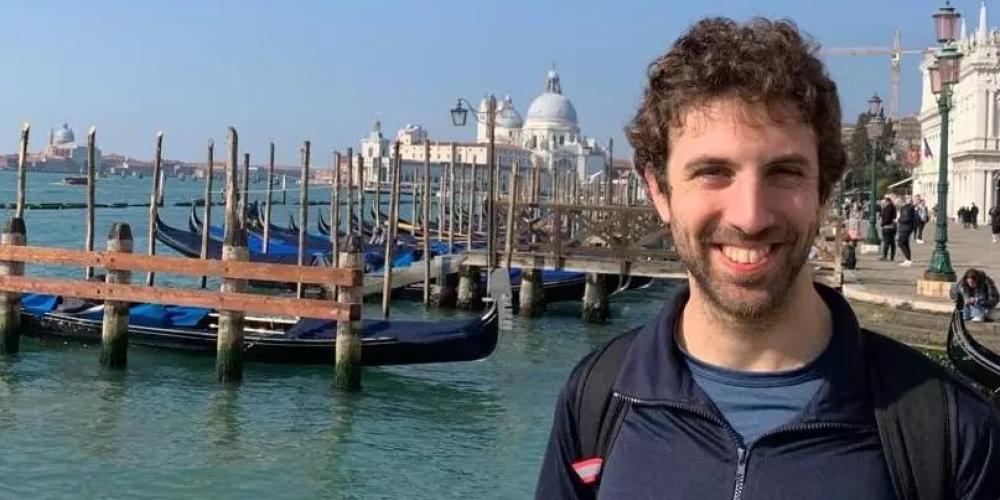


The Belgian Mathematical Society has awarded its 2025 Young Scholar Award to Kevin Iván Piterman, a postdoctoral researcher at the Vrije Universiteit Brussel. This year marks an exceptional edition of the prize: for the first time, two laureates have been selected in the same year, highlighting the outstanding calibre of the winners. Alongside Piterman, Stijn Cambie (KU Leuven) was also honoured.
The Young Scholar Award is presented annually by the Belgian Mathematical Society to a young mathematician who excels in scientific research and maintains a strong connection to Belgium. Although Piterman hails from Argentina – where he earned his PhD at the University of Buenos Aires in 2019 – he is currently a postdoctoral fellow at the VUB, funded by the Research Foundation – Flanders (FWO).
His research spans a broad area within mathematics, working at the crossroads of algebra and geometry. He focuses in particular on mathematical structures that describe symmetries and explores how these behave in space.
The award recognises not only his impressive list of publications, but also his contribution to the international mathematical community. “Kevin combines deep theoretical insight with a creative approach to complex problems,” says his supervisor Leandro Vendramin. “This recognition is a well-deserved acknowledgement of both his work and the efforts of the algebra research group at VUB.”
Award met warm onthaal
Kevin Piterman: “VUB is an excellent environment for young researchers”
What does receiving the Young Scholar Award mean to you personally and for your career?
Receiving the Young Scholar Award is a great honour and makes me feel truly welcomed into the Belgian mathematical community, which I joined only recently.
For my career, it is both an encouragement and a responsibility: it confirms that my long-term projects are valued, and it motivates me to use this visibility to support students and younger researchers, especially those building their careers far from home.
Which aspects of your research do you find the most exciting or innovative?
I am most excited by how abstract mathematics can uncover hidden structure in very concrete objects. I study how algebraic objects—such as groups of symmetries—give rise to high-dimensional geometric spaces, and how the group-theoretic and topological properties interact. What I find particularly innovative is using tools from algebraic topology to answer precise questions in group theory and representation theory, and vice versa, often in situations involving "simple groups". I also enjoy combining theoretical work with explicit computations using computer algebra, which lets us test conjectures and explore examples that would be inaccessible by hand.
How has your international experience – from Buenos Aires to Marburg and now Brussels – influenced your approach to research?
Starting in Buenos Aires, I worked in a very strong but relatively local research environment. My first experiences abroad, especially in Marburg and through visits to places like Oberwolfach, opened up the international side of mathematics and gave me both visibility and confidence. They also broadened my interests, showing me how fruitful it is to combine ideas from topology, algebra, combinatorics, and computation. Now in Brussels, I see my role as building a stable base from which I can grow into a research leader, connect different communities, and help newcomers—especially international students and early-career researchers—integrate and thrive.
What attracted you to the mathematics team at VUB?
I was initially attracted by the opportunity to work with Prof. Leandro Vendramin and by the excellent research conditions offered through the FWO fellowship that supports my position. His broad network and vision have been very important for my development as an independent researcher. When I first visited VUB, I was struck by how active and lively the department is: people are constantly discussing mathematics on the blackboards and helping each other across different areas. That everyday atmosphere convinced me that VUB is a place where I can both grow scientifically and contribute to a vibrant research community.
In your view, what makes VUB a leading place for mathematical research?
For me, what makes VUB a strong place for mathematical research is the quality and energy of some of its research groups. In my area, there is a very active cluster around algebra and combinatorics, led by colleagues who are internationally visible and who work hard to create a genuine research community. Being part of this group gives me the freedom to pursue ambitious long-term projects, while also having close collaborators just down the hall.
VUB also offers a very good environment for young researchers. The combination of external funding (such as FWO fellowships) and a relatively small department means that postdocs and PhD students are not just “extra hands”, but play a real role in the scientific life of the group. We regularly host visitors, organise seminars and workshops, and interact with colleagues in Belgium and abroad, so the research atmosphere feels much bigger than the department’s size.
Finally, being in Brussels is also a real advantage: we are at the heart of Europe, with easy connections to many major universities and research centres. This makes it natural to build collaborations and to bring people here. I think VUB has all the ingredients to continue growing as a visible and attractive place for mathematics, and I am excited to contribute to that.