

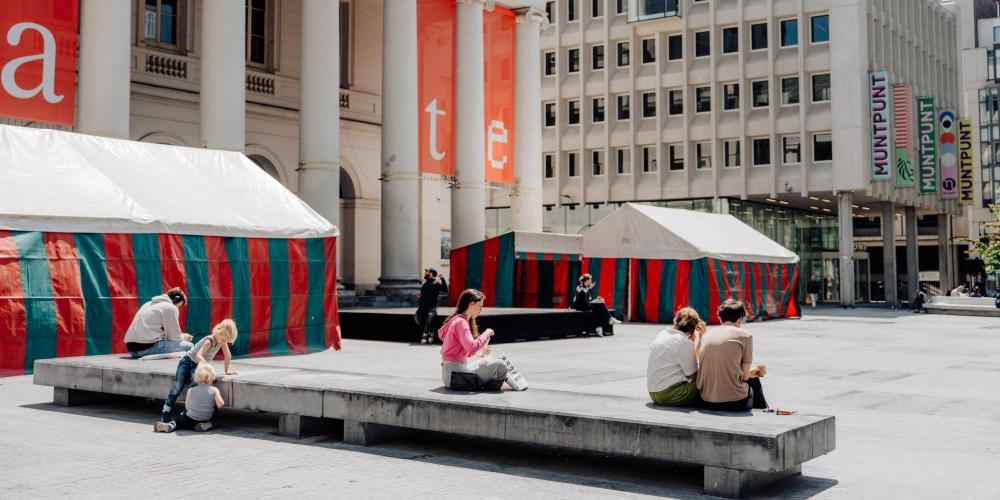


On the occasion of International Migrants Day, VUB researcher Tulya Su Güven reflects on the importance of so-called ‘third places’. “If policymakers are serious about integration, they cannot ignore the significance of public space.” The opinion piece was published in Knack.
Moving to a new country often means rebuilding your life from scratch: learning a new language, meeting new people, establishing new routines, and finding new ways to organise your daily life. At first, certain structures help provide a sense of stability—whether it's work, school, or a language course.
But once you step out of the classroom or office, other questions arise: where do I go after work, who do I relax with, and where do I feel at home in this new environment? Yet these questions are routinely overlooked in debates on integration, despite being essential for newcomers seeking a sense of belonging in a new country.
That feeling of belonging has become increasingly elusive and abstract. For most of us, it develops quite naturally as we grow up. We're surrounded by family, classmates, neighbours and childhood friends, and our bonds are formed and nurtured in and around specific places: a cheap bar where we spent hours, or a bench in the park. Together, these people and places form a network of connection that gives us a sense of home—wherever that may be. Migration reshapes that network entirely.
This is what we call the socio-spatial dimension of life: the way relationships are anchored in the environments in which they unfold. The path to belonging often starts here, in small, everyday moments—new connections, the feeling of being recognised, and spaces where you can simply exist without having to explain or justify yourself. And yet, this dimension rarely features in conversations about integration, even though everyday public spaces—like a park or the waiting room of a community centre—are absolutely vital.
Maybe a colleague you met at a work drinks event becomes a close friend, or the mosque, church or student bar you once entered alone becomes the first place that truly feels like home.
The importance of these spaces becomes even clearer when we look at how they’re changing. In The Great Good Place, sociologist Ray Oldenburg introduced the concept of “third places”: cafés, hair salons, parks and libraries—open, accessible spaces embedded in the everyday life of a local community. As far back as the late 20th century, he warned that such places were under threat, squeezed out by an increasingly consumer-driven and individualistic society.
Today, those pressures have only intensified: digital interactions are replacing in-person encounters, streamlined workplaces leave little room for informal chats, and public spaces are becoming ever more commercialised.
These shifts affect everyone, but they’re particularly acute for newcomers. As access to such spaces becomes more difficult across the board, the barrier is even higher for those who’ve only just arrived. Third places serve as gateways: spaces where people can ease into local life, gradually build connections, share experiences, and pick up the small but crucial bits of information that make a new beginning possible.
In my own research on newcomers in Belgium, I examine how these spaces shape their experiences of settling in, how they help build social ties, and how they support a sense of belonging. If we truly want to welcome newcomers, focusing solely on housing and the labour market isn’t enough.
If policymakers are serious about integration, they must actively protect, support and create these everyday spaces. That means investing in accessible public areas, community centres, parks and meeting places—and recognising them as core pillars of integration policy. Because if we want people to feel at home, we need to make room for connection. Belonging is a slow process, both spatial and social. It grows through routine, proximity, and small gestures—in deep as well as fleeting encounters that together lay the groundwork for something more. And for newcomers, that process sometimes begins in the most unexpected places.
Tulya Su Güven is an FWO researcher at BIRMM & BRISPO, Vrije Universiteit Brussel (VUB).