

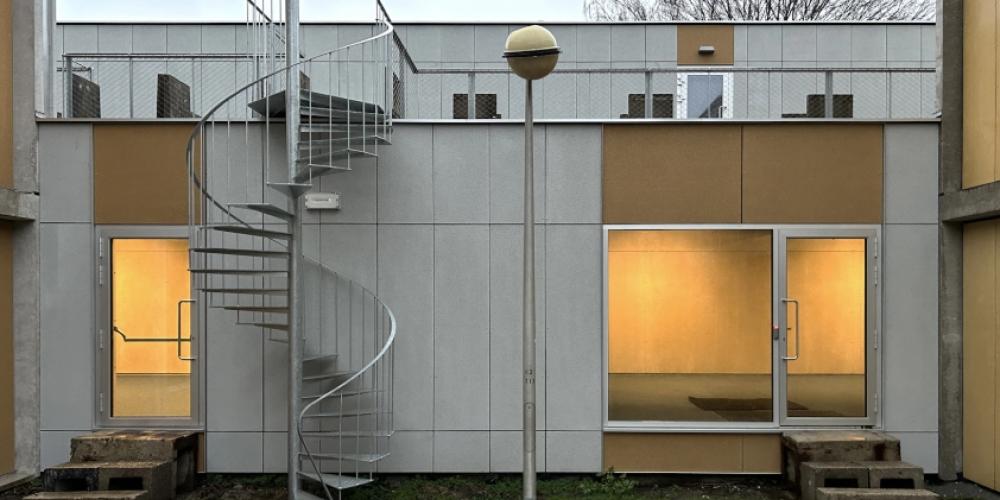


The WVDM Living Lab at VUB has officially been named a winner of the Henry van de Velde Awards 2026 in the Environment category. A strong recognition. And not the only one. This year, the project was also one of just five nominees in the Small Intervention category of the Brussels Architecture Prize. Today, the Living Lab stands out as a leading example of circular architecture, recognised at both Brussels and Flemish level.
Update: Silver Award for WVDM Living Lab
The WVDM Living Lab has officially won the Henry van de Velde Environment Silver Award 2026.
During the award ceremony on 27 January 2026 at Bozar, the project was recognized for its strong contribution to circular architecture and future-oriented renovation.
From heritage to a future-ready model
The WVDM Living Lab starts from a sharp and timely question: how can post-war architecture be renovated sustainably, without losing its identity?
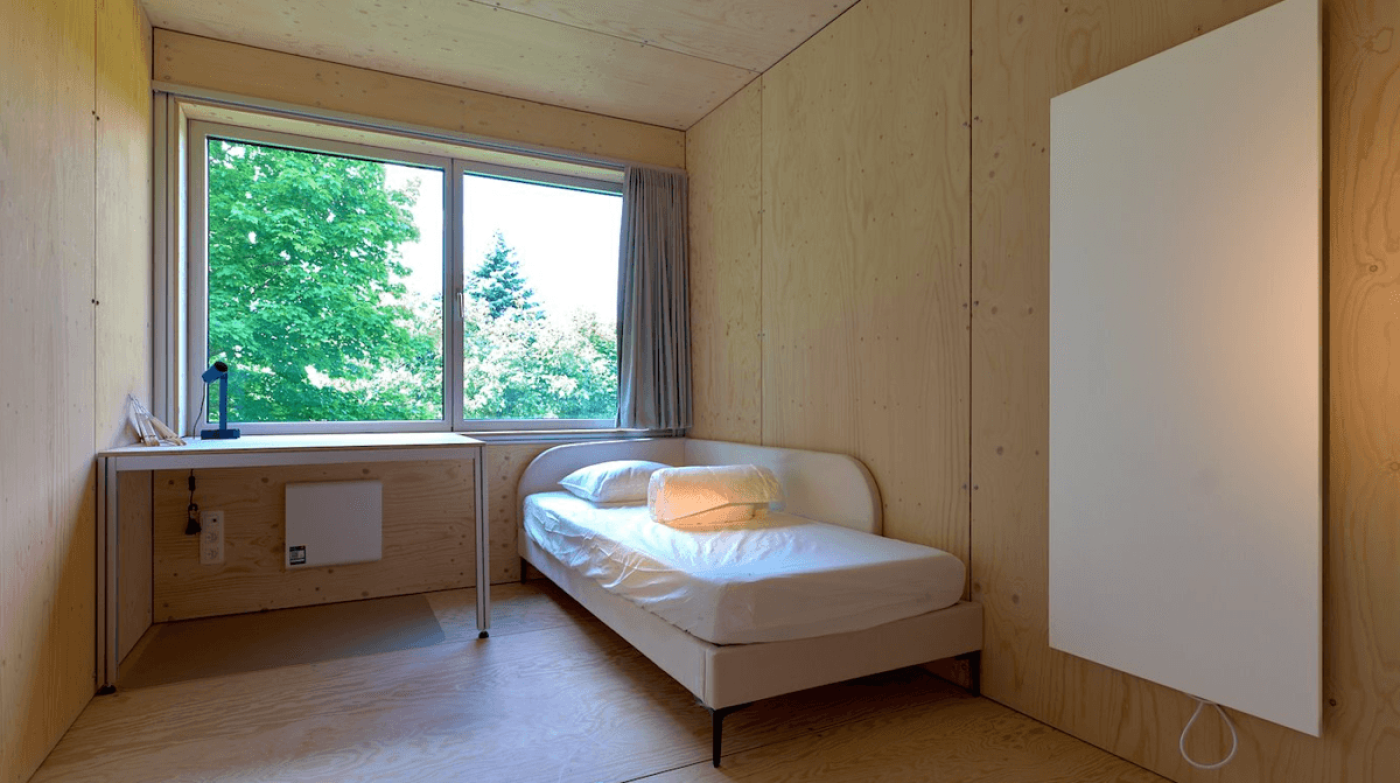
The case is both iconic and concrete. Twelve modules of former student rooms on the VUB campus, designed in 1972 by Willy Van Der Meeren, were used as a testing ground. Not a conventional renovation, but a research-driven process, with reuse, adaptability and scalability at its core.
The focus was not on a fixed end result, but on developing reproducible circular strategies. Think of building like a meccano set: with standardised, compatible components that can be assembled, disassembled and reused.
Circular down to the detail
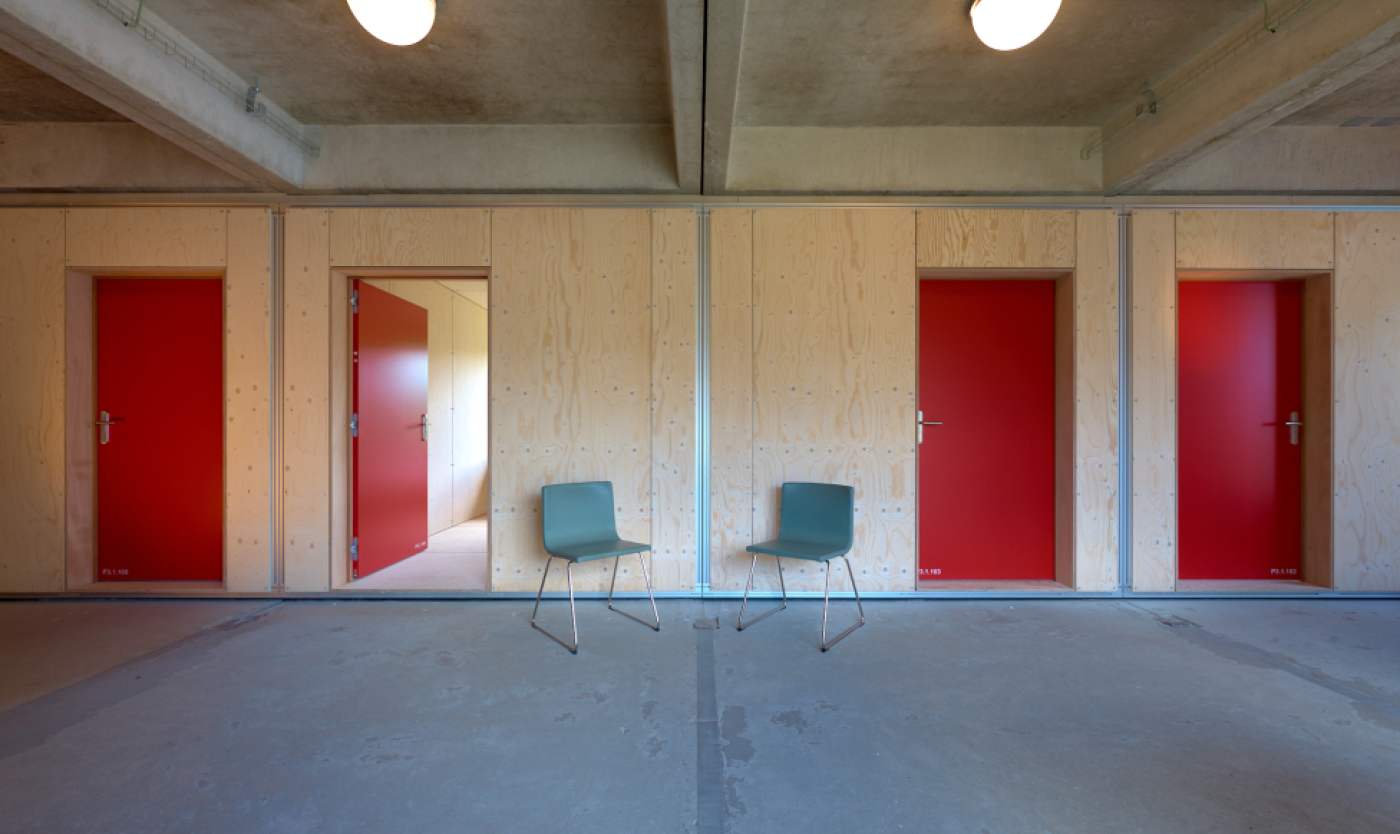
The Living Lab is based on the kit-of-parts principle. The building envelope and interior walls consist of manageable components that are technically reversible. The result is an architecture that can adapt as needs change.
During construction, the emphasis was firmly on maximising material reuse—both on site and elsewhere. From load-bearing structures and sanitary units to lighting fixtures, carpet tiles and kitchen elements. Where new materials were required, choices were made deliberately for low-impact options, such as grass-fibre insulation, timber structures and mineral-based boards.
The project brings theory and practice together. The developed strategies were assessed using four pillars: energy, heritage, sustainability and economy. This approach called for new skill sets and close collaboration with local experts.
According to the Henry van de Velde Awards jury, the Living Lab demonstrates how existing materials can play a role not only today, but also tomorrow, in future-oriented building systems. With respect for the original design language. And with a clear invitation to the sector to think beyond traditional renovation models.
Scaling up, on campus and beyond
The impact goes well beyond these twelve modules. On the VUB campus, 56 additional student rooms have already been renovated using one of the developed strategies, with a similar trajectory planned for the next phase. The research also continues within MAKER architects. The growing database of details, materials and evaluation tools is now actively used in new projects. Always layered. Always reversible. Always tailored to context and use.
Contact
This Living Lab is the joint effort of the research group VUB Architectural Engineering and the VUB Infrastructure, funded by Innoviris and VUB. Don't hesitate to reach out to our researchers at VUB Architectural Engineering (Waldo Galle, Stephanie Van de Voorde, Niels De Temmerman, and Ine Wouters) directly or via livinglab.arch@vub.be for a lecture, tour and collaboration.
Read more about the WVDM Living Lab on the Henry van de Velde Awards website: WVDM Living Lab | Henry van de Velde Awards