

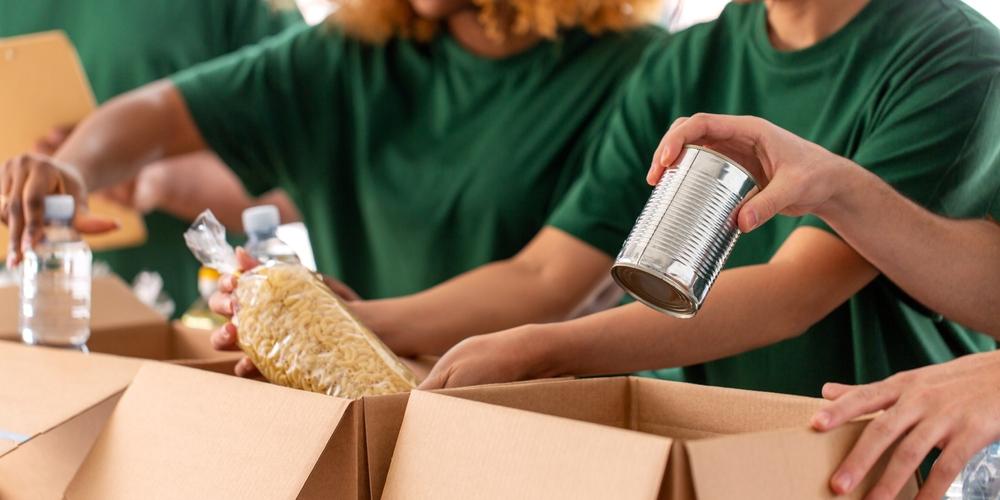


In the new thematic volume JONGeren in Meervoud, VUB researchers reveal how young people’s participation in volunteering continues to be strongly shaped by social inequalities: who you are, which school you attend and the networks you have largely determine whether you find your way into civic engagement. VUB researcher Fien Pauwels: “Young people with a migration background are still too often not seen as the ‘ideal volunteer’.”
The new thematic volume JONGeren in Meervoud has been published, with three VUB researchers — Fien Pauwels, Bram Spruyt and Jessy Siongers — making a substantial and striking contribution. Their research into youth volunteering forms a central chapter of the book and sheds new light on the social inequalities that determine who is able to engage and who is not. Building on insights from the JOP metropolitan monitor, the volume brings together recent analyses of young people’s lived realities in Flanders and Brussels. In the chapter “Social Differences in Volunteering in an Increasingly Diverse Society”, the VUB team examines who participates in formal volunteering today — that is, engagement within an organisation — and why some young people find it far harder to get involved.
Based on research among more than 2,300 young people, the study shows that formal volunteering remains strongly socially patterned. Young people from families with a higher socio-economic status are significantly more likely to volunteer, while those of Turkish or Moroccan background participate considerably less. Gender in itself explains little, but differences become far more pronounced when gender intersects with other forms of inequality.
According to Fien Pauwels, this means that young people who themselves belong to vulnerable groups remain underrepresented in organisations that often focus precisely on social vulnerability. “Some young people are underrepresented in organisations that actively support people in difficult circumstances,” she says. She also points out that inequalities can reinforce one another: girls of Turkish background, for instance, are even less likely to volunteer than their male peers. Pauwels highlights the role of perceptions within organisations: “Young people with a migration background are still too often not seen as the ‘ideal volunteer’, and as a result they are recruited less frequently.”
One striking finding is that young people who are already informally engaged — by helping friends, taking on caring responsibilities or contributing to household tasks — are much more likely to move into formal volunteering. Similarly, young people who are members of an association more easily find their way into organised engagement. As Pauwels puts it: “Engagement breeds engagement. Young people who contribute to others and their community in one way or another are more inclined to do so in a formal context as well.”
This runs counter to the so-called time-scarcity hypothesis, which suggests that young people lack the time to combine different forms of engagement. The VUB data offer little evidence of this: engagement in one context appears to act as a stepping stone to engagement in another. Pauwels argues that organisations can respond by lowering thresholds and offering flexible entry points: “If young people can get involved occasionally without too many rules or rigid structures, their engagement can grow naturally over time.”
“Socialisation through education strongly determines who gets the opportunity to volunteer.”
Education also emerges as a particularly strong predictor of participation in volunteering. Pupils in vocationally oriented tracks (BSO) and programmes with a dual finality (TSO) are far less likely to engage than those in academically oriented tracks preparing for higher education (ASO). These differences are linked to time pressure, more limited networks and the ways in which young people are — or are not — approached by organisations. According to Fien Pauwels, the implicit image of the ‘ideal volunteer’ plays a significant role here. That image typically aligns with young people from a higher socio-economic background and without a migration background, meaning others are less readily perceived as natural volunteers.
“Socialisation through education strongly determines who gets the opportunity to volunteer,” Pauwels explains. “Those who resemble the people already active in volunteer organisations are more quickly seen as obvious candidates for volunteering.”
The researchers conclude that volunteering can empower young people, but that it still too often reproduces existing inequalities. There is a need to lower thresholds and to recognise informal engagement more broadly as a valuable form of involvement. Pauwels captures the essence of the research succinctly: “Young people do not have the same opportunities to engage in formal volunteering. Anyone who wants to tackle inequality must examine how organisations themselves may help sustain it — and how young people who are already engaged can be encouraged to continue.”
“Inequality is not confined to volunteering, but extends into other areas of life.”
In the original chapter, organisations and young people themselves were also given a voice. Their insights echo Pauwels’ findings: young people feel most engaged when they feel safe, seen and recognised; when they experience a sense of ownership; and when they are trusted. Engagement works best when it is offered in a flexible and accessible way, allowing young people to get involved at a pace that is manageable for them. Recognition often proves to be a stronger motivator than financial incentives or formal expectations. Taken together, these elements show how organisations can make their recruitment and support more inclusive.
Finally, the book makes clear that inequality is not confined to volunteering, but extends into other areas of young people’s lives. Young people from financially vulnerable families, girls and young people with disabilities often have less autonomy and fewer accessible leisure spaces, while participation in associations can create additional pressure for some. In the field of support services, young people encounter barriers such as shame, unfamiliarity, mistrust or uncertainty about where to turn. This broader context underlines the importance of not viewing volunteering in isolation, but as part of the structural inequalities that shape young people’s everyday lives.