

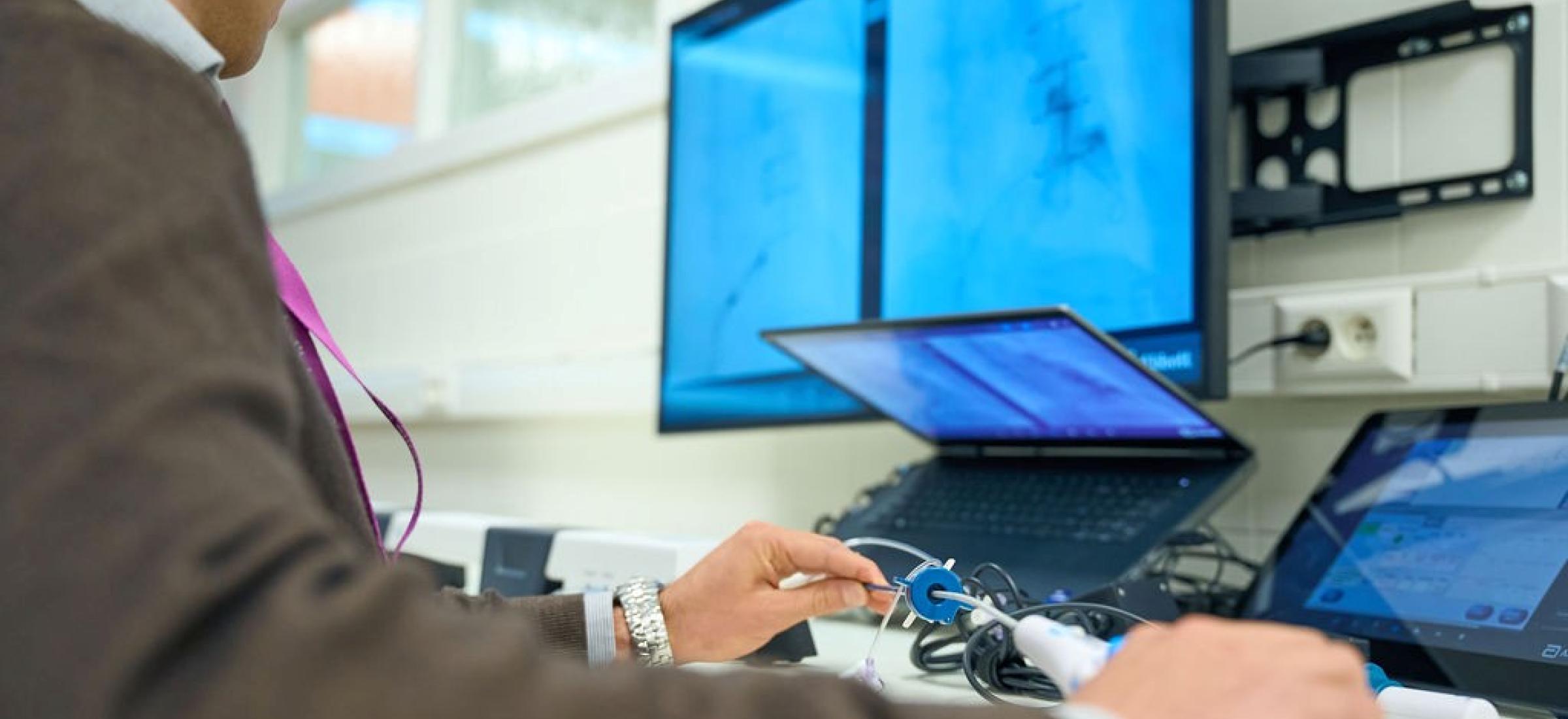
Innovative procedural techniques in AF-ablation
Atrial fibrillation (AF) is the most common sustained arrhythmia, and its prevalence is expected to double by 2030. The management of AF is rapidly developing from 1987 starting from very invasive surgical procedures to endovascular catheter ablations, minimally invasive surgical and hybrid procedures. Despite that in general, only 4 % of AF patients receive interventional treatment (endovascular catheter ablation, surgcal ablation or hybrid).
Significant technological advancement has been done through last 30 years to improve the procedural success, allowing not only the virtual visualization of multiple catheters and heart chambers in the real time but also helping to uncover and effectively trat complex arrhythmias. All these technologies require specific skills and expertise from cardiologists and/or cardiac surgeons.
This microcredential course is a simulation-based hands-on training focusing on particular AF ablation techniques ensuring safe and effective technology adoption.
During this course you will enrich your theoretical knowledge about most advanced contemporary methods of atrial fibrillation management, learn and practice specific procedural workflow on the simulator models and observe live-cases.
Course is led by international faculty board in partnership with European Research Institute for Simulation (ERIS).
The pre learning materials for the course are available online, the course is strictly off-line (physical presence only). Certification is granted after successful theoretical and practical assessment (2 attempts during the course)
Details
Admission criteria
Course is available to certified cardiologists and cardiac surgeons, specialized in Electrophysiology. Master in Medicine and a Completed Cardiology or Cardiac Surgery specialization are mandatory to enroll.
Candidates first need to register via https://eris-eu.eu/en/courses/pfa-af-ablation_intracardiac
Only after acceptance by the course director, candidates are allowed to register for the micro-credential at VUB.
Course
3 ECTS - 3 day intensive course with mandatory online preparation
Maximum participants per course
A maximum of 9 participants per course
Semesters
Courses during first and second semester
Location
VUB Campus Jette/UZ Brussel
What is a Micro-credential?
Micro-credentials are small, academic programmes that focus on specific subjects and competences. They consist of one or more courses or course parts taught in a Bachelor or Master programme at the university. Usually, they are taught for a few hours spread over one semester or one academic year. They are literally micro-courses.
If you pass the micro-credential, you receive a certificate proving that you have acquired the competences. These are official credits. This is where micro-credentials differ from other programmes, such as study days or trainings. The credits and competences you obtain are recognised throughout your career and can lead to exemptions from future programmes, for example, even at other institutions.
Micro-credentials are important for lifelong learning. After all, in our rapidly changing society, it is essential that everyone keeps working to renew their own competences. Micro-credentials are blocks that you can stack and combine throughout your life and career to further direct your own pathway. There are several advantages to taking micro-credentials. Since they are short, specific courses, you only learn what you need to upskill or specialise.
In addition, the certificate guarantees your acquired competences and the credits are often recognised abroad. They are a great asset on your CV.
Costs
The tuition fee consist of a fixed amount and a variable amount
The fixed amount is an administrative fee paid once per academic year. The variable amount is a specific fee per credit or ECTS that you enrol for.
Enrolment
Start your online application here
Look under 'continuing education' to select your micro-credential.
Check the application deadlines here
Need help?
Teaching methods
The VUB is committed to blended learning, a combination of online and on-campus lessons. Therefore, students need not necessarily be on campus if they do not have to be, but we still believe in the added value of physical teaching moments.
Classes are usually taught for a few hours spread over one semester or one academic year. You can always check the class timetable, where you can see if a course is online, on campus or taught through recorded lessons. It is best to view the timetables for each individual course.
Any questions?
microcredentials@vub.be

The new training offer of micro-credentials was developed and announced with the support of the European Union.