

On 11 May, the Green Energy Park in Zellik welcomed four Year 10 classes. It wasn’t a typical school day, but a varied STEM programme under the banner of Climate Technology Day. Together with a few VUB professors, the young people explored the climate solutions of tomorrow. At the same time, they were given a taster of the engineering courses at the VUB. Because engineers? “The world needs them, more than ever!”
At least, that’s what we took away from Professor Johan Stiens’ session on the ‘Internet of Things and how Big Data is Changing Everything’. In capital letters, please, because the professor holds the engineering profession in the highest regard. He emphasised this message with enthusiastic gestures and concrete examples. “Just look around you. Your laptop, the car or bus you came here in, the building we’re in right now: it’s all been developed by engineers. Their impact on society is enormous, but unfortunately also invisible. When do you ever see an engineer on a TV programme? Never. That’s a shame, because what is unknown is unloved. We urgently need to show more appreciation for engineers, so that more young people choose this path.”
Tens of thousands of turbines
More young people studying engineering or at least choosing a STEM subject: that was precisely the aim of this Climate Technology Day at the Green Energy Park. Four classes from three schools had signed up: the Sint-Jozefsinstituut Ternat, the GO! Atheneum Etterbeek and ZAVO Zaventem. They were first given information about engineering courses, including a testimonial from a Civil Engineering and Architecture student. Marleen Claeys, a business developer with the VUB’s CHIS (Chemical Engineering) research group, explained how a Master’s degree in Chemical Engineering and a PhD in Bioengineering served as the starting point for a career that was as surprising as it was varied. Inspiring reading for aspiring engineers. Afterwards, several VUB professors gave short introductory lectures on the climate solutions of today and tomorrow. For instance, Professor Maarten Messagie spoke about the true carbon footprint of electric vehicles (spoiler: battery-powered vehicles are indeed the most sustainable option.)
Professor Christof Devriendt explained how offshore wind turbines can be designed using less material, even as they continue to grow in size. “Belgium currently has 399 wind turbines in the North Sea, providing around 2.26 GW of offshore capacity, and aims to double that figure. Yet on a European scale, this is only a small contribution. Under the Green Deal, tens of thousands of new turbines are planned across European waters. “The latest generation of offshore turbines is colossal. A single blade is at least as large as an Airbus A380, the world’s biggest passenger aircraft. Imagine three of those aircraft rotating around a tower 240 metres high and 8 metres in diameter. Constructing such a turbine offshore can easily cost tens of millions of euros, so every centimetre of steel saved makes a real difference to affordability. “At the same time, these structures must withstand the relentless forces of wind and waves for decades. Balancing those demands is engineering in its purest form.””
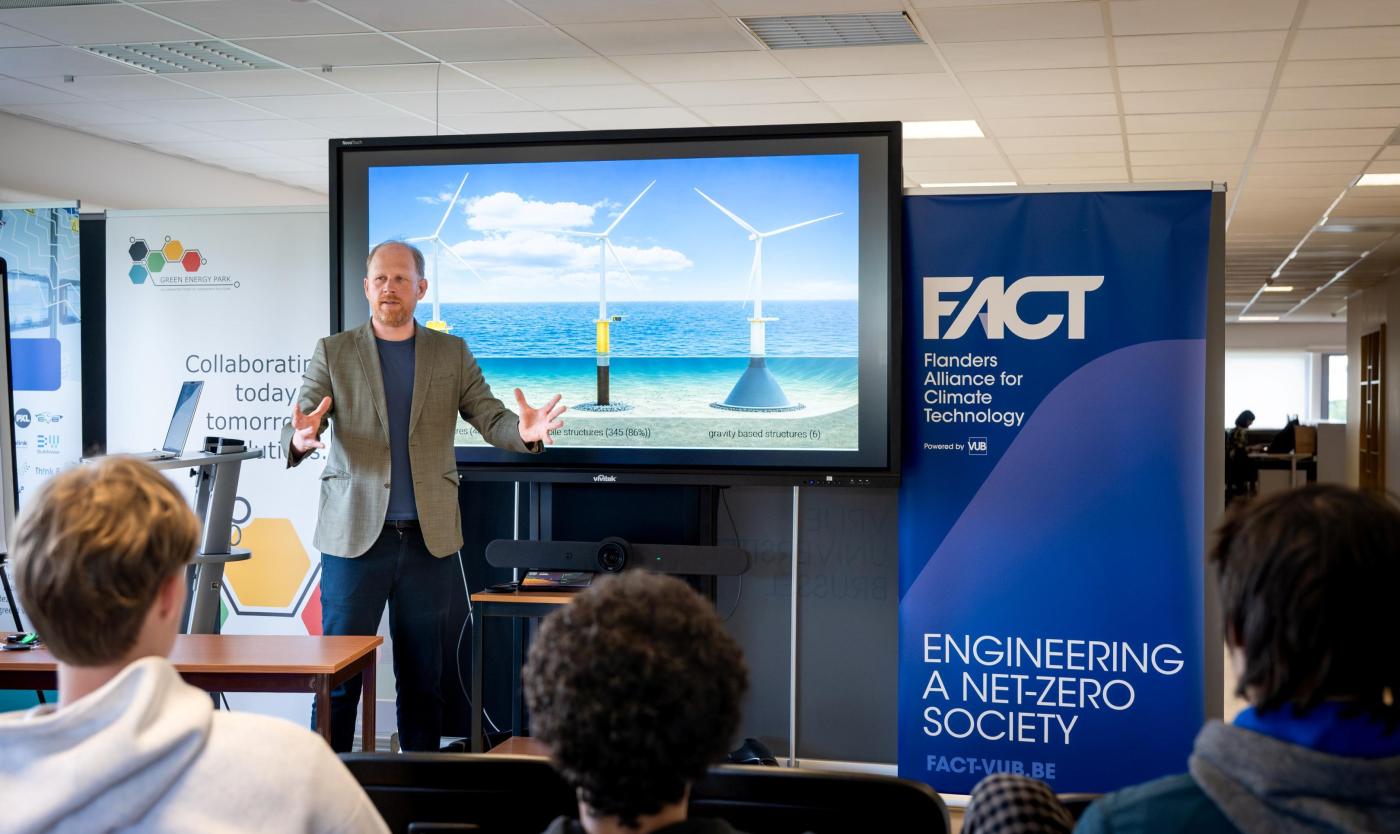
Christophe Devriendt
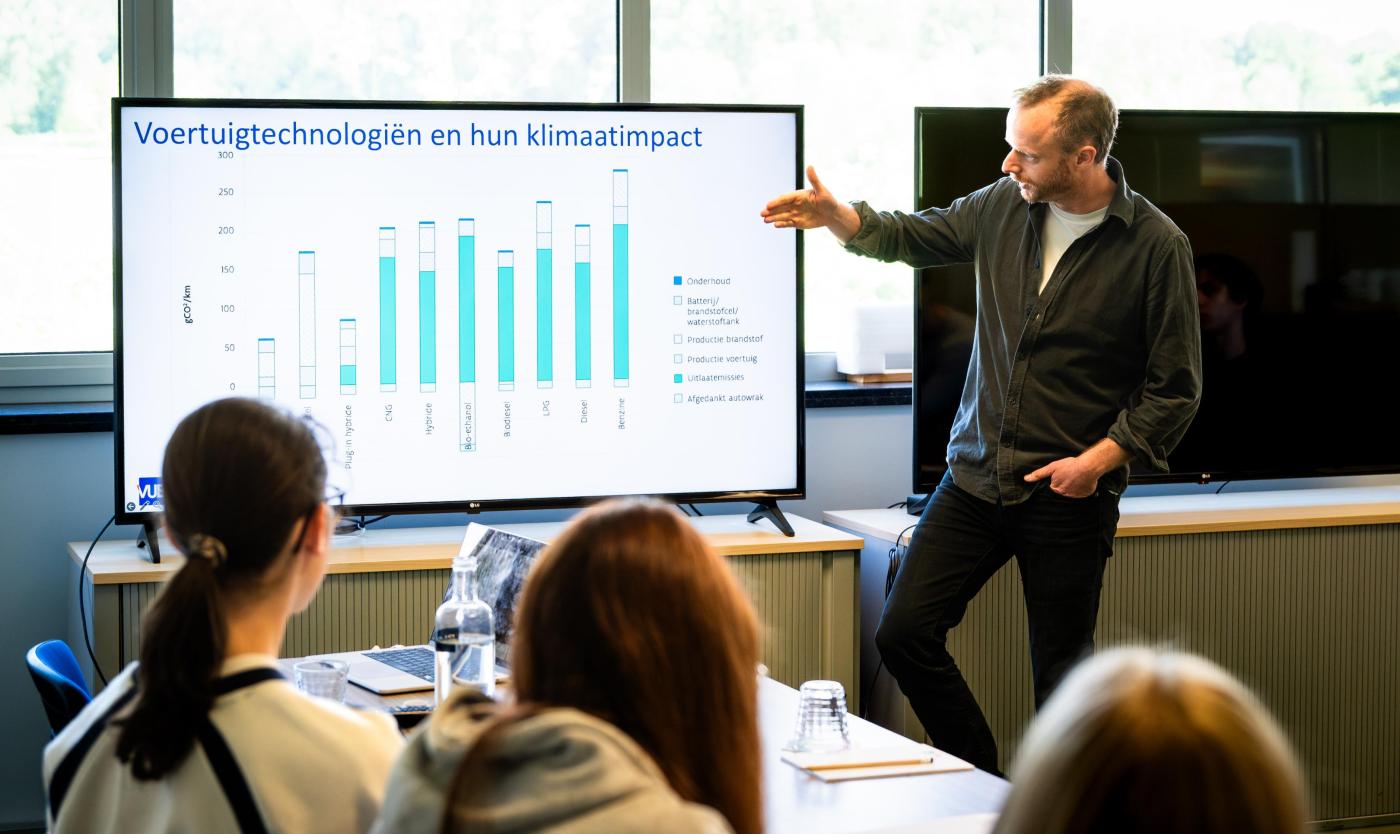
Maarten Messagie
Built, not bought
Most of the pupils listened intently and asked pertinent questions, including about the impact of all those wind turbines on marine life and birds. Basic knowledge of chemistry also bubbled to the surface quite readily when Maarten Messagie asked about the chemical reactions that occur during the combustion of fossil fuels. Iris Van den Bossche, a chemistry teacher at the Sint-Jozef Institute in Ternat, quietly breathed a sigh of relief.
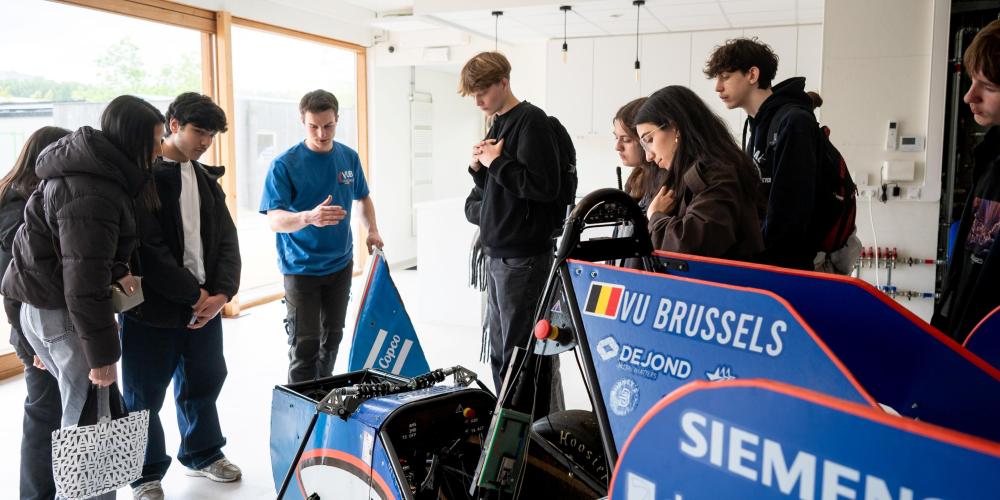
But most eyes really lit up during the demonstration of the Formula Student racing car. This electric racing car was designed and built by a team of forty VUB students from the engineering, electronics, computer science, economics and communication programmes. The team took part in international university competitions in Italy and England this year; next year, Germany and Switzerland are on the agenda. The racing car combines electric propulsion with innovative materials and a ‘built, not bought’ principle: the motor and batteries were purchased, but the students designed and built everything else themselves using 3D printers, laser cutters and CNC machines. The car’s cost: just under 90,000 euros, a large part of which was sponsored
Girls and motorbikes
Evy Verhulst and Elaine Fockedey from GO! Atheneum Etterbeek found the Formula Student project incredibly inspiring. They are here under the supervision of physics teacher Vincent De Vits. The pair pose enthusiastically next to the racing car. Girls and motorbikes – a winning combination? “We’re both big Formula 1 fans,” explained Evy. “I’ve actually been to a race in person, at Francorchamps. And this summer I did an internship at Toyota and got to watch test drives at the Silverstone circuit in England. My dream? To study engineering and then work as a Formula 1 engineer, perhaps in aerodynamics. Taking part in the Formula Student project seems like a brilliant idea to me.” Perhaps Evy will bump into Elaine in the F1 world later on. She too wants to study civil engineering and then do something involving mechanics or engines. “It doesn’t have to be Formula 1, but if possible I’d love to do something in the automotive industry. Making cars more environmentally friendly, for example. In any case, there are plenty of opportunities for engineers.”
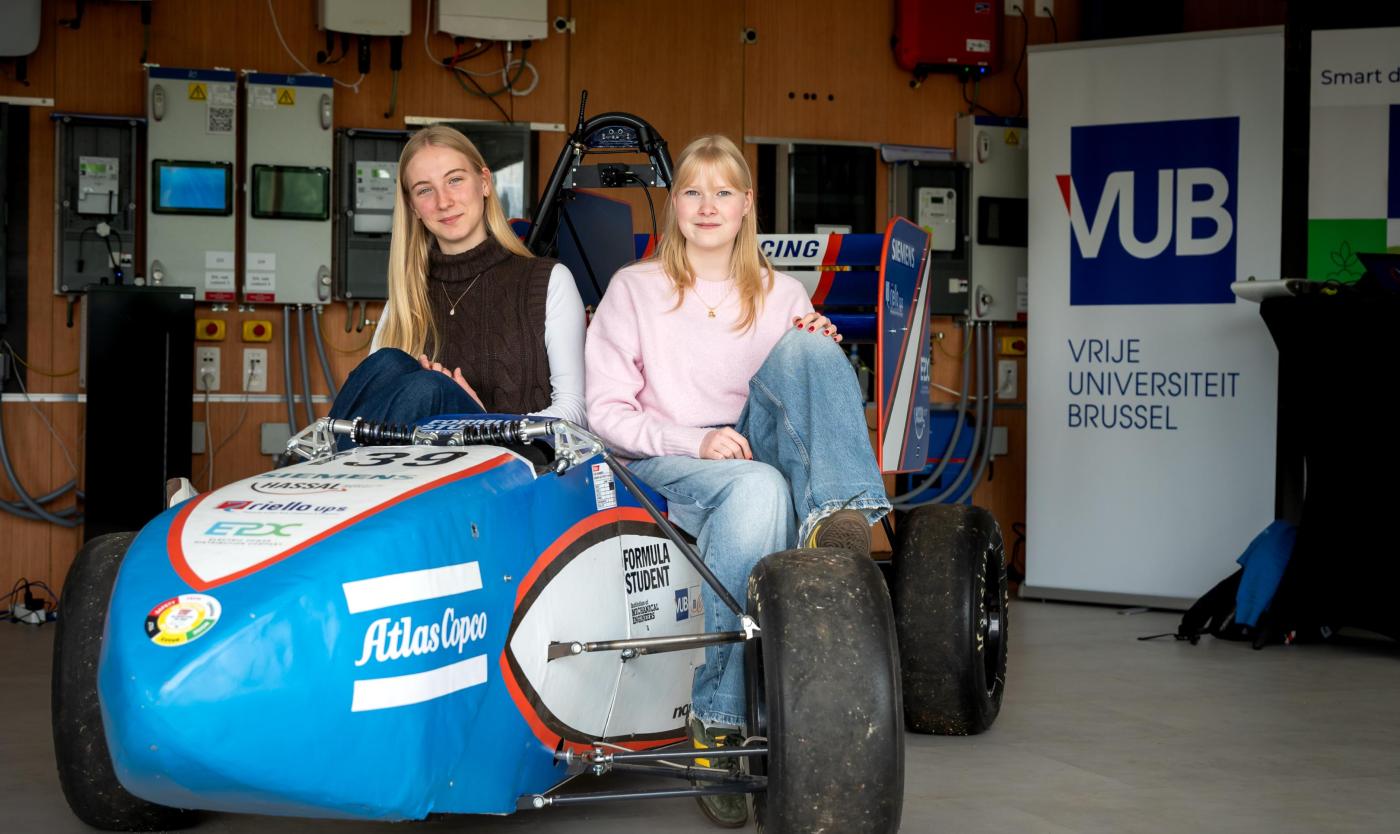
Elaine Fockedey and Evy Verhelst
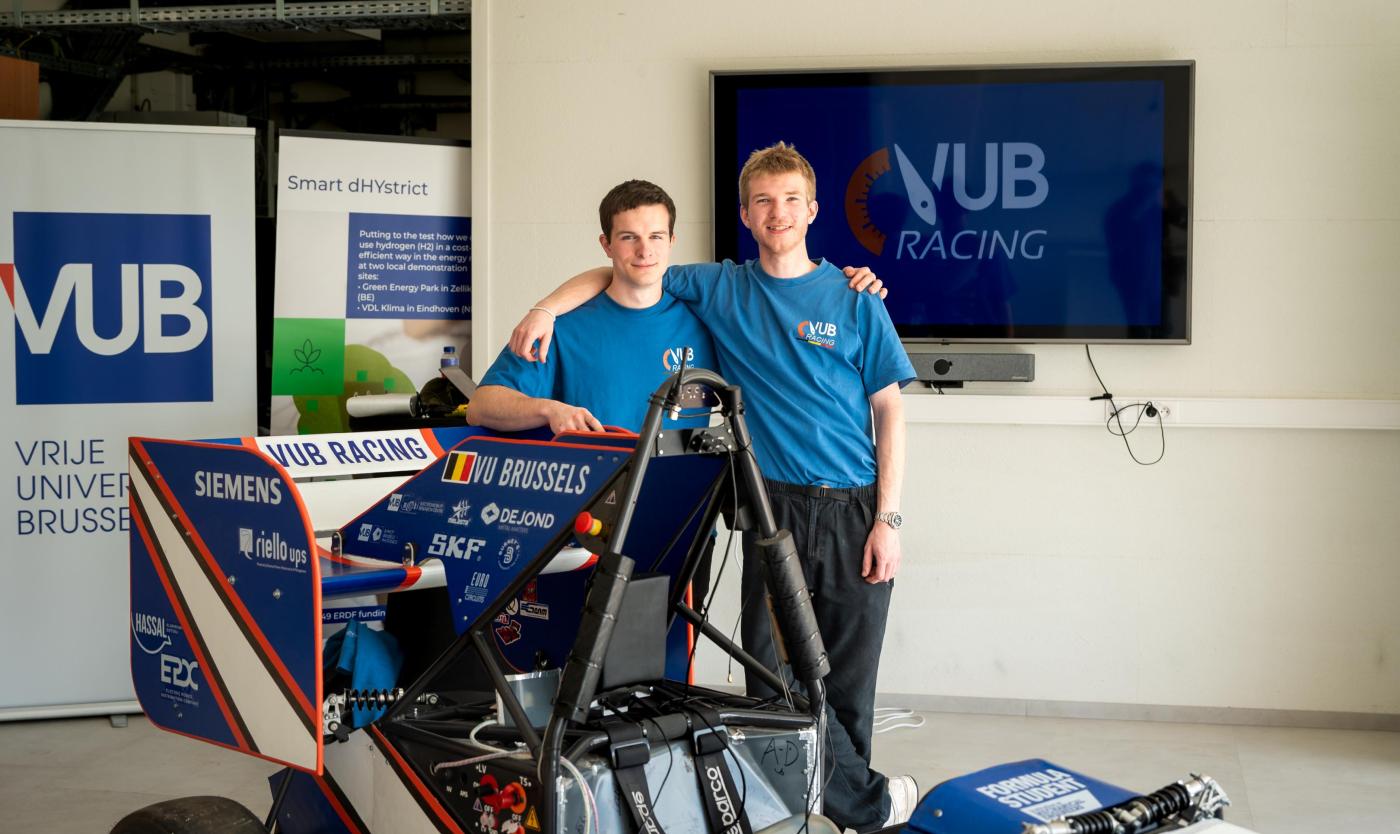
Yorick Hendrickx and Matthias Van Hauwe
Good support
Matthias Van Hauwe and Yorick Hendrickx from the VUB Racing team are happy to hear that. Matthias graduated last year with a degree in industrial engineering, and Yorick this year. They reassure prospective engineering students: at the VUB, they won’t be left to fend for themselves. Matthias himself came from a background with four hours of maths a week and had failed the placement test. “Yet I graduated with first-class honours. So don’t be put off. Class sizes have grown slightly at the VUB in recent years, but students are still well looked after. In the basic maths module, for example, you have to complete exercises every week. These are marked, which is an incentive to keep up with the material. The same applies to the mid-year chemistry exam and the weekly assignments you’re given in other subjects. That’s the beauty of studying at the VUB: you have to do the work yourself, of course, but you can count on support.”
A new generation on the horizon
By early afternoon, Climate Technology Day had come to an end. Good news for Professor Johan Stiens: a new generation of eighteen-year-olds seems keen on studying engineering or another STEM subject. Aisa Al Morabet and Ounayssa El Khayatti, classmates at the Sint-Jozef Institute in Ternat, are sticking to their ambitions. Even after his visit to the Green Energy Park, he still dreams of studying medicine at the VUB, whilst she is aiming for a degree in civil engineering at the Royal Military Academy.
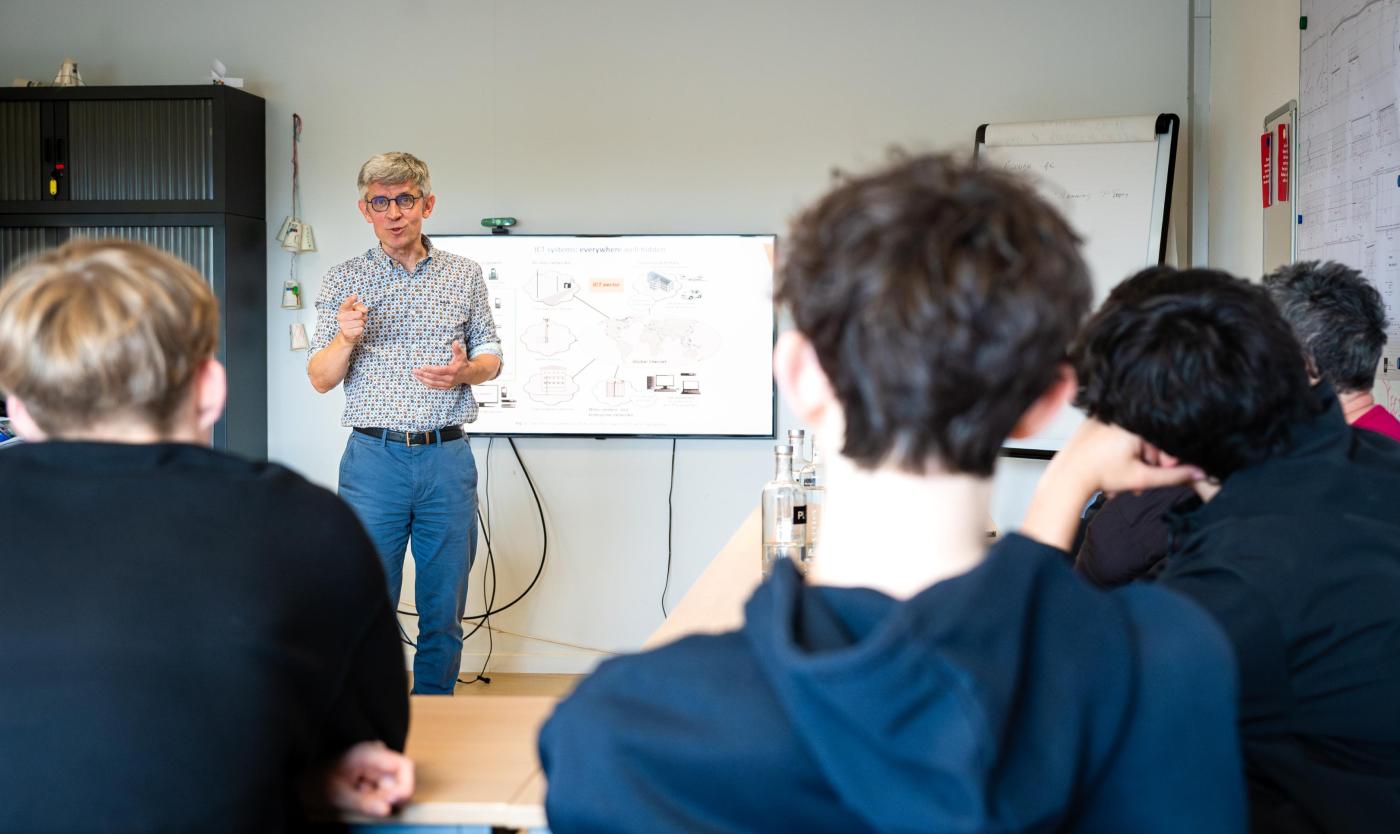
Johan Stiens
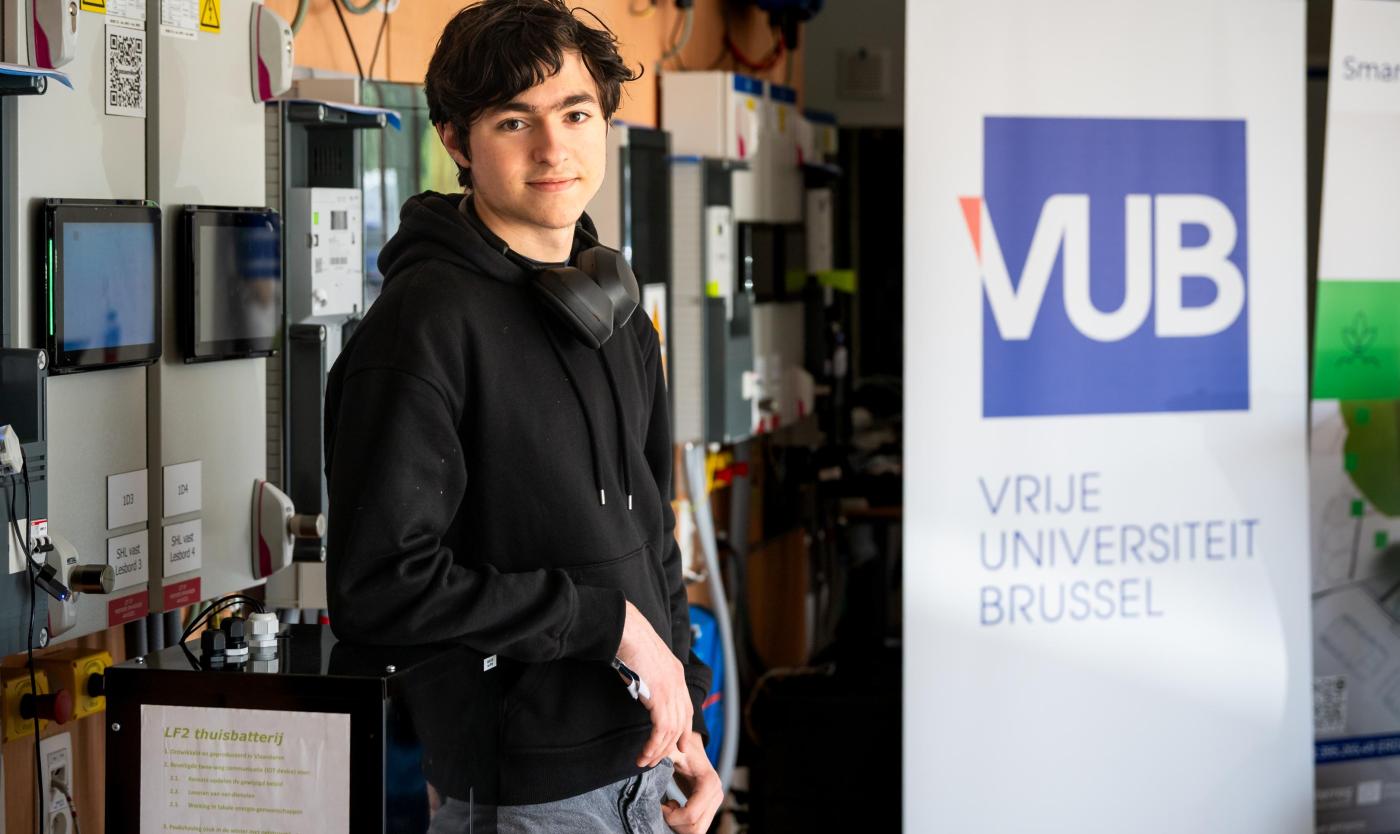
Victor Ver Eecke
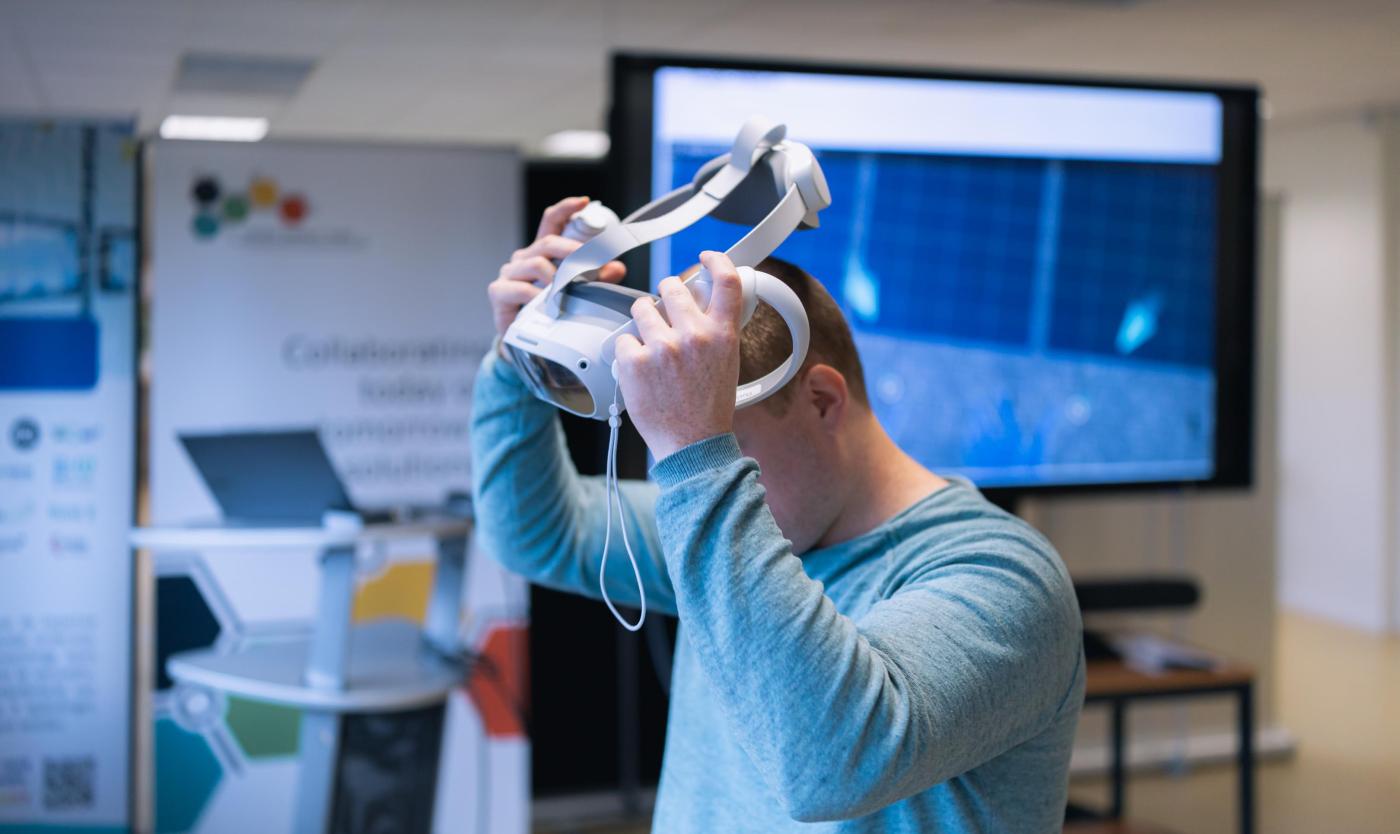
Victor Ver Eecke from GO! Atheneum Etterbeek also feels more confident about his plans to study engineering. What he remembers most is the visit to the Green Energy Park’s Multi-energy Living Lab. This lab is a test environment where different forms of energy – electricity, heat, battery storage, etc. – are tested simultaneously and in combination with one another in a realistic setting. Victor was particularly fascinated by the Smart Digital Table Top. This is an interactive simulator that depicts the Zellik Research Park, of which Green Energy Park is a part, on a scale model. “You can use it to visualise the site’s energy flows and compare energy scenarios, so that they can work together intelligently. I do the same at home, with our home network. Using an algorithm, I track how much energy our solar panels generate and how much energy we consume. That way, we know when it’s best to charge the car or prevent peak usage from getting too high. In the future, I can certainly see myself working with this kind of network architecture.”
Green Energy Park
The VUB and UZ Brussel are developing the Green Energy Park into a living lab for energy, health and digital technology. Info.