

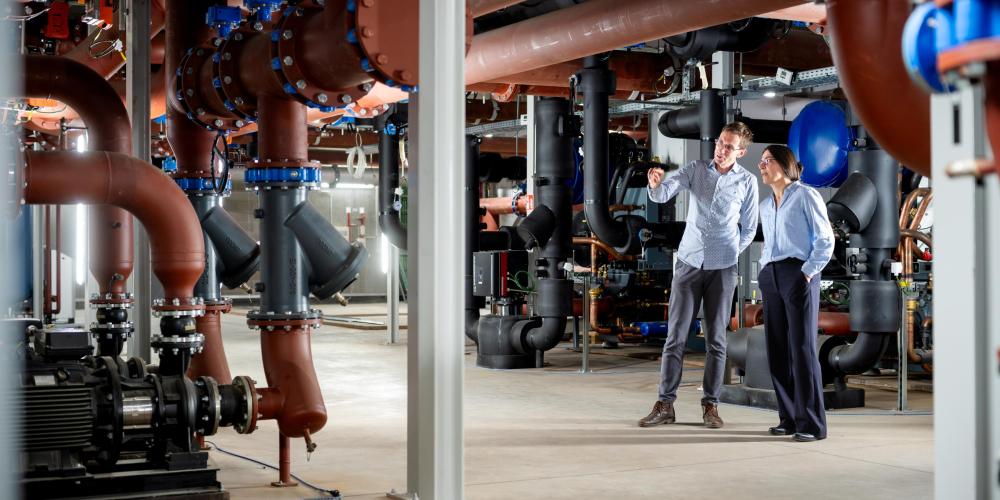


Anyone leafing through Facts & Figures 2024–2025 will immediately notice that the digital dimension of the Vrije Universiteit Brussel is no longer a support service, but a strategic driving force behind education, research and campus operations. The figures show how the university has built a fully fledged digital backbone at a time when artificial intelligence (AI) is experiencing unprecedented global growth and bringing with it increasing energy use and climate impact.
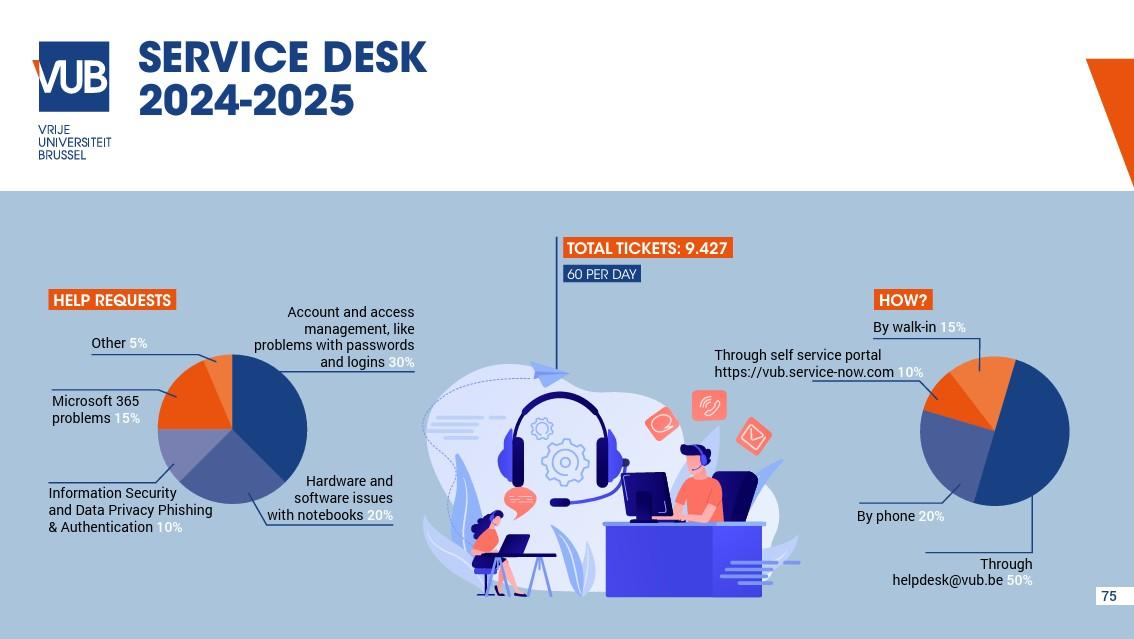
The digital campus is now operating at full capacity. Over the past year, the ICT helpdesk received more than 9,400 requests, a clear indication that almost every aspect of education, administration and research has become dependent on stable digital services. The Learning & Innovation Center (LIC), which has been in use since the previous academic year, has also got off to a notably strong start. More than 10,000 students, researchers and staff have already made their way to the new learning spaces, media studios and technology labs.
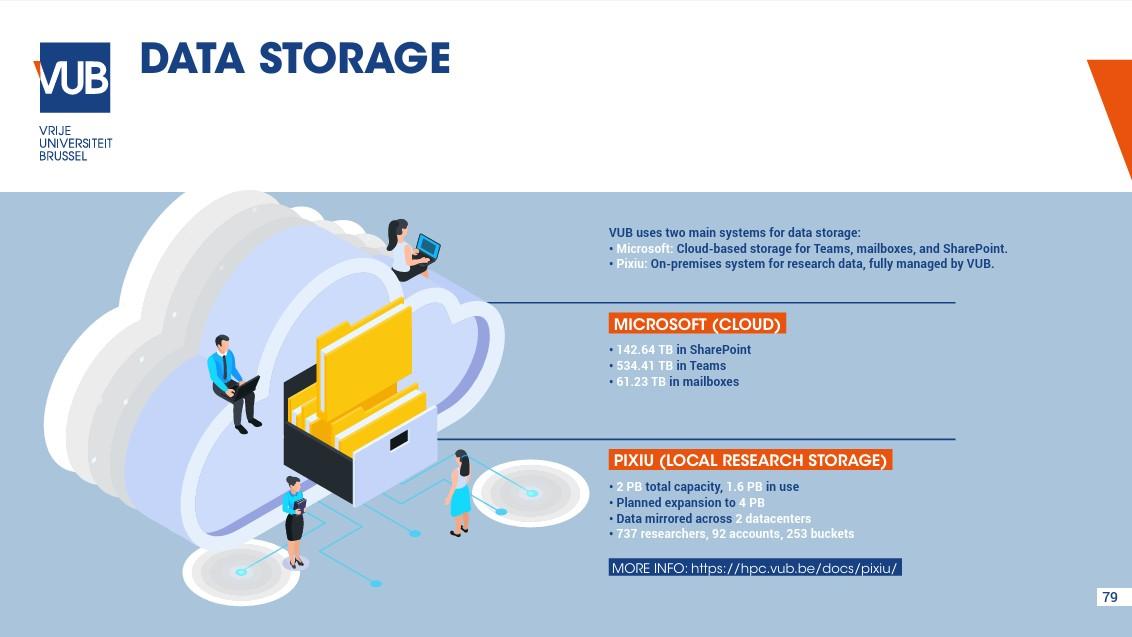
Beneath the surface lies the quiet engine driving this evolution: the computing power the university has built up over recent years. ICT specialists may describe it in impenetrable technical terms, but together they represent immense processing capacity. The Nexus Data Center houses 48 server racks, 900 computing cores and 3 petabytes of research data, while the Hydra high-performance computing cluster adds 3,968 cores and 22 specialised graphics accelerators. Combined with 2 petabytes of Pixiu storage and flexible cloud services, this infrastructure forms the technological foundation on which researchers across all disciplines can rely — from biomedical simulations to social science analyses.
Since May 2024, the VUB has had an additional asset at its disposal: the new Nexus data centre at the Researchpark Zellik. Its sustainable design — powered by 100 per cent renewable energy, recovering residual heat, using rainwater for cooling and holding three international sustainability certifications — places the VUB in an exceptional position within European higher education. In 2025, Nexus also became the home of Flanders’ new top-tier supercomputer, which is used for the most demanding calculations in fields such as climate science, medicine and AI research.
That sustainable course is not a choice but a necessity, as the global energy appetite of artificial intelligence is growing at breakneck speed. Worldwide use of specialised chips for AI systems has risen to five gigawatts and, by 2025, was even approaching 23 gigawatts — comparable to the total electricity consumption of the Netherlands. Data centre energy use has been increasing by more than 12 per cent a year since 2017, largely driven by the growth of AI applications, while water consumption is rising at a similar pace: Google alone used 21 billion litres in 2022 to cool its data centres.
“Students also benefit from this digital infrastructure”
The arrival of GPT-5, the latest generation of large-scale language and multimodal models, throws this trend into even sharper relief. Independent measurements show that generating an average response with GPT-5 requires more than 18 watt-hours of electricity, with peaks of up to 40 watt-hours. By comparison, a similar response from GPT-4 required around 2.12 watt-hours. If GPT-5 were to be used worldwide on the scale of ChatGPT — around 2.5 billion queries per day — this would amount to daily consumption of up to 45 gigawatt-hours, comparable to the electricity use of 1.5 million US households. Researchers suspect that the impact of GPT-5 is significantly greater than that of its predecessors, and that the exponential growth in the number of parameters almost automatically leads to exponentially higher energy and water consumption. This makes sustainable computing infrastructure not a luxury, but an absolute prerequisite for keeping AI development viable.
This is precisely why VUB’s approach is significant on the international stage. By constructing Nexus as a CO₂‑neutral and energy-efficient data centre, the university can offer the computing power required for large-scale AI models locally, without incurring the ecological costs that are increasingly heavy elsewhere. Researchers can train large models and run complex simulations with considerably lower energy consumption than in traditional data centres. In this way, AI research is not slowed down, but is supported in a smarter, more sustainable manner.
Students also benefit from this digital infrastructure. With 24,199 enrolments and growing interest in science and engineering programmes, digital literacy is playing an increasingly central role in the curriculum. In the LIC and across the campus, students not only explore the latest learning technologies, but also gain insight into the underlying AI processes and the societal debates that accompany them. International scholars warn that AI systems must become more energy-efficient and that institutions need to optimise both hardware and software to reduce their ecological impact. VUB is leading the way by integrating technological innovation and sustainability, rather than treating them separately.
At a time when international organisations such as the International Energy Agency and the International Telecommunication Union warn that the expansion of data centres and AI models threatens global climate targets, VUB demonstrates that a different path is possible. With Nexus, Hydra, the Flemish supercomputer, the LIC and comprehensive digitalisation, the university is building a future where computing power and responsibility go hand in hand. Today’s digital campus is not just a technical achievement; it is a blueprint for what sustainable innovation in higher education can look like.
The Vrije Universiteit Brussel has published its Facts & Figures 2024–2025. The report brings together all the key figures on students, research, infrastructure and societal impact. It presents a university that is not only growing, but also fully committed to research, innovation, digital transformation and sustainability.