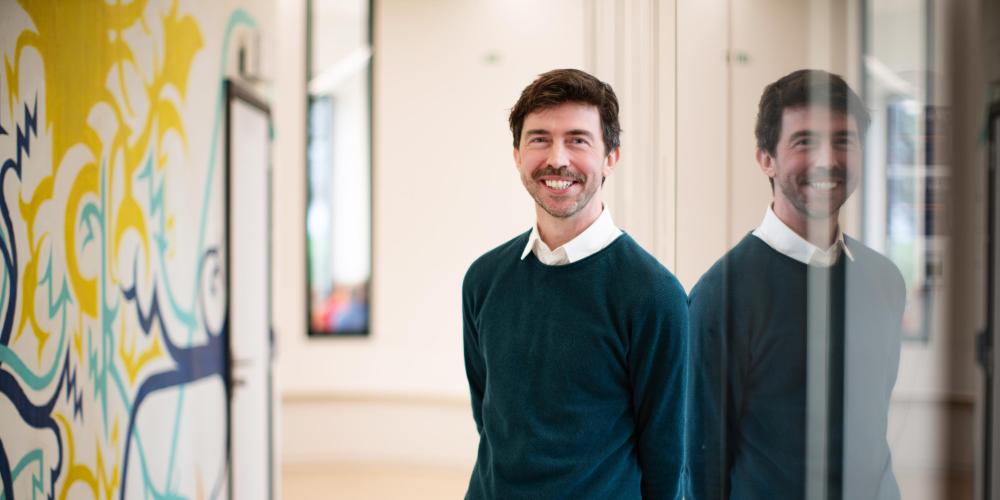


Vincent Ginis, professor and researcher at the Vrije Universiteit Brussel, has been awarded the Silvain Loccufier Prize. The award recognises researchers who combine scientific excellence with a strong commitment to society, in keeping with the spirit of free inquiry and the secular values upheld by the university. “At the VUB, free inquiry is not just a slogan, but a reality.”
What does the prize mean to you?
“The combination of scientific excellence and societal impact is something I value deeply. In academia, as a young researcher, you’re often given the implicit — and sometimes explicit — advice to ‘optimise’ strategically: how do you divide your time between research, teaching, supervision and public engagement? I’ve always found that way of thinking rather constraining. I therefore tried to shape my academic path in line with my own intuition and values, rather than externally imposed targets. Looking back — although it still very much feels like I’m only at the beginning — I’m convinced that this approach hasn’t held my research back; on the contrary, it has strengthened it. Many of my best research ideas have emerged through cross-fertilisation with other disciplines, including via the Young Academy. My engagements in Belgium, in turn, were inspired by examples from the United States. My teaching has improved thanks to my international experiences, and my research has benefited from my teaching. By not confining myself to a single field, unexpected feedback loops emerge.
It is therefore somewhat ironic that part of my research focuses precisely on what goes wrong when AI systems are optimised for a single metric. That insight applies just as much to an academic career. The fact that this prize affirms that makes it all the more meaningful to me.”
What has been the highlight of your scientific career so far?
“My greatest pride lies in the research group I’ve been able to build. I’m proud of the curious, critical team of students and postdocs working there today, and of the research culture we’ve developed together. That culture isn’t about quick wins, but about critical thinking. Even results published in the most prestigious journals are questioned in our group. We don’t follow trends simply because they’re fashionable; we conduct research because it is necessary and impactful. For instance, one of my PhD candidates uncovered a fundamental error in one of the most cited papers in a leading journal. The group has grown by consciously avoiding short-term optimisation: by recruiting across disciplinary boundaries and by making time for activities that don’t appear in performance metrics. What I try to pass on there is what I learned from my own mentors: a strong research environment begins with trust, curiosity and celebrating one another’s successes.
I encourage my researchers to think actively about the world in which they work — about the relationship between research and society, education and even the arts. That’s why every three months we organise a collective reflection exercise around an unconventional question. It takes time, but it sharpens their thinking and — I’m convinced — makes them better researchers.”
What has enabled you to conduct top-level research at the VUB?
“At the VUB, free inquiry is not just a slogan, but a reality. I’ve genuinely been given that freedom, in a way that might be less self-evident elsewhere. When I decided in 2020 to study large language models — then still a niche field — it was explicitly encouraged. That freedom to explore is essential for genuine science. In addition, the role of the Research Foundation – Flanders has been crucial. My PhD, postdoctoral work and first major projects were all funded by the foundation. Without that support, much of the work being recognised today simply wouldn’t exist.
Finally, there is the culture at the VUB, which allows room for experimentation while placing people at its centre. Failure is not stigmatised, and research is not treated as a production line. The international dimension of my work has also been seen as an asset. The same applies to our students: three of my PhD candidates worked at MIT or Harvard, demonstrating there just how well their VUB education had prepared them.”
Bio Vincent Ginis
Vincent Ginis works as a researcher at the intersection of physics, artificial intelligence and complex systems. His scientific work spans both fundamental research into new materials and the control of light, as well as the development of methods to better analyse complex systems. He collaborates with international research teams and publishes in leading journals such as Science, Nature Photonics and PNAS. In recent research, Ginis has focused on making artificial intelligence more understandable, safer and easier to test. He develops techniques to uncover the behaviour and vulnerabilities of AI systems, with particular attention to instability, feedback mechanisms and systemic risks. In doing so, he contributes work that is both scientifically significant and closely aligned with current technological challenges. Alongside his academic work, Ginis plays an active role in public debate on the impact of artificial intelligence on work, education and society. He has been selected for the Young Academy and named one of Belgium’s fifty leading technological pioneers, underlining his role as a bridge between fundamental science and society.