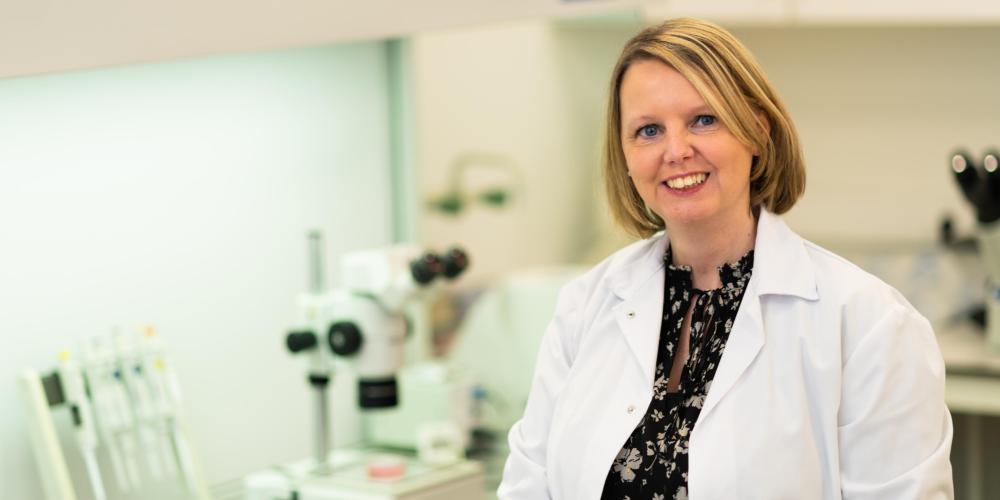


Ellen Goossens, a professor and researcher at the Vrije Universiteit Brussel, has been awarded the Liebaers–Van Steirteghem Prize. The award is presented to Life Sciences researchers with between 10 and 25 years of experience and recognises outstanding research with a clear clinical impact. Goossens’ work focuses on restoring fertility and developing new reproductive technologies.
What does the prize mean to you?
“This prize has a special significance for me, as Professor André Van Steirteghem was one of the supervisors of my doctoral thesis. His pioneering work in the field of Intracytoplasmic Sperm Injection (a specialised IVF treatment in which a single healthy sperm cell is injected directly into a mature egg, ed.) has not only made an enormous difference to infertile couples, but also inspired me to pursue a career in reproductive science.Both Professor Van Steirteghem and Professor Liebaers supported and encouraged me throughout my career. I have great respect for their legacy, and it is an honour to receive a prize that bears their name.The Liebaers–Van Steirteghem Prize also enables me to continue our clinical studies on fertility restoration. We aim to further develop our culture system for generating sperm cells in the laboratory, outside the human body. This brings us closer to restoring fertility in patients who currently have no options for having biological children of their own.”
What has been the highlight of your scientific career?
“The highlight is without doubt the very first successful transplantation of testicular tissue in a man who had lost his fertility as a child. That moment was the result of more than 25 years of intensive preliminary research. This breakthrough was only possible thanks to close collaboration with dedicated clinicians at UZ Brussel and with fellow researchers abroad. Continued support from the VUB, external funding from, among others, the European Union and the Research Foundation – Flanders (FWO), and, not least, the patients themselves, were all crucial. Without that broad base of support, this would never have been possible.”
What enabled you to carry out top-level research at the VUB?
“Alongside perseverance and resilience, as a researcher you above all need people who believe in you. At the VUB, led by Professor Herman Tournaye, I was given the opportunity, the freedom and the financial support to turn my ideas into applications that can genuinely help patients. A key moment came after my postdoctoral research mandate at the Research Foundation – Flanders. For many researchers, the end of such a mandate also marks the end of an academic career. Thanks to support from UZ Brussel and the VUB, I was able to continue my research until I secured a permanent academic position.
It is also important to feel at ease in your workplace. Colleagues and team members create a warm and supportive environment, which motivates me every day to give my best. The support from home is equally indispensable. At difficult times, my family was there to step in, take over responsibilities, or simply allow me to take a step back from work. That support makes a world of difference.”
Biography Ellen Goossens
Ellen Goossens is an internationally recognised authority in male reproductive biology. For more than twenty years, she has been investigating how sperm cells are formed and how fertility can be preserved or restored in boys and men who risk becoming infertile later in life due to illness or medical treatment. Her work focuses in particular on patients for whom there are currently very limited reproductive options. What sets her research apart is the close link between laboratory work and clinical practice. Together with her team, Goossens has developed innovative techniques such as the preservation and transplantation of testicular tissue and stem cells capable of developing into sperm cells. This research led to a global medical first in 2023: the first transplantation of a patient’s own testicular tissue in an adult man. With more than 125 scientific publications and a strongly integrated approach to research and care, Goossens demonstrates how fundamental science can translate into tangible medical innovation, with a lasting impact on patients and their prospects for the future.