

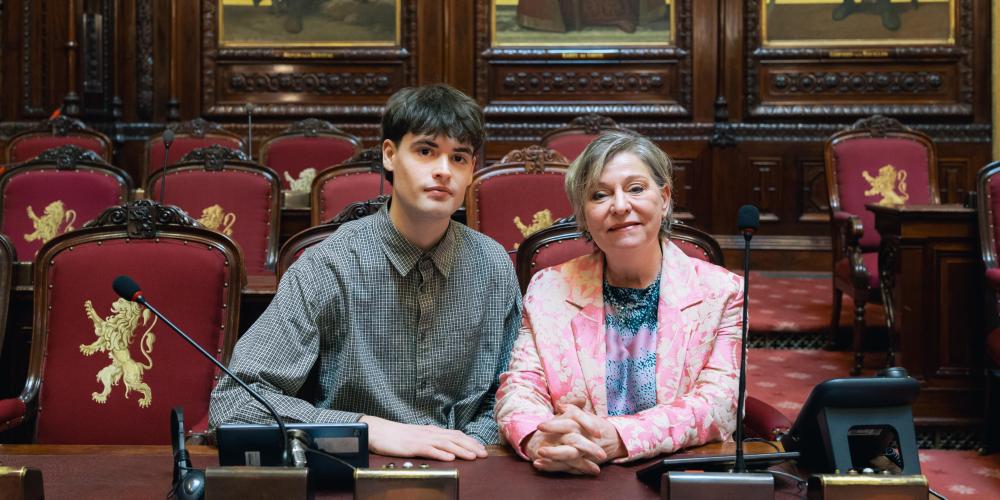


On Friday 13 February 2026, 21-year-old Mauro Michielsen, a sociology student at the VUB, was sworn in at the Senate. In doing so, he became the youngest senator in history. Where needed, he will be guided by a fellow VUB member and party colleague from Vooruit: Professor of Communication Sciences, Flemish MP and senator Katia Segers. “I feel that this appeals to my maternal feelings”, she jokes.
Politics came about almost by chance, Mauro insists. “I never had great ambitions in that direction, but I’ve always wanted to put right the things that are going wrong. It started on a very small scale, in school pupil councils. As chair of the Flemish Students’ Union, I came into contact with politics for the first time. In 2020, at the height of the coronavirus pandemic, there was intense debate about young people’s learning loss. I sat down with the Minister of Education to represent young people and safeguard their wellbeing.
“I also created a theatre production and wrote newspaper columns — all on issues that keep my generation awake at night. One of the parties that approached me was Vooruit, asking me to stand on the European list. I hesitated for a while, wondering whether I might achieve more in civil society than in politics. At the same time, I was arguing everywhere that young people are not properly represented in politics. It would have been difficult to refuse.”
Mauro stood on the list in Leuven and was immediately elected to the municipal council. “The doorstep visits I did with Katia in Flemish Brabant were incredibly valuable to me. We often think — including at the VUB — that we understand the world and have all the answers. But going door to door and speaking to people made me realise just how much we tend to live in a bubble.”
How does a professor of communication sciences end up in politics?
Katia: “For me, it was a late calling. During and after my studies at the VUB, I lived in Brussels for many years. I searched in vain for a home, until my father — a bricklayer — decided to build one himself for me and my husband in Liedekerke. I returned to my roots, and the political bug began to bite.
“In 2006, there were local elections and I was elected to the municipal council. My grandmother was the very first woman to be elected to the Public Centre for Social Welfare in Liedekerke, and she even campaigned for me. By 2014, I had already fought eight campaigns and was elected nationally to the Senate.”
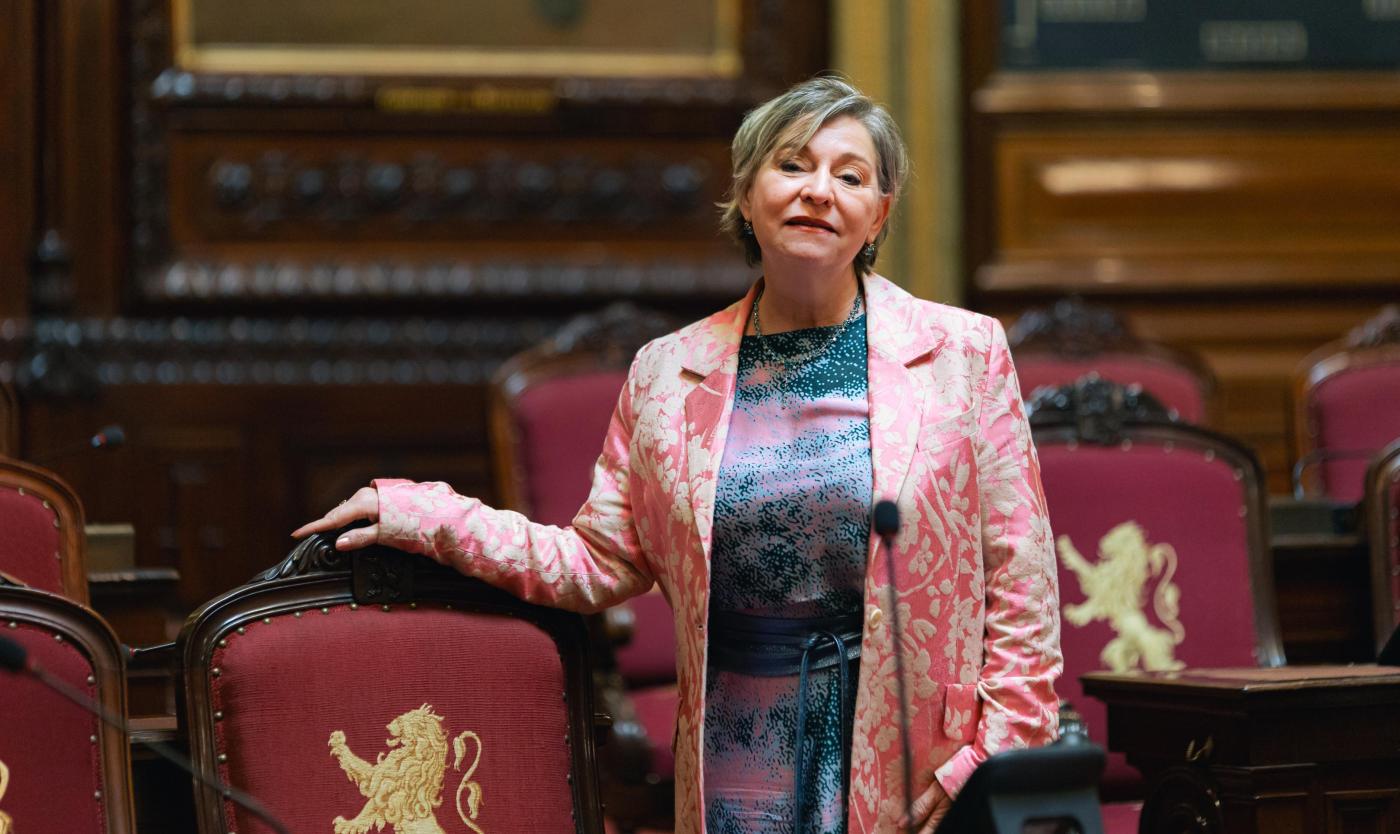
Katia Segers © Matthieu Labey
“In the court of public opinion, the image of a money-draining machine and a useless institution has proved impossible to shake”
- Katia Segers
You were away from the Senate between 2022 and 2025
Katia: “When I became an alderwoman in my municipality, I had to resign from the Senate, because you cannot serve simultaneously as a federated entity senator and hold a local executive office. Mauro is a co-opted senator — not directly elected, but appointed by already elected federated entity senators — and can therefore combine his seat with his position on Leuven’s municipal council.”
Mauro: “Within Vooruit, our initial view was that not co-opting anyone would bring us one step closer to abolishing the Senate. But in the end, that chamber still proves necessary in order to secure a two-thirds majority to amend the Constitution. Its abolition is set out in the coalition agreement, and Vooruit has been advocating it for years.
“Since the most recent state reform in 2014, members of the Senate are no longer directly elected. I think many people feel that the Senate is far removed from them and no longer has a decisive impact. The real political debate no longer takes place here. My mission is to ensure that the Senate is effectively abolished. And people expect politicians to keep their word.”
Forgive the comparison, but on my way here I was thinking of Nigel Farage, who sat in the European Parliament for years with the aim of dismantling the EU.
Mauro: “That’s not exactly the most flattering comparison,” he laughs. “But it is true that I’m here for a very clear reason: to abolish the Senate.”
But now that you are here, surely you can also pursue other objectives?
Katia: “As long as the Senate exists, we must do the work — and as long as that is the case, I will remain a senator. We tackle important issues that may not be glamorous, but are deeply substantive. I produced the first information report on AI in 2018, at a time when hardly anyone knew what it was.
“In the Senate, we can debate matters that transcend the politics of the day, which is not always possible in the Chamber or in the Flemish Parliament. The challenge, however, is to ensure that those carefully prepared reports do not simply gather dust, and that MPs take them forward in their own parliaments.”
“The abolition must not be an end point, but an opportunity to organise our democracy differently and better”
- Mauro Michielsen
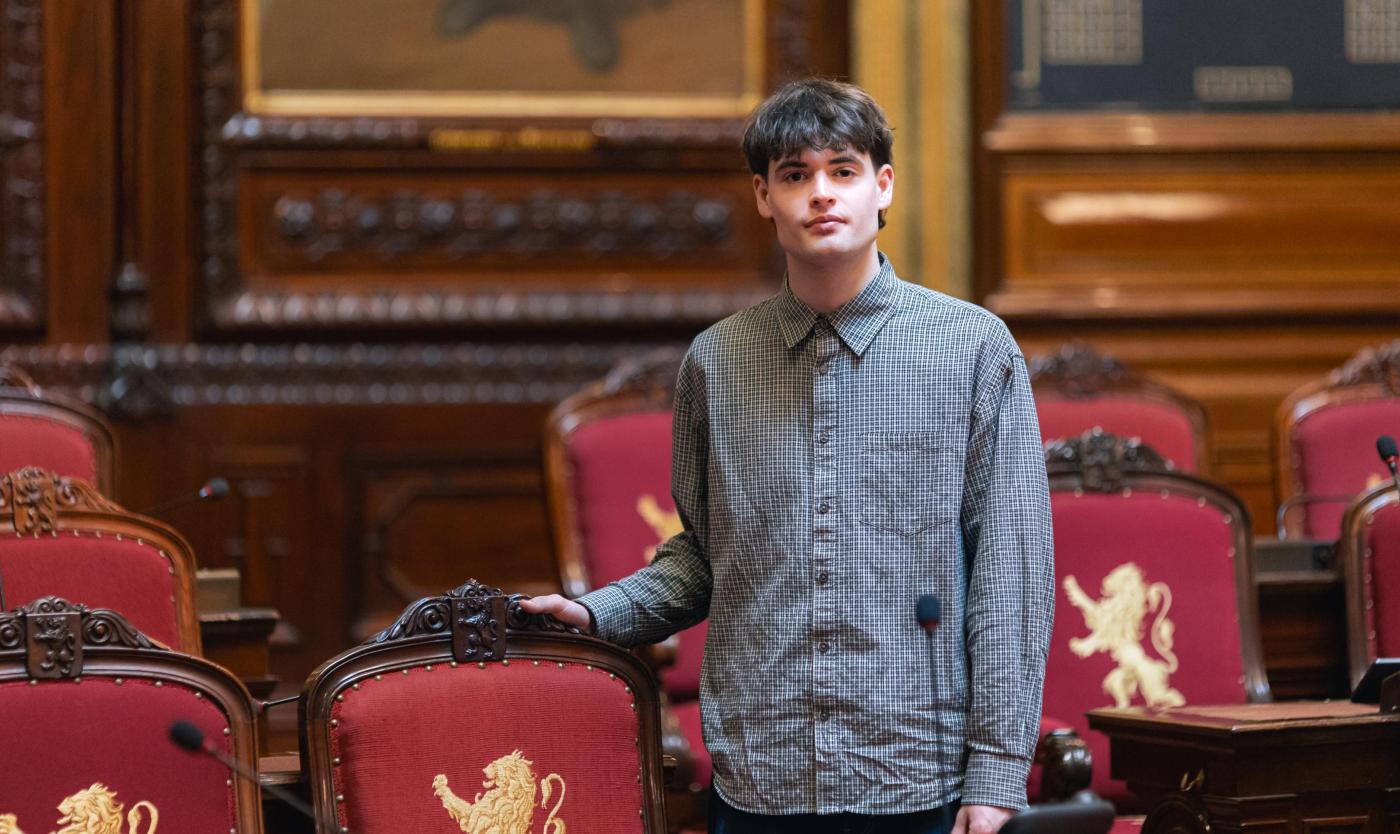
Mauro Michielsen © Matthieu Labey
Will abolishing what was once an important institution really restore public trust?
Mauro: “It’s true that the Senate once played a valuable role. The Chamber’s scrutiny function and constitutional oversight were crucial. But at present, I can only conclude that the Senate’s role has become largely symbolic. Constitutional review, for instance, now largely lies with the judiciary, with the Constitutional Court.
“Belgium is a complex country with many parliaments — and we should have the courage to make savings there. In financially challenging times, when we are doing everything possible to balance the books, being critical of ourselves is the very least we can do.”
By saying the Senate no longer has a function, aren’t you making it an easy target?
Katia: “That perception took hold in 2014, when its powers were dismantled and the number of senators was reduced to 60. In the court of public opinion, the image of a money-draining machine and a useless institution has proved impossible to shake. But we must, of course, deliver on what we promised — and that is to abolish the Senate.”
Mauro: “Abolition must not be an end point, but an opportunity to organise our democracy differently — and better. Young people are disengaging because they feel unheard. That means we must change the way we work.”
Katia: “That will be the second phase, because — as I said — distrust of politicians runs deep. The same applies to the press and government more broadly. I still see a role for the Senate there. During the previous legislature, we produced an excellent report, together with David Van Reybrouck, on renewing democracy, including the possibilities for citizen participation.”
“There is now a widespread perception that politics does not listen to people. When you allow them to take part in politics themselves, you remove part of that perception”
- Mauro Michielsen
How do you see that working?
Katia: “One possible avenue is that, following the abolition of the Senate, we strengthen democracy by investing in citizen participation in a mixed format — for example, alongside MPs. Or as President Macron did in France, convening citizens’ assemblies selected by lot to deliberate on issues such as the climate transition and euthanasia, and to issue recommendations.”
Will randomly selected citizens really strengthen democracy?
Katia: “That naturally requires a robust methodology in advance — to ensure those citizens are properly informed and genuinely representative of the wider population. You can already see this happening in many cities and municipalities.”
But who will inform these selected citizens? If politicians do it, isn’t that little different from how our democracy already operates?
Katia: “As I said, the methodology must be clearly defined beforehand. I am convinced that once people are able to take part in the political process themselves, they will realise how difficult it is to reach a compromise.”
So the end result will once again be consensus. There’s nothing wrong with that — but is that what dissatisfied voters are waiting for? They want to get their way.
Mauro: “That may be so. But at present there is a perception that politics does not listen to people. When you allow them to participate directly, you remove part of that perception. I can well imagine that public support would increase as a result.”
Katia: “At that point, those citizens also become ambassadors. It’s a way of rebuilding trust.”
You also sit on Leuven’s municipal council. As a politician, you can hardly get any closer to the public than that, can you?
Mauro: “You cannot operate effectively at a higher political level if you don’t understand how things work locally. That’s where people’s concerns land directly on your desk. Sometimes they seem trivial — street lighting, for instance — but they are issues that genuinely keep people awake at night. Local politics is therefore essential work, and something you must continue doing.”
“My academic expertise aligns with my political work. That makes me credible when I question ministers”
- Katia Segers
Has your work as a professor influenced your political work — and vice versa?
Katia: “Absolutely — although I am always very careful about that. I would never make political statements during my lectures, for instance. My perspective is much broader than a purely academic one, and that is enormously enriching. I can bring my experience of political debates into the classroom.“My academic expertise aligns closely with my political work. That makes me credible when I question ministers.”
For you, it is all new — you are also in your third year of a sociology degree. Do you aspire to an academic career?
Mauro: “No. I consider the theoretical foundation absolutely essential. But I am someone who wants to put that knowledge into practice. As a politician, you never hold the absolute truth. You have to keep learning — and that is what I intend to do. I find it fascinating to take those concepts beyond the lecture hall. “But politics is about people. And people often cannot be neatly captured in theory. As a politician, you have to be prepared to let go of those concepts.”
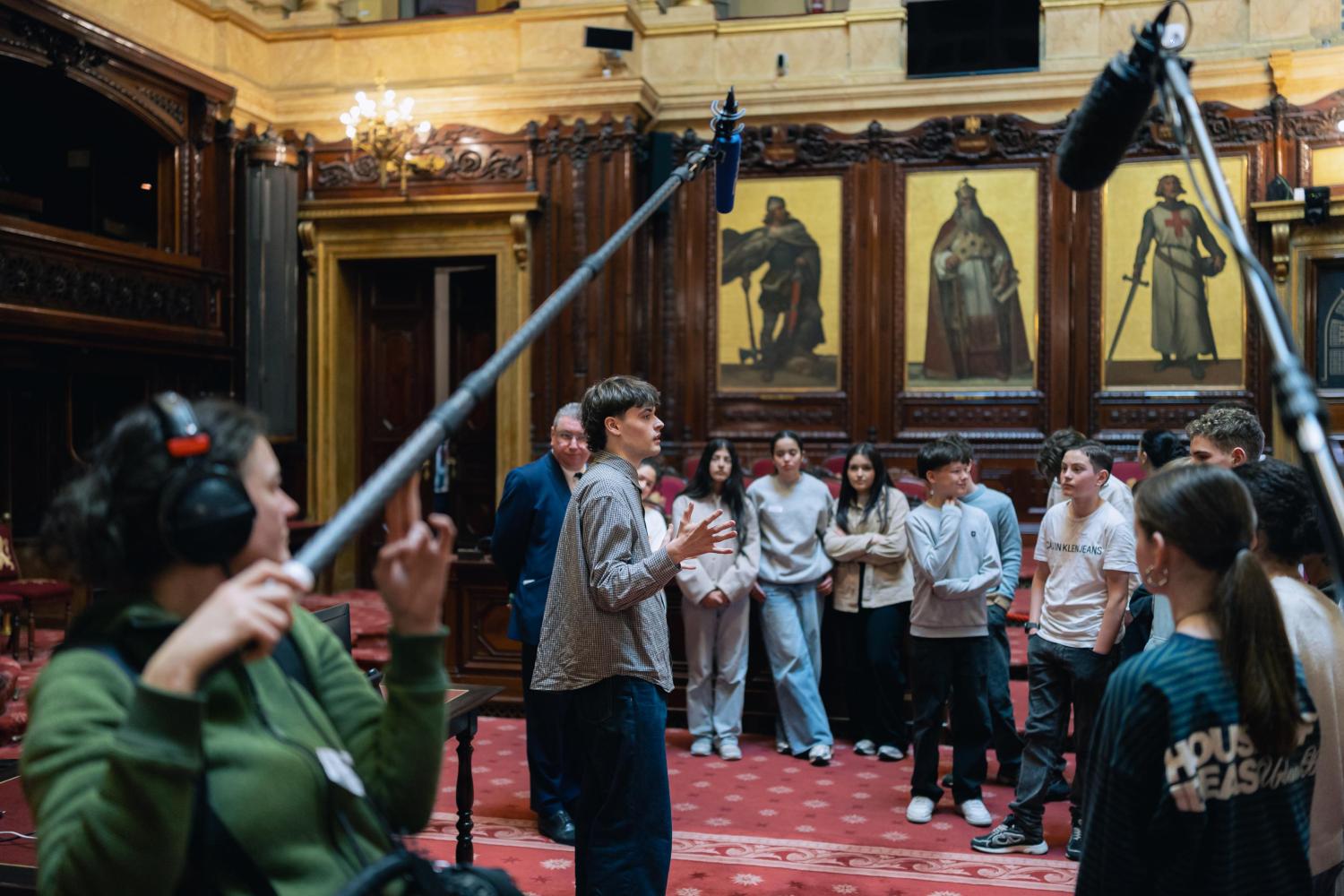
Mauro Michielsen, © Matthieu Labey