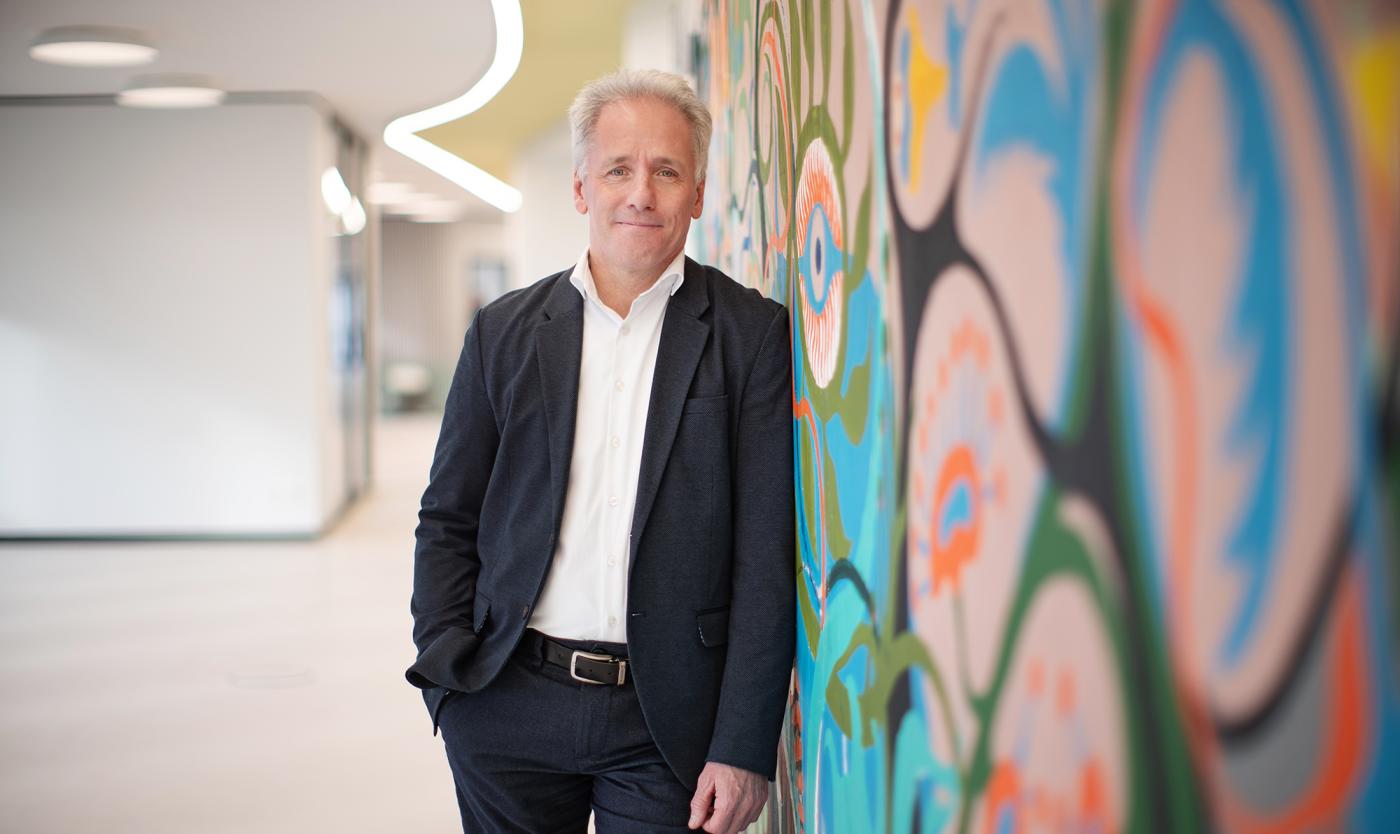


Nic Van Craen has been in the seat of General Manager at the VUB for quite some time now. Looking back on the achievements of recent years, he can sometimes lean back comfortably. “Our campus development and the associated IT developments have been real milestones for me.” But that same chair becomes far less comfortable when budget cuts enter the conversation. “We literally have to scrutinise everything. At the same time, we must not forget that our pioneering and boundary-pushing role in education and research has to remain healthy.”
“As General Manager, I have consistently focused over the past few years on actively supporting growth. Growth of the VUB was an ambition of the late Paul De Knop, who made it a strategic objective. And in recent years we have seen that growth materialise. On the one hand in student numbers, but also across our other core missions: research, innovation and valorisation. There too, we have made a significant leap forward. As a manager, I obviously look at a range of indicators, but I keep a close eye on the financial parameters. Between 2015 and 2024 alone, turnover from external research income rose from 80 million euros to 126 million euros. Our total income increased from 260 million euros in 2015 to 405 million euros in 2025. That growth translated into substantial investments in infrastructure and in people who can act as catalysts. Because attractive infrastructure, solid basic facilities and excellent research programmes attract additional research and innovative players.”
Where does most of the income come from?
“When you divide income between education and research, there is not a huge difference in scale. In education, student numbers are largely responsible; in research, it is basic research, applied research and research in collaboration with industry. Other income comes from donations, legacies and the VUB Foundation. Overall, the increases are fairly evenly spread. But when you zoom in on specific domains, clear differences emerge. Student growth has been exponential in the humanities, while research has seen exponential growth in applied European research. In that respect, there is still plenty of room for further growth and greater diversification of our income. I see that as my priority for the coming years.”
More students in the humanities and more income from applied research. Doesn’t that risk skewing the balance?
“Rather than opting for a broad, general recruitment strategy, we want to focus much more on targeted recruitment, particularly in STEM programmes. This is driven by societal need, but also because we have to grow there in order to remain in a healthy position. At other Flemish universities, student numbers are more evenly distributed across the humanities, exact sciences and medical sciences. At the VUB, that balance is different.”
“We want to invest much more in targeted recruitment, particularly in STEM programmes”
How difficult is it to involve industry?
“Industrial collaboration is not organised institutionally; it grows at the level of individual research groups. It is important to attract a number of major players. The proximity of facilities such as the recently installed Sofia supercomputer and the 7-Tesla MRI scanner can help. The Brubotics incubator will soon be added to that mix. We are currently drafting a master plan to realise sufficient square metres in phases over the coming years. To be clear, we are not doing this alone: we are working with several commercial partners who bring both capital and know-how.”
You mentioned Paul De Knop. One of his key projects was the Research Park in Zellik.
“As General Manager, I see my role primarily as supporting the rector and vice-rectors in delivering their priorities. I am also responsible for the administrative organisation, but I can rely on many competent directors and colleagues for that. Whenever I was able to focus on the bigger picture, campus and infrastructure development were crucial to realising Paul’s growth ambitions. Zellik was not initially on our radar; that came later. First, expansion focused on the Usquare site, the new student housing and teaching facilities in the XY complex, and the LIC. That was followed by the development of the Photonica campus in Pajottegem and the Steam Academy that will soon be built there. We also transformed the student rooms on the Willy Van Der Meeren site into a research valley housing the electron microscope, the pre bio-incubator, the MICRO lab, the brewery-bakery-chocolaterie and the circular retrofit lab. Zellik came back into focus when it became clear that our research collaboration with industry and knowledge institutions, as well as our spin-offs, needed a larger site where everything could be brought together. In that sense, the research park was the ideal location.”
What do you see as the other major achievements?
“Our campus development and the associated IT developments have been real reference points for me. In terms of research activities, both on and beyond the core campuses, we have succeeded in developing or redeveloping a great deal of basic infrastructure. In Jette, the Animalarium is probably the most significant achievement, along with additional research space in the former temporary nursery above the library. To keep pace with student growth, a temporary lecture hall with capacity for 600 students was also built last year. Organisational development is another major project. To absorb growth while operating with fewer resources, the organisation needs focus. That remains a key point of attention.”
It may no longer dominate the headlines, but around the Russian invasion of Ukraine everything revolved around energy consumption.
“Energy consumption is still very much a hot topic. Both because of the geopolitical context and its impact on prices, and because of the university’s sustainability policy. There is a continuous greening effort underway. Purchased energy is sustainable energy, solar panels have been installed wherever possible, although the coverage of our total consumption remains relatively low. Our main challenge lies in improving buildings and installations. That is difficult given the age of most of them, the intensity of activities and the many legal obligations we have to meet.”
“There is a continuous greening process underway at the VUB”
“There is also a necessary cultural shift taking place. Colleagues and students accept a standard temperature of 19°C and the idea that you can put on a jumper. Small habits matter too: switching off lights when you leave, reporting a leaking tap to Infrastructure, closing windows when the heating is on. New ways of working have also changed space occupancy. Especially in administrative and support functions, I still see opportunities there — more in downsizing the number of square metres than in expanding them.”
What opportunities does the strengthened collaboration with ULB offer?
“It is not really a new collaboration. The current intense partnership has its roots in the rapprochement during the tenure of former rector Ben Van Camp. Cooperation around the LIC and Usquare was realised during the rectorates of Paul De Knop and Caroline Pauwels. Under the current rectorate, building on that foundation, we have been able to present ourselves much more clearly together as the universities of the Brussels-Capital Region and to develop a joint strategy in that area. This leads not only to shared buildings, but above all to joint education and research projects, giving us access to resources and structures that were previously out of reach. Recently, we established the non-profit association Andrée Guelen, which will present our combined strengths externally and give us access to political and funding channels that would not be accessible to the VUB on its own.”
Is there (perhaps quietly) talk of a new campus?
“The research park in Zellik will genuinely become an innovation campus. That is essential if it is to function as an ecosystem, which also means developing a range of supporting facilities to enhance liveability and attractiveness on site. That is not the case yet, but it is planned. Given projected student growth and our strategic position in Brussels, we also need to start thinking now about the possibility of a second campus, should that prove necessary. But it must not become a fixation. First and foremost, we need to think about the education model and the impact it has on spatial needs. In other words, we must carefully consider where the VUB will stand in the future. I am fairly certain that within five years, the education model — and even the role of the university — will look different. The Covid period brought many new insights, and the same is now true of the rapid development of AI. It is even conceivable that we may not need to expand in square metres at all. The evolution of the education model should drive campus development, not the other way round. That means walking a tightrope, because building is by definition a long-term process — easily spanning ten years.”
How challenging is that for a General Manager, given the many different stakeholders at the VUB?
“By trying to maintain distance from individual needs and by doing a great deal of preparatory analysis. Within Infrastructure Services, we have a team that works almost exclusively on this. If you can explain the strategy — and especially make clear that every euro not spent on square metres can be invested in people — then most people understand that it is a better way of working. That said, some spaces are genuinely outdated or no longer meet the standards of a proper workplace. Given limited investment resources, we will carry out renovations that are future-proof for the next generation. To accelerate renovation while still enabling necessary expansion, the current rectorate has deployed a significant share of its own financial reserves.”
Which achievement of the past four years makes you most proud?
“Many achievements were the result of earlier decisions. What is now in full swing — and whose results we will only really see in the next rectorate — is the strong focus on people after years of focusing on bricks and mortar. In particular on leadership and wellbeing. A new, people-centred policy has been developed. Without caricaturing or oversimplifying things, I would say that Paul focused on building, Caroline gave the VUB a face, and Jan placed people at the heart of the VUB.”
“There has also been an effort to drive organisational change. That has been partly successful. The development of large research groups and the governance exercise around organisational structures did not lead to all the changes that were hoped for. What we are currently still working on is the so-called core tasks debate, in which we aim to determine what we will continue to do and what we will no longer do. The abrupt budget cuts imposed on us have accelerated that process. We will be forced to prune — even in areas we would prefer to keep.”
What should never be touched, in your view?
“I am currently sitting in a rather uncomfortable chair because these savings have to be delivered. The total saving amounts to just under 30 million euros. Twelve million is a direct result of measures taken by the Flemish government. Another part will be the impact of federal measures, although exact figures are not yet available. A worst-case scenario calculated by us is included in that 30 million. In addition, we already had our own savings programme of 10 million euros. What is not yet factored in is the impact on students: reductions in study grants or in the target groups eligible for them. The same goes for reforms such as pension changes that would directly affect staff.”
“In this savings exercise, we have to scrutinise everything — without forgetting that education and research are the engine of our university”
“We must literally put everything under the microscope. But we cannot forget that education and research are the engine of the university. Our pioneering and boundary-breaking role is essential. It must remain healthy and continue to develop sustainably. That does not mean we should not look at it critically, or rationalise where necessary — but above all, we must make it future-proof. All surrounding structures can, in my view, be reviewed, with their role, impact and added value to core processes, efficiency and essential services firmly in mind.”
“What we must not touch, in my view, is anything related to our IT environment. For multiple reasons it is crucial to the functioning of the university: data security, cybercrime, privacy, AI. The university community must be able to continue to rely on it. In fact, with an eye on the future, it will require sustained investment.”
“Finally, we must not forget that the university is value-driven. In times of polarisation, tension and populism, we have a responsibility as a scientific institution to uphold our values of free inquiry, free thinking and dialogue based on facts rather than beliefs. We must continue to engage actively with the outside world.”
Where do you see the VUB in 2030?
“2030 is tomorrow — even if tomorrow’s world may look completely different. We need to be robust and resilient enough to deal with that. AI is developing at great speed, in domains and dimensions we could not have imagined five years ago. It will have a major and disruptive impact on the university and all its components, forcing us to reflect on the role of the university itself. Work is already underway through the GAIA project, within the vice-rectorates and with our CIO, but there is no doubt that we need to step up significantly in the coming years.”
“I therefore expect that within five years we will be operating under a different model. The objectives are further internationalisation and stronger European networks in both research and education, excellence, entrepreneurship and innovation — but also the right level of student support. We must continue to fulfil the university’s mission of democratisation, especially as a humanist institution like the VUB. At the same time, we need to be brave enough to look at the right mix of measures to reach the right student groups. At present, there is virtually no threshold to entering higher education. That benefits no one: not government, not the university, and not the student. We must avoid a situation where you can almost predict in advance who will succeed and who will not. At the same time, we must ensure that those with the intellectual capacity, but facing other barriers, are not denied access.”