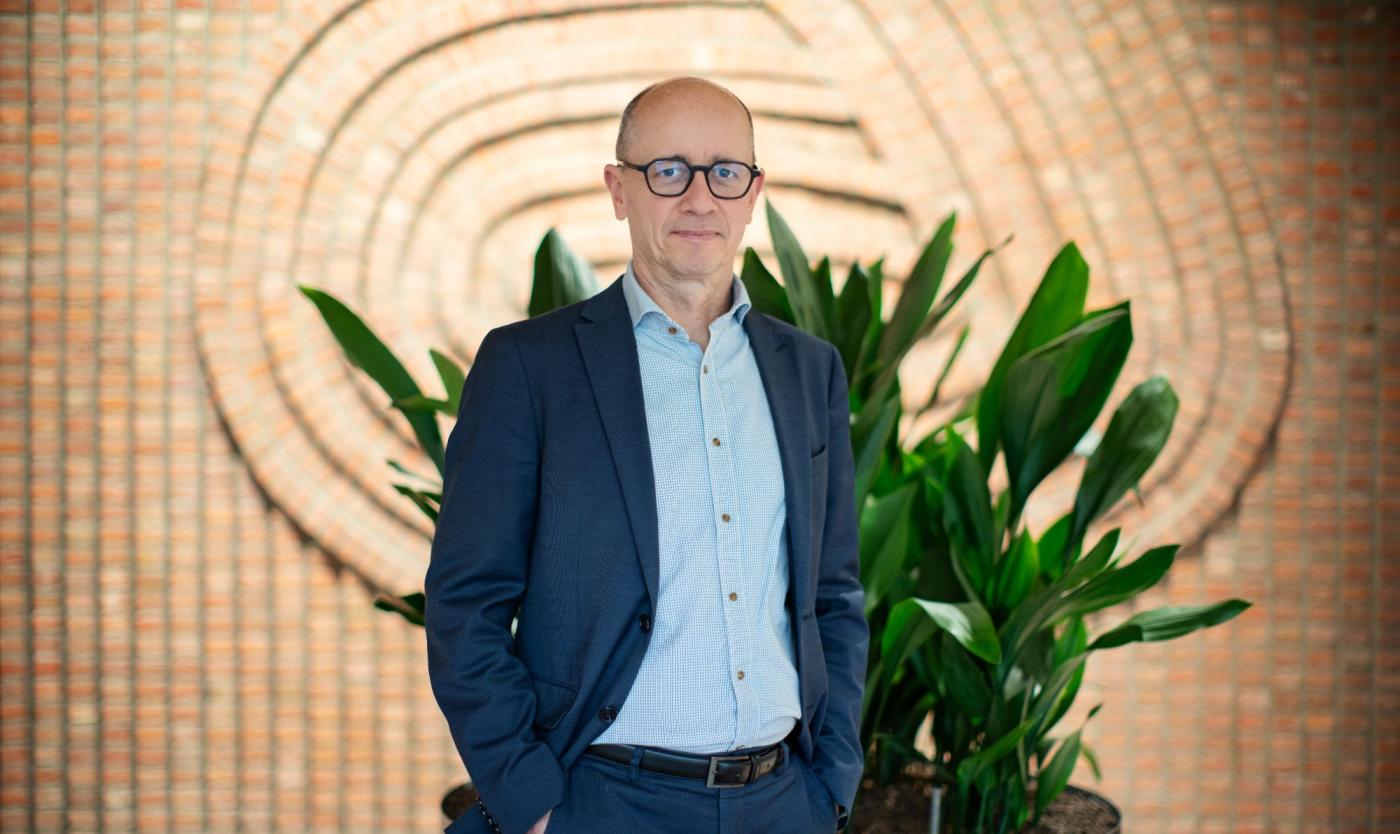


Iwein Baeyens has been Director of Infrastructure and Heritage at the VUB since 2019. He helped steer the renovation of the iconic Braem Building, as well as the construction of the brand-new LIC and the Theodoor Children’s Campus in Jette. “As a socially engaged university, the VUB has set itself ambitious goals. Creating the most eco-friendly infrastructure and heritage possible sits at the heart of that.”
Sustainability is central to the vision on building, renovating and maintenance. It includes optimising the use of available infrastructure. “That’s no small task,” says Iwein. “The campuses in Etterbeek and Jette were designed in the seventies for 5,000 students. Today, they welcome almost 25,000. That puts the number of square metres per student under pressure. Still, we don’t simply add more buildings. We’re also investing in blended learning and in sharing existing research infrastructure across different disciplines and research groups.”
“Our campuses were built for 5,000 students. Today we welcome nearly 25,000”
Is the Learning and Innovation Centre a successful example of the VUB’s ambitions?
“Absolutely. Thanks to the support of Beliris, and because of the symbolic value of the collaboration between VUB and ULB. But also because we created a state-of-the-art library for science and a place where around a thousand students can study and collaborate in a high-tech environment. The 9,000 m² of new building are completely future-proof, and every day it’s ‘full house’.”
Did the renovation of the Braem Building take a lot of effort?
“Many of the projects finished in recent years, or those still ongoing, were launched during the term of Rector Paul De Knop. The Braem Building was in very poor condition: rain came in, there were concrete issues in many places, and it no longer met modern environmental or comfort standards. It was clear that not renovating, or just patching things up bit by bit, would be like sticking plasters on a wooden leg. So, we made the decision to fully renovate, also because the building is protected, which opened up access to subsidies. Another trigger was the chance to bring the rectorates—scattered over time—back together in one building.”
Achieving climate goals is high on the agenda at the VUB.
“We will meet the CO₂ targets for 2030. We’ve already made our heating plant more sustainable, built an energy network with heat pumps, and installed solar panels and a combined heat and power unit. That last one allows us to generate electricity efficiently and make good use of the residual heat. Thanks to these measures, we can prepare ourselves in the coming years for the innovative technologies our researchers are currently developing.”
“We will meet the CO₂ targets for 2030”
“Over the past 10 years, VUB has once again fully committed to the Green Energy Park”
Bart Sibiel is Head of the Infrastructure and Heritage Project Office. He has been involved in all of the VUB’s construction and renovation projects in recent years.
“We’re increasingly reluctant to demolish buildings. Our Department of Architecture and Engineering has really put its foot on the accelerator when it comes to circular and sustainable construction. We try to avoid demolition as much as possible and to reuse existing structures. One painful moment for students was the transformation of the party tent into the temporary QE auditorium. We built that auditorium to meet the urgent need for teaching space. The tent had been standing for almost 25 years and had already had several patch-ups. We were also receiving more and more noise complaints from the neighbourhood. This week, we’re meeting with students to evaluate the ‘Fuifbunker’ we built in Parking C. A dream project I’d love to take on is the renovation of Auditorium Q. That building also has heritage value, but from the outside it really no longer looks the part.”
“There are limits to growth when it comes to new construction. There’s also the financial impact of political decisions. At the moment, our budget for the next decade has been halved. As a result, progress on some renovation plans will slow down. Ongoing projects like Usquare are barely affected. Phase one of Building A has been completed, and soon Buildings F and G, home to the Fablabs, will be tackled. Together with ULB we’ll also develop a number of auditoriums. The renovation of the physiotherapy wing in the Erasmus University College building on the Jette campus is also planned. Upcoming projects will mainly focus on energy and cost efficiency. Early next year we’ll start on Building L, the main building of the Faculty of Medicine and Pharmacy. We have already renovated G9 and G10, and G8 is next in line.”
"Installing the 42-tonne 7-Tesla MRI at the Green Energy Park is a true milestone”
“The Green Energy Park in Zellik has a rather complicated history. It is a research park, like those assigned to other universities in the seventies. But back then the VUB was still very young, and everything was in its infancy. The spin-off story certainly wasn’t developed yet. Over the last decade, the VUB has again fully committed to the park. The Infrastructure department is currently guiding the 7-Tesla project. On 7 October, the 42-tonne MRI scanner was installed. Several buildings are being developed in collaboration with a private partner, such as the data centre that now houses the Tier-1 supercomputer.”
The very first lecture in Auditorium QE
Professor Frederik Dhondt teaches political and legal history at the Faculty of Law and Criminology at the VUB. He gave the very first test lecture in the new temporary QE auditorium. “A great experience. Especially because I like to mix things in my teaching: showing slides and videos, letting students vote… All the technical elements worked together perfectly.”
“The VUB is dealing with a sharp rise in student numbers. When I started here 11 years ago, I had 420 students for my course. Now there are 670, including working students. If they all turned up, QA—until recently our largest room—would be too small. People often claim that students have got used to lecture recordings and streaming since covid and no longer attend in person. I’d nuance that. Many of our students, and we saw this during the pandemic, do not have a quiet or comfortable space at home. The campus is crucial for them, also socially. That’s why they now use the library and the new Learning and Innovation Centre so intensively. With rising housing costs in Brussels, I can imagine that some students commute by train for compulsory moments but still want to follow other classes online. For that, you need a high-quality technical set-up in the auditorium to broadcast the lecture.”
“Auditorium QE has space for around 650 students. It’s a very modern room with three projection options at the front, so everyone has a clear view of the slides. It’s up to the lecturer to be dynamic and creative enough to ‘reach’ all parts of the room. That way, students don’t disappear into the crowd. The teething problems with QE have been minimal. So far, everything is running smoothly, even for more complex tasks like streaming and showing a video at the same time.”
“The financial context at the VUB will become very uncomfortable from next year onwards. So I’m glad they managed to convert the party tent into an auditorium so quickly. Over the last ten years, many buildings have been added: Building I with its modern classrooms, the student housing opposite, the LIC… In a relatively short time, the university has been able to adapt to the ever-growing number of students."