
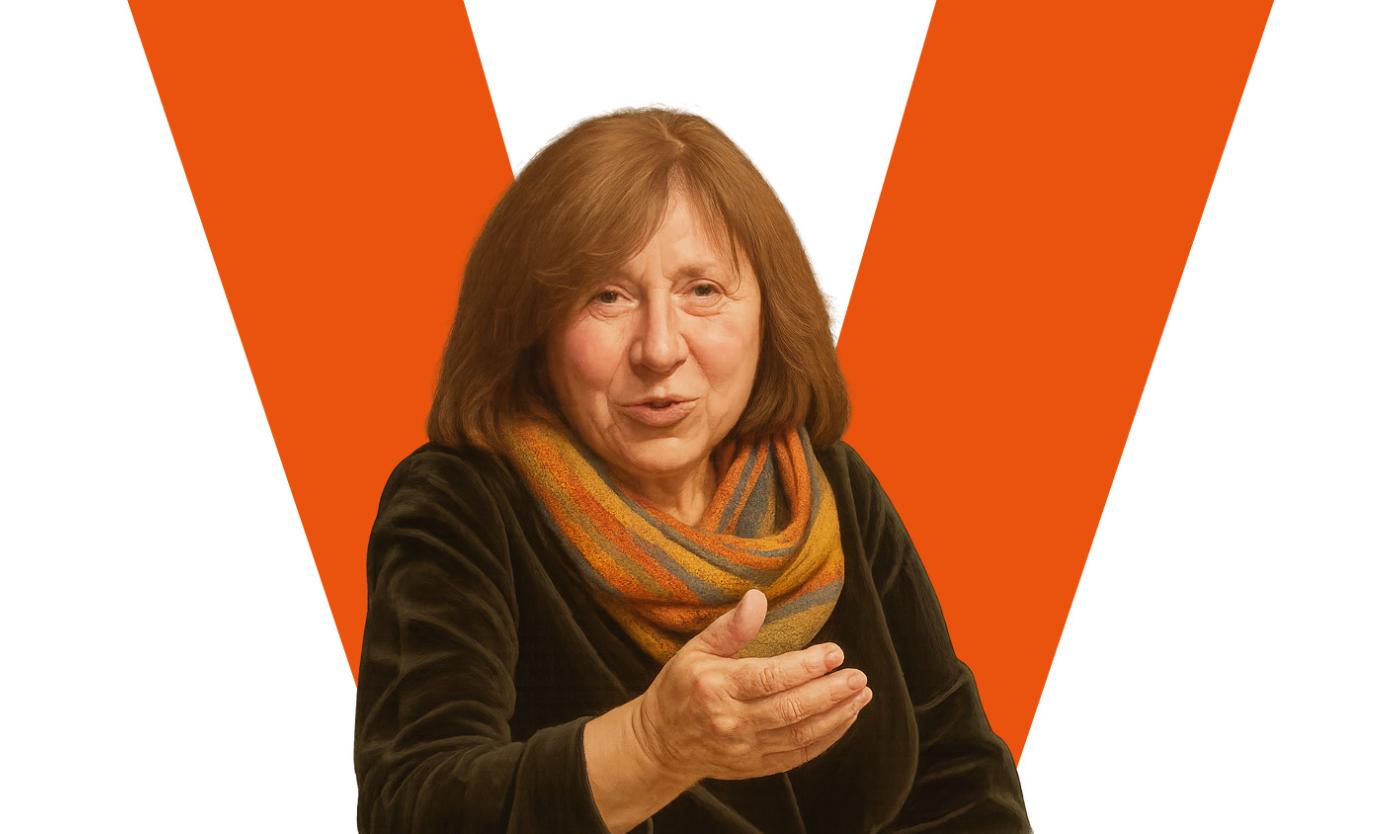
Svetlana Alexandrovna Aleksijevitch is a Belarusian investigative journalist, historian, and author who received the Nobel Prize in Literature in 2015. Because her work challenges myths and illusions and refuses to be guided by the official version of events, she has often faced attacks from authorities—both during the Soviet era, when she lost her job as a journalist, and later as a writer in Belarus. In 2000, she was forced to leave her country. In 2011, she consciously chose to return to Belarus and became one of the prominent faces of the democratic opposition in the country—until 2020, when she had to leave again under pressure from the Lukashenko regime.
Honorary Doctorate Difference Day for Freedom of Expression 2021
Svetlana Alexandrovna Aleksijevitch is a Belarusian investigative journalist, historian, and author. In 2015, she received the Nobel Prize in Literature. By awarding her an honorary doctorate, the VUB and ULB paid tribute to an author who thinks independently, speaks freely, and acts courageously. An author who gives voice to those whose voices are often unheard. In her pursuit of truth, she does not shy away from seeking out uncomfortable facts and events that have been erased from official histories, even at great personal risk.
Aleksijevitch’s oeuvre can be read as a form of contemporary oral history of the Soviet Union and its former states. Because her work breaks through myths and illusions and refuses to follow the official narrative, she has often been targeted by authorities—both during the Soviet era, when she lost her job as a journalist, and later as a writer in Belarus, where her work could not be published. As a result, in 2000 she had to leave her country and spent a long time in Paris and Berlin. In 2011, she consciously chose to return to Belarus and became one of the faces of the democratic opposition in the country.
In August 2020, Aleksijevitch joined the protests against elections manipulated by incumbent President Lukashenko. On a free radio station, she urged the president to step down: “Leave before it is too late, before you plunge the people into a terrible abyss, the abyss of civil war. Nobody wants bloodshed. You only want power. And it is your thirst for power that requires bloodshed.” Aleksijevitch took a leading role in the Coordination Council that united opposition against Lukashenko. In September 2020, all members of the Council were arrested, exiled, or disappeared following abductions. Only Aleksijevitch remained at liberty, presumably due to her international prestige. Nevertheless, she faced threats, and Western diplomats stayed in her home in Minsk for several days to prevent her detention. Although she initially intended to remain in Belarus at all costs, she decided in September 2020 to relocate to Germany, with the intention of returning as soon as possible.
On repression in Belarus and Russia and the war in Ukraine, Aleksijevitch offers striking insights. She does not doubt the role of leaders in history, but warns against attributing problems solely to “evil leaders,” whether Putin or Lukashenko. She argues that the greatest problem is that the totalitarian tradition of communism has not died. It nurtured people who lived in it for too long and absorbed its ethos into their very souls. They became not only slaves but also romantics of slavery. They still believe that the Soviet world was founded on justice and strive to return to how things once were. “In the 1990s, we were naïve, convinced that the people themselves had sparked the revolution against the Soviet regime. We were wrong,” admits Aleksijevitch. “The change was driven only by a small group of intelligentsia surrounding Soviet leader Mikhail Gorbachev. The Soviet people did not welcome the sudden change. Later, the populace became impoverished as public assets and natural resources were divided among cronies, leading them to believe that the entire transition from Soviet rule to freedom and democracy was a disaster.”
She recalls a similar atmosphere in Belarus in 2020, when demonstrators joyfully took to the streets, dressed in white, holding flowers. “We were mistaken in the illusion that totalitarianism would disappear peacefully.” According to Aleksijevitch, Putin understands the real desires of his subjects better than democracy advocates. He knows how to awaken their basest feelings and flood the darkest corners of their souls. “There are also leaders who know how to inspire their people positively, such as Václav Havel, the first leader of post-communist Czechoslovakia. Unlike him, Putin sets low goals using barbaric methods. He exploits the fact that the people of his country were raised by Soviet parents, who taught them the world according to Soviet textbooks and Soviet teachers.”
Sources: VUB Today, Israel Hayom