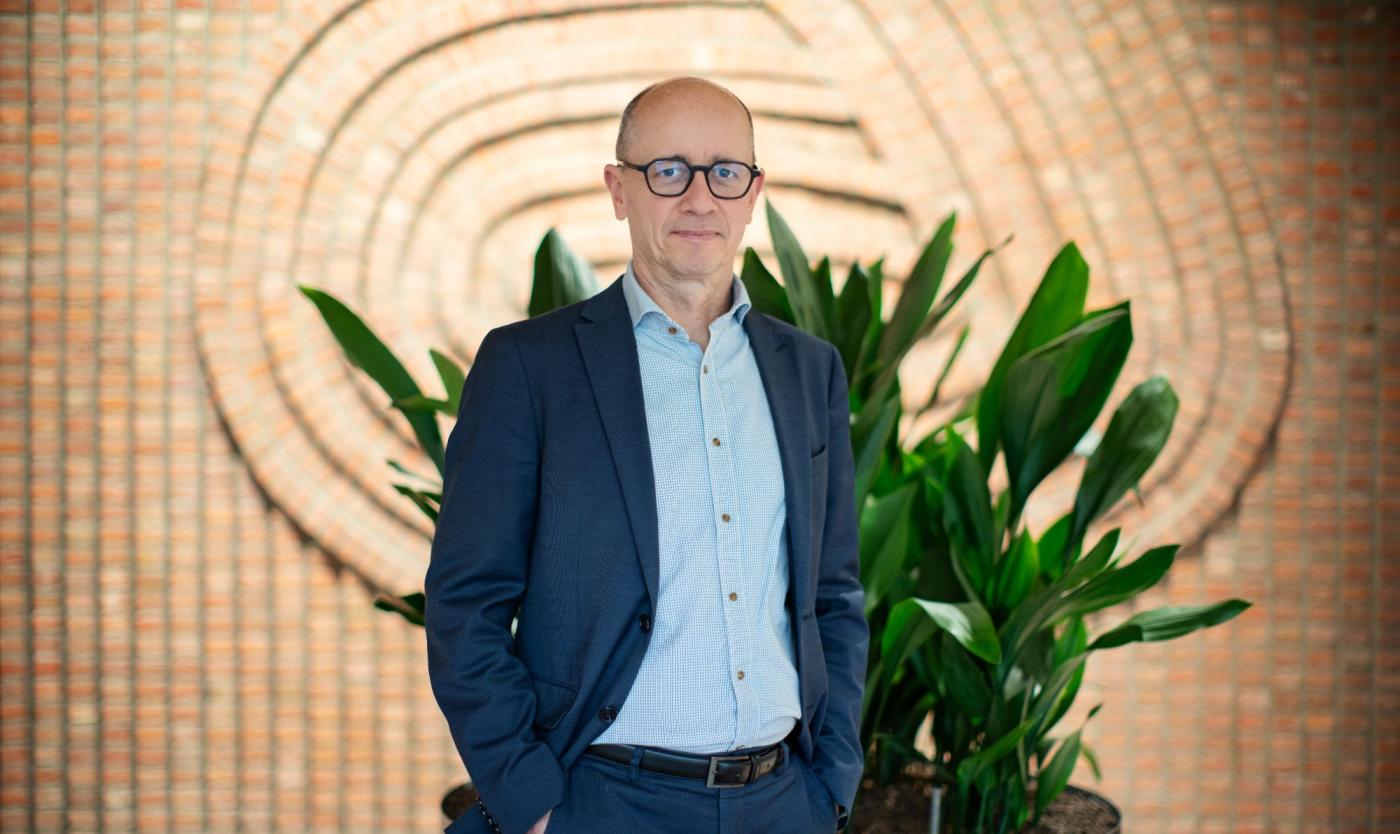
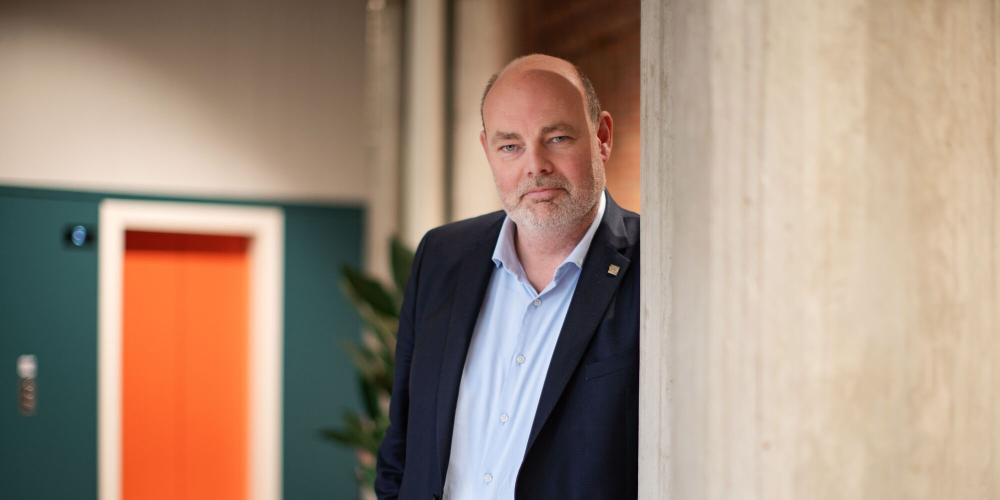


The VUB’s Public Affairs operation has officially existed for only a year and a half. But long before that, Director Raf Devos had already been working steadily to connect the university with society, politics and the business community. “The VUB has managed to achieve certain things in which we played a clear role – such as the reconsideration of two decisions: by the Flemish Government to partially replace the scrapped Brussels funds with resources for a language policy, and by the Brussels Government to levy a tax on our student halls of residence. But in most matters, discretion is essential.”
Why should a university engage in public affairs?
“Because the world, both inside and outside the VUB, is changing very quickly. That’s why it’s necessary to be able to connect these two worlds. One of my main tasks is to share information, both from the university to society and vice versa. A university wants to have an impact on society. Increasing that impact is expressed in a very specific mission in our motto: ‘Overcoming darkness through science.’ That’s quite ambitious, and I try to add value by connecting all the puzzle pieces of university and society.”
The creation of this office is already an achievement in itself.
“In April 2024, I officially became Director of Public Affairs. But in reality, I had been preparing this office for ten years. When in 2014 I was appointed Personnel Director by then-Rector Paul De Knop, his request was also to manage relationships with governments, policymakers, and companies. Paul, like me, had spent part of his career in politics and therefore knew very well that for a large organization, which is heavily dependent on external stakeholders, a public affairs approach is vital. Caroline Pauwels further developed this vision, and Jan Danckaert made the position official because the time was ripe. This is how I became the first Public Affairs Director at a Belgian university.”
“Paul De Knop knew that for a large organization dependent on external stakeholders, a public affairs approach is vital.”
At what levels are you active? You, for example, work one day a week at the European Parliament.
“That has decreased a bit recently because attention is now needed at other political levels. Our contacts range from international to very local. Last week, we were in London to set up an alumni event and establish contacts for further collaborations with the staff of the Flemish and Brussels diplomatic posts. Regarding the European Parliament, as a university, we depend on European programs such as student mobility with Erasmus+ and the Horizon research program. Europe is also increasingly providing defense-oriented programs directed at both companies and universities.”
“And then there are, of course, the various governments in our country. Few people know that a lot of funding and legislation for universities comes from the federal government. For example, regarding development cooperation, tax incentives for researchers, or certain research grants. UZ Brussel also deals with the federal government because public health is a federal matter. The university, on the other hand, falls under the authority of the Flemish government, with several ministers active in this area: the Ministers of Education, Science Policy, and Welfare. The Brussels government also has its own science policy, but for land-related issues such as permits, student housing, and property taxes, we also have to consult them. The local level is equally important for us: the VUB Main Campus is located at the intersection of three municipalities: Etterbeek, Ixelles, and Oudergem. When a new auditorium had to be built at record speed, we were called upon to engage the right people in the administrations. In addition, we work closely with the city of Brussels, with Jette, but also outside Brussels. With Zellik for the research park, with Mechelen where we co-founded the Hannah Arendt Institute, and recently also with Ostend, where a small campus will start early next year as a VUB hub.”
“Few people know that a lot of funding and legislation for universities comes from the federal government”
At all these levels, we are active, and with a small team: myself as director and two very capable colleagues working part-time, one on administrative matters, the other on European and international affairs. All other work is done by VUB members who voluntarily want to contribute. That’s necessary because our growth brings major challenges: we have become a large university with around 25,000 students and over 4,000 staff members. In economic terms, we are a large ‘enterprise.’ That’s why I follow many employer organizations. I am a board member of Voka Metropolitan, and the rector is in BECI, the Brussels Chamber of Commerce, because these are two Brussels economic actors important for our innovation policy.”