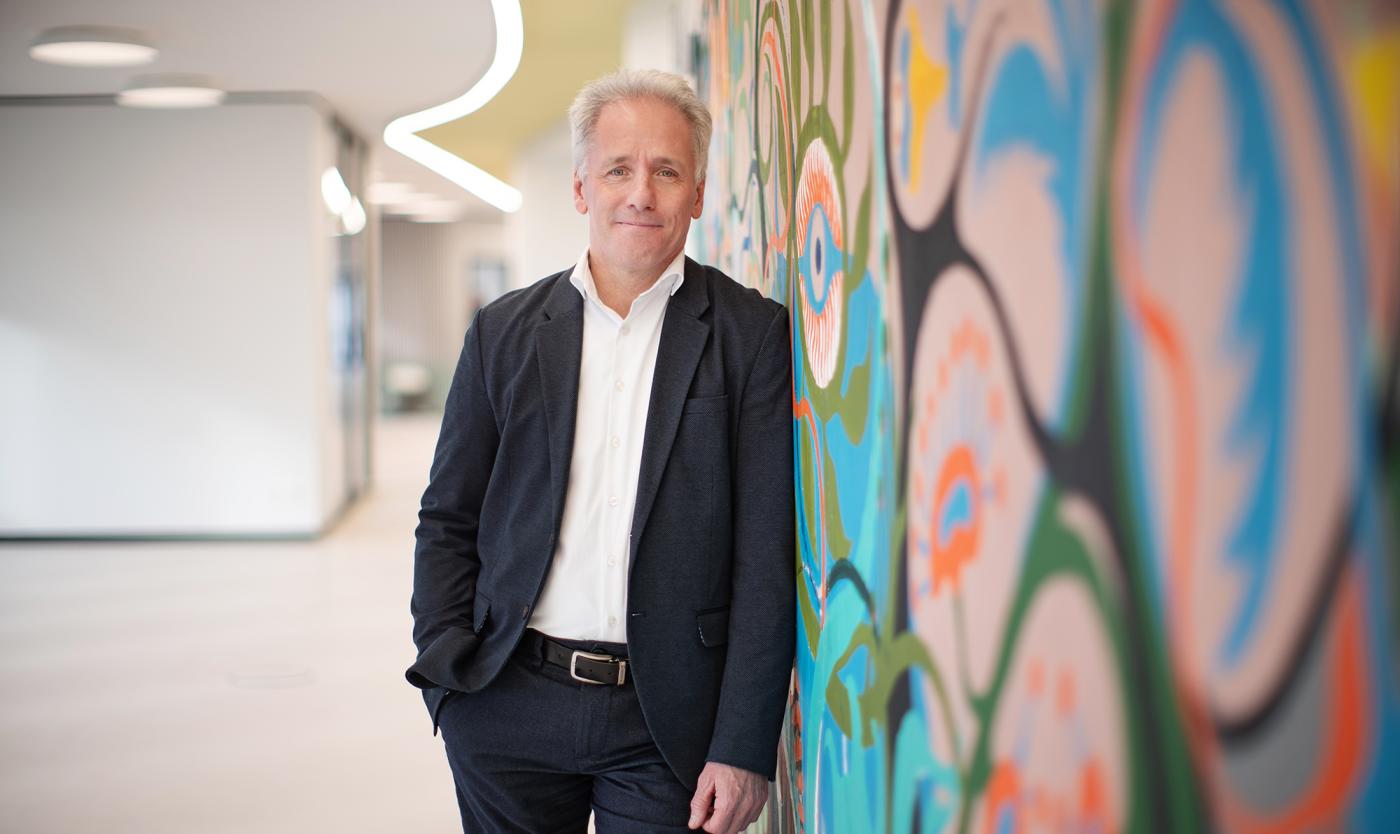
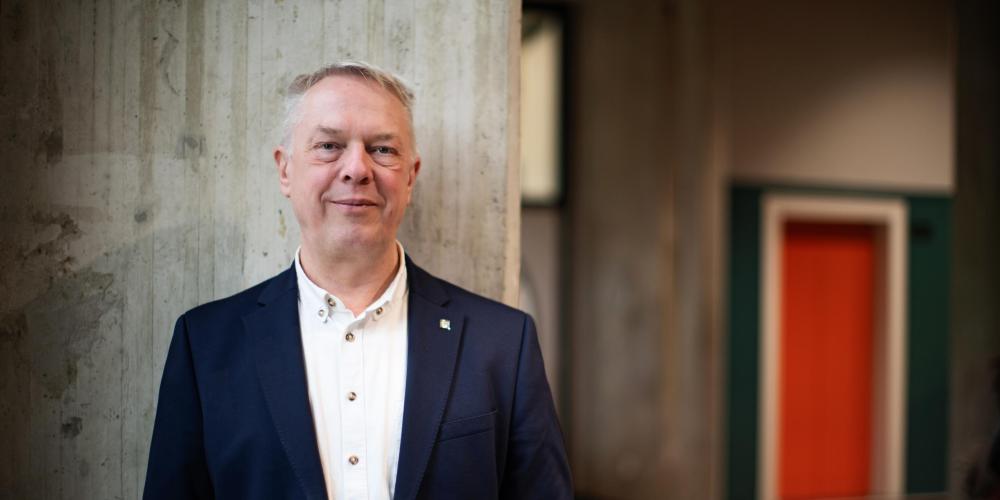


Brutal budget cuts, ongoing student protests over Gaza, post-COVID fallout: Jan Danckaert can look back on a demanding journey as VUB rector. A path marked by many obstacles and challenges, but also by numerous achievements and tangible results.
That journey began in February 2022, when he took up the role of rector ad interim, after the much-loved Caroline Pauwels had been forced to step down from her mandate because of illness. Danckaert only became full rector after the early rectoral elections, in which he defeated challenger Dirk Devroey. In his very first opening address, delivered on location at the Abattoir in Anderlecht, he immediately set out a clear course by firmly backing science.
In your maiden speech in 2022, you made a strong plea for ‘science as a public good’. You called for investment in the kind of science the world in transition urgently needs. You linked this to three conditions: more targeted research, larger and more robust research groups, and academic careers built on trust rather than internal competition. Has that ambition been realised?
“We have certainly already achieved part of it, but allow me to sketch the context at the time. We were coming out of a turbulent period. First, there was the institutional review: we were the first institution in Flanders to undergo such an assessment. At the time, I was still vice-rector for Education and Student Affairs and was directly involved. We were told that our quality assurance system for education was sound. That kind of trust immediately offers a multi-year perspective, as the next institutional review is only scheduled for 2027.
Second, COVID was still very fresh in everyone’s mind. We were in the transition from largely online education back to on-campus teaching. That was an intense adjustment for both students and staff.
And third, there was the passing, in quick succession, of two former rectors, Caroline Pauwels and Paul De Knop. That had a deep impact on everyone. It was in those circumstances that I began my mandate.
I wanted to make it clear that, as rector, I stand behind all core tasks of the university, education included. But we had just received the green light for education through the institutional review. That is why, in that first opening session, I placed the emphasis on research and science. This obviously does not mean that education is less important to me. Both are equally fundamental tasks of a university.”
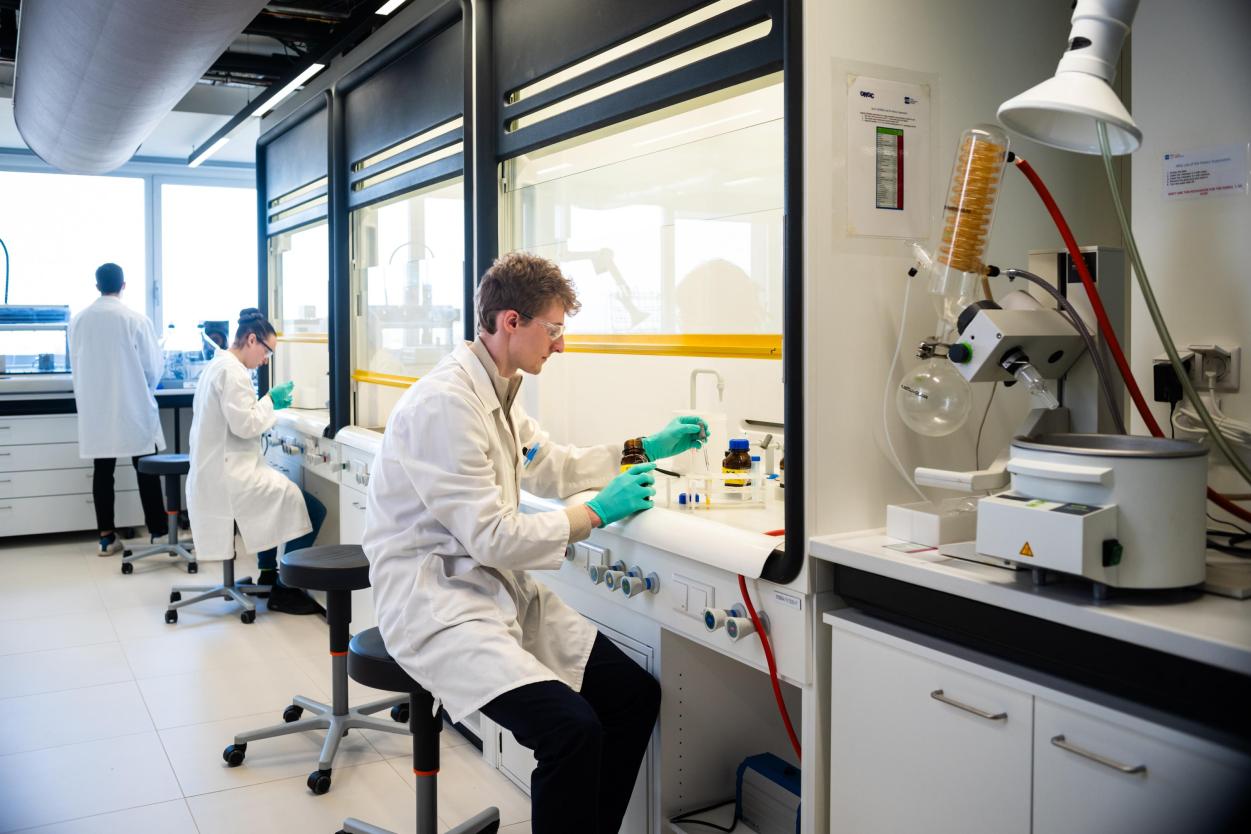
You say that the change you had in mind has been partially realised. Let us start with scaling up.
“We have genuinely been able to scale up our research groups. We went from around 150 research groups to roughly ninety. Almost half of those are genuinely large, the other half somewhat smaller — and that in itself is not a problem, because small can be just as excellent. More importantly, we have moved away from a system in which research revolved too strongly around individual supervisors. Research groups now carry more weight. They can manage accounts and resources as a group; these are no longer tied to one individual. That is a real shift.”
Are we already seeing effects from this?
“Yes. We can see that scaling up is beginning to pay off, among other things in applications for external funding. Larger groups can present themselves more strongly to the FWO (Research Foundation – Flanders), the European Commission or other funding bodies.
I see the impact of scaling up on three levels: impact within your own discipline, impact through international collaboration, and impact on society. For the latter, you often need interdisciplinarity and sufficient critical mass. And we are now seeing more examples of that.”
One of the biggest challenges of today and tomorrow is climate change.
“Indeed. And here we can clearly see that collaboration and pooling expertise increases impact. Think of the House of Sustainable Transitions, FACT, the Flanders Alliance for Climate Technology, or the strong interdisciplinary cooperation we see around water and climate. But in other domains as well — for example in health — scaling up leads to greater impact, thanks to increased visibility, stronger capacity and more robust research portfolios.”
What about the other point you made four years ago: less competition, more trust?
“We have realised that through the ZAP career policy. It did take longer than I expected in 2022, but such changes inevitably require time, consultation and negotiations with the social partners. In the end, we reached an agreement and are now rolling it out. You can even see the new philosophy reflected in the change of terminology. Previously, we spoke of ‘evaluation and promotion committees’. From now on, it is ‘feedback, evaluation and promotion’ — FEP. The starting point is an agreement note, drawn up at the initiative of the staff member. On that basis, regular feedback follows, and only then do we look at evaluation and possible promotion, in line with the competences and goals that the colleague sets for themself.”
What changes in essence?
“We now look beyond individual output. We also take into account contributions to teaching and research teams, and engagement in internal governance bodies. All of that is essential if you want to reduce competition and strengthen trust.
The implementation of the new ZAP career policy is a major operation: drafting agreement notes in an institution with so many staff members is not something you do in a few months. But the train has left the station. And the Board of Governors has just approved the ATP career policy as well. So that is now on its way.”
There is also a new view on leadership: not controlling, but coaching.
“We want to focus on coaching and supportive leadership. We provide not only training and development for early-career ZAP staff, but also for colleagues who take on more policy responsibilities. We want leaders to be able to coach, guide and pick up signals in good time.”
And yet cases of inappropriate behaviour and toxic leadership continue to surface.
“It is work in progress. I do believe that we are genuinely bringing about a cultural shift. That is already noticeable. But as rector, you sometimes receive cases from the past that resurface — and you have to deal with those correctly and decisively. We have rolled out our YANA policy — You Are Not Alone — we have strengthened the VUB reporting point, and we have made better agreements within the ecosystem around wellbeing and safety: confidential advisers, follow-up, procedures. And in this academic year, we are reviewing the composition and functioning of the disciplinary committee.”
Does the disciplinary committee need to change?
“We have learned from concrete experiences. Complainants are generally well heard during the preliminary investigation, but they feel that they do not get sufficient space within the disciplinary committee itself. That may be because committee members look at cases too much from a strictly legal perspective, and too little with regard to the wellbeing of those who report. We need to strike a better balance there. So we will be adjusting both the composition and the way the committee works.”
There are calls to have cases of inappropriate behaviour handled externally. Are you in favour of that?
“I am open to that idea — and I have said so publicly, including in the VRT-Panorama report on inappropriate behaviour at universities. At the same time, I see both advantages and disadvantages. In any case, we are not going to wait for a major system change: we are reforming our disciplinary committee regardless, and we are already involving more external members as a first step.
Completely external, however, touches on the employer–employee relationship. An external body can make recommendations, but you are still dealing with labour law and our employment regulations. So it has to be legally and organisationally sound, which requires consultation with government, with other institutions within the Flemish Interuniversity Council, and with employee representatives.”
Another major pillar of your rectorship is Europe. You were an early advocate of the European University Alliances, and of EUTOPIA in particular — the alliance of ten universities of which the VUB is a founding member. All EUTOPIA partners were also present at the opening of the academic year 2023–2024 in the European Parliament.
“EUTOPIA is indeed a story we believed in early on, back then with Caroline Pauwels’ team. We started with six partners and, at the European Commission’s request, expanded to ten. We set up a central office in Brussels, on our Usquare site, and we received the green light from Europe for an extension of the project. We are now in the second phase, which runs until the end of 2026. At the moment, we are working on a further two-year extension. After that, there will probably be a new European call, but the European Commission and the Member States are still negotiating the funding and the way it will work.”
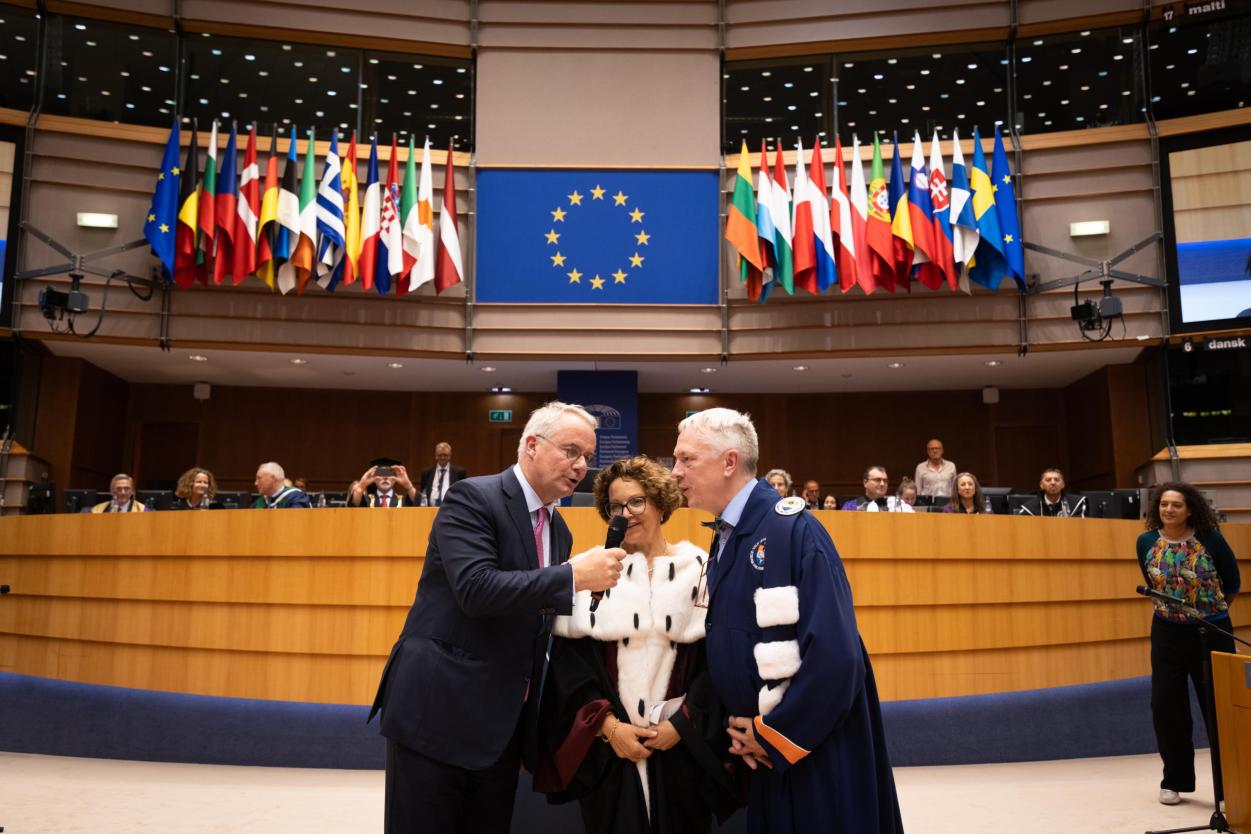
Academic Opening in the European Parliament
What do you see as EUTOPIA’s biggest strength, with its 280,000 students?
“The greatest added value is our model of ‘connected communities’ — which used to be called ‘connected learning communities’. We consciously worked bottom-up, by connecting people within existing degree programmes and research lines, so their collaboration could grow organically. And through those connected communities, our students can gain a unique European learning experience.
The challenge today is further scaling up: generating more impact, gaining more visibility through EUTOPIA labels, and reaching more students — with joint degrees from multiple EUTOPIA partners in the longer run.”
The European story is a story of values.
“Europe is at a tipping point. Values on which universities are built — the free exchange of ideas, international collaboration, academic freedom — are under pressure. Science is being questioned more often. That is precisely why European university alliances matter so much: together, you can defend those values more strongly.
Within the EU, this is strongly linked to the so-called fifth freedom: science and knowledge as a fifth freedom (alongside the free movement of goods, services, people and capital, ed.). It is about anchoring free inquiry in Europe. If some other countries close themselves off from that, Europe can become more attractive to talent from other regions. That is an opportunity — but also a responsibility.”
The VUB reached out to scientists in the United States who see their research threatened by the Trump administration. Why is that so important to you?
“Because more and more researchers in the US — and elsewhere too — feel that certain themes are becoming harder to pursue, that funding is disappearing, or that the freedom to speak and publish is under pressure. Europe then has to make it clear that free inquiry remains a core value for us. We took the lead, and that received a lot of attention in the American and international press, all the way to China. And a number of scientists in the US responded to our call. But the procedures are still ongoing.”
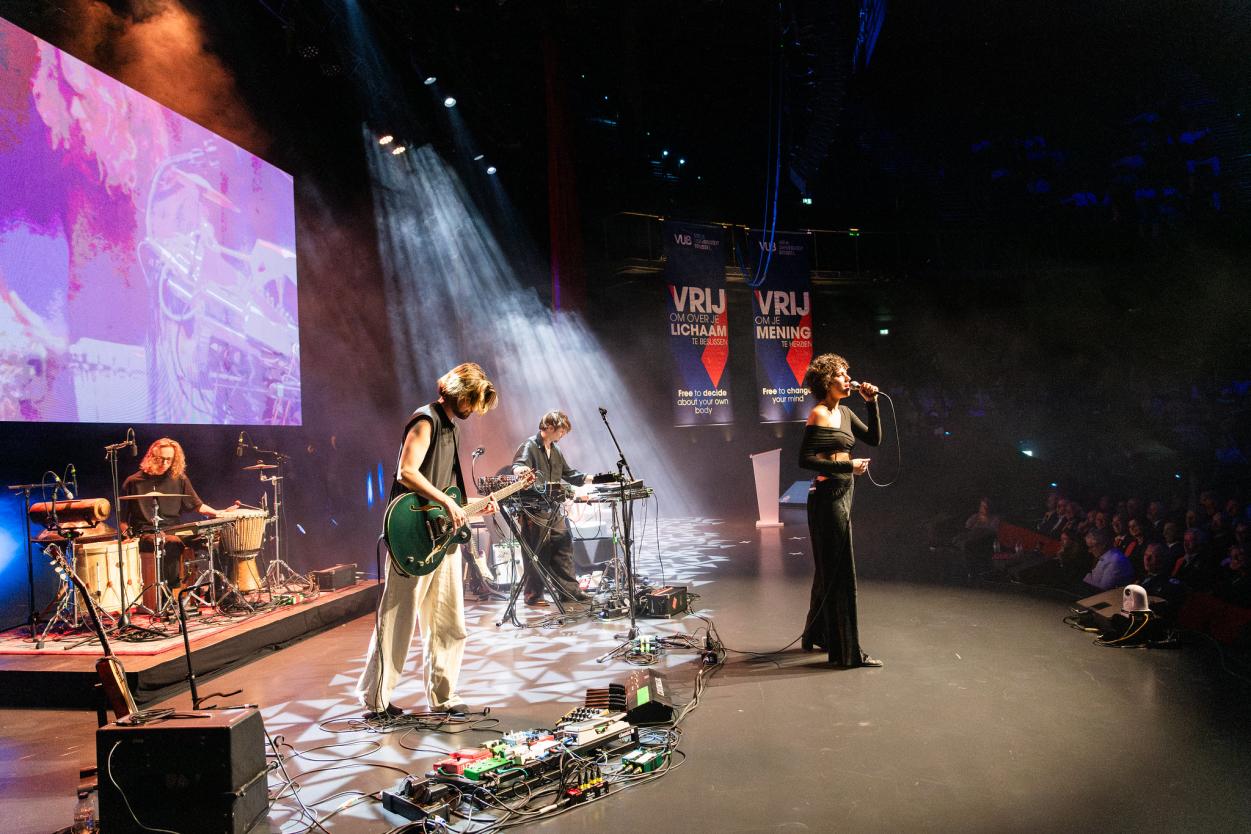
Celebration of the Open Mind
We opened the academic year 2024–2025 with the Celebration of the Open Mind at the Koninklijk Circus. The VUB’s own values were placed very deliberately at the centre, because new and increasingly diverse generations of students do not always clearly know what the university stands for.
“You have to explain those values anew every single year, both to students and to staff. There is a lot of inflow and outflow: new colleagues, new students. That is a good thing — but it means you have to keep repeating what we stand for, together with our sister university ULB: free inquiry, freedom of expression and open debate.
Everyone is welcome, regardless of background or philosophical conviction. At the same time, we believe religion belongs in the private sphere. That translates into the position that we do not facilitate prayer rooms on campus and do not allow religious activities. That is a choice connected to our historical profile.
But if you want to position yourself around free inquiry, you also have to keep updating that method. Society changes quickly. That is a role for PACT, the Pauwels Academy for Critical Thinking. Despite the cuts, we have pooled resources from within and outside the VUB to give PACT new momentum.”
The VUB came under fire during the student protests around Gaza. Students sometimes felt the university was being hypocritical. How do you look back on that?
“The university is a microcosm. Global problems shake our campuses — also because of our international student population. We saw that at the start of the war in Ukraine: we reached out to the communities involved and offered support. Some students suddenly found themselves cut off from their financial means.
As for the Israeli–Palestinian conflict, we as a university took a clear position very early on, in November 2023, with human rights at the centre. We condemned both Hamas’ terrorist attacks and Israel’s absolutely disproportionate response. Together with the Hannah Arendt Institute, we chose the side of international law.”
There was also a long occupation of the Stoa on campus.
“I always tried to keep the conversation open with the protesting students and colleagues: where can we find agreement, and where can we not. ‘Agree to disagree’ can sometimes be a conclusion too. In the end, the occupation ended before the summer of 2024.
But the outrage remains strong among part of the student body and staff. I think that, in our country, the university sector has taken very clear positions. Cooperation within the Flemish Interuniversity Council and between the Belgian rectors is, by the way, excellent. All Belgian rectors together called on the European Commission to test the association agreement with Israel against the human rights clauses. That is a significant signal. Europe did respond to that — albeit far too limitedly — in the context of the Horizon research programme.
At the same time, we had all ongoing projects involving an Israeli partner re-evaluated by the ethics committee. When one project showed a clear risk of military ‘dual use’, we started a procedure to withdraw — and we succeeded, as the only university. We now still have three such collaboration projects, which in no way could lead to dual use. And at the start of the academic year, I said that, as rector, I will not sign any international cooperation agreement with an Israeli partner as long as there is no sustainable peace in Gaza and in the West Bank.”
From the outset, you argued that the VUB had to become an agile ship that can withstand storms. The university already had growing pains — with core funding not keeping pace — and on top of that we were hit by the latest round of cuts from the Flemish government. Four years ago, did you expect our agility would be tested this hard?
“No, not to that extent. Nobody truly saw the storm that has blown up worldwide coming — not in Belgium, not in the US, or elsewhere. But it was already clear then that we were living in unstable times. So I still stand by the principle from the start of my rectoral mandate: we have to become more agile.
We worked intensively for two years on a thorough reform of our governance model. There was a majority in favour in the University Council, but not the two-thirds majority required by statute. That is, of course, difficult — but we learned a lot from it. And we are taking some insights with us into the cost-cutting exercise that is now underway.”
What can you implement without the approved plan?
“We will keep looking at scaling up, for example in administrative support. That can mean clustering departmental secretariats or pooling secretariats across faculties. It is unfortunate that it now has to happen under pressure from cuts rather than in a growth context, but it can help us come out of the transition stronger.”
The Flemish government has taken a knife to our resources: more than ten million euros less, on top of an ongoing saving exercise of ten million euros. When do the saving measures need to land concretely?
“Everything has to land in an adjustment to the 2026 budget, which we will present to the University Council in early March. We are currently discussing that with the faculties, the central services, and the trade union organisations.”
A major development during your rectorship was the global breakthrough of artificial intelligence. What does that do to a university?
“AI as a research field has existed for a long time. The VUB was a pioneer with Luc Steels’ AI Lab — notably, a linguist. Today, we are seeing AI’s breakthrough through Large Language Models. We can count ourselves fortunate to have a lot of expertise, also through our collaboration with ULB in the FARI institute — AI for the common good. We have also appointed a VUB mandate holder for AI, with a focus on its impact on education, research and our operations. We want not only to optimise our own processes, but also to use AI to make new things possible.”
What changes in education?
“A lot. We need to rethink assessment formats. The content of degree programmes will change, although I do not immediately think whole programmes will disappear. AI also offers opportunities: think of personalised AI tutors in the learning environment, better support for students, different forms of guidance. This is not just ‘another tool’; it is a profound and long-term transformation. I once heard a student representative put it perfectly: ‘Since I started studying at university, every year has been fundamentally different: first COVID, then post-COVID, and then AI.’ The student is right — it is all moving incredibly fast.”
And in research?
“AI speeds up research. It is as if every scientist has an extremely powerful assistant — though you always have to stay critical, because it sometimes hallucinates. But you can see that writing happens faster, that research applications are increasing, that workflows are changing.”
Are there things you hoped four years ago you could change faster, but which proved more difficult?
“Study progress remains a major challenge. When I was vice-rector for Education and Student Affairs, we had managed to bring study progress up to the Flemish average. Then COVID came. Study progress even increased slightly then, but after the COVID period we saw a sharp drop — more pronounced at the VUB than at other universities.
On top of that, our student population is becoming more diverse, and Flemish rules around study progress have been tightened. The ‘threshold’ requiring students to complete all courses of the first bachelor year within two years can weigh heavily on some groups. We still have too little refined data to see all effects clearly, but there will be an evaluation at Flemish level. It is absolutely a point of attention.”
Another sensitive point is the balance between STEM and non-STEM, especially since STEM students are funded more favourably. We are now at 30%.
“We need to push that number up. That has to do with students’ choices — and with whether they choose the VUB for STEM. So we have to communicate more strongly that the VUB is also pioneering in STEM: AI, engineering sciences, climate science, you name it. Our research infrastructure helps too: the new Flemish supercomputer in our research park in Zellik, for example, or the 7 Tesla MRI scanner, also in Zellik. What we are building in our research park is, by the way, impressive.”
And what about the Medicine programme? That too remains a fight for students.
“Cooperation on the Brussels Health Campus between the Faculty of Medicine and Pharmacy and UZ Brussel is better than ever. That is crucial: if you want to pioneer in health and innovation, it has to be one story.
The market share of the medicine programme can still rise, yes. We need to keep working on that. And in principle we have received the green light to launch Dentistry, but we are still looking at whether the financial conditions are in place — certainly in the current context of cuts. If we do go ahead, we would be aiming for September 2027.”
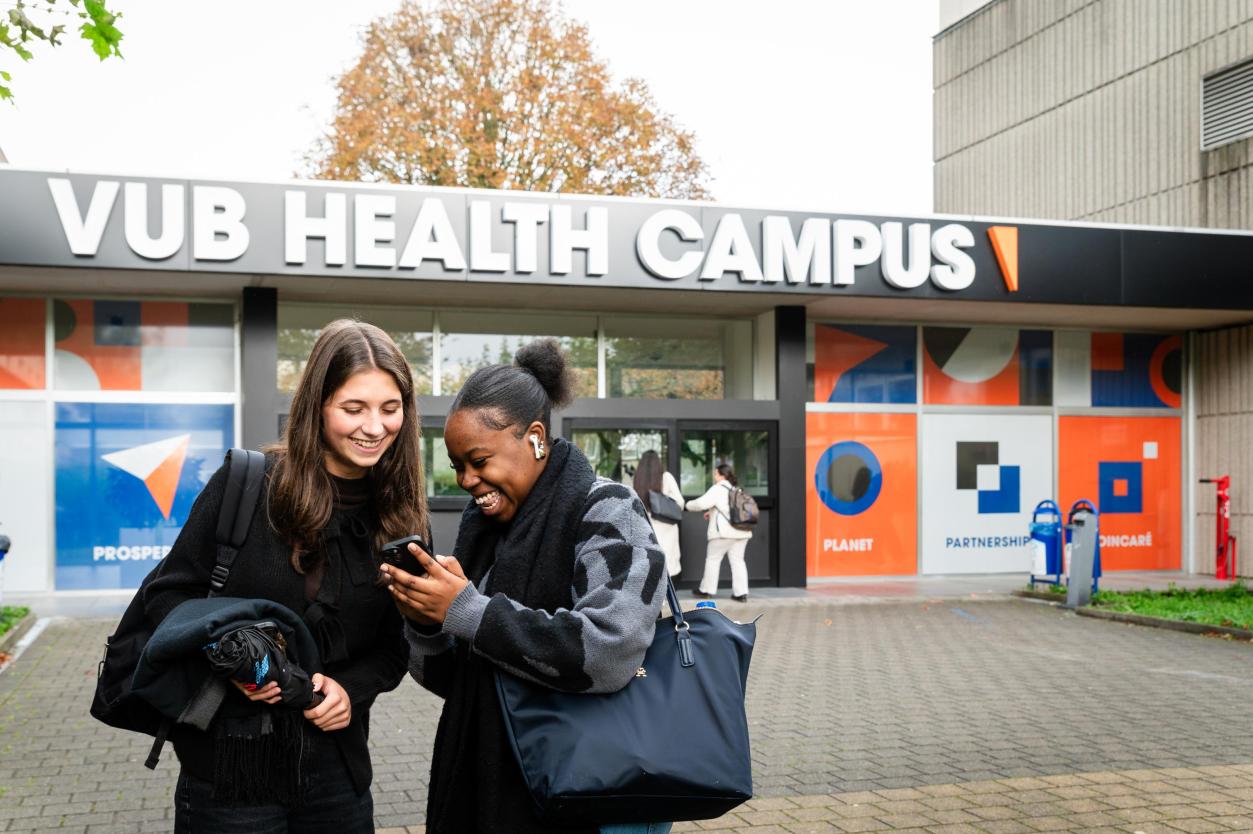
VUB Health Campus Jette
What are you most proud of, when you look back on the past four years?
“I am proud of how we have put science back at the very centre — and how we link that scientific strength to societal impact, across all domains. I am proud of our new career and wellbeing policy, for all staff members. I am also proud of European cooperation, of EUTOPIA, and of the way VUB and ULB — as two independent institutions — show that intense cooperation across language borders is possible. Brussels politics could learn a thing or two from us.”
What surprised you the most?
“The rise in polarisation. The hardening of the debate. And the fact that people sometimes no longer accept that different opinions can exist side by side. That only leads to mutual criminalisation. It worries me — also because we see it increasing on campus.”