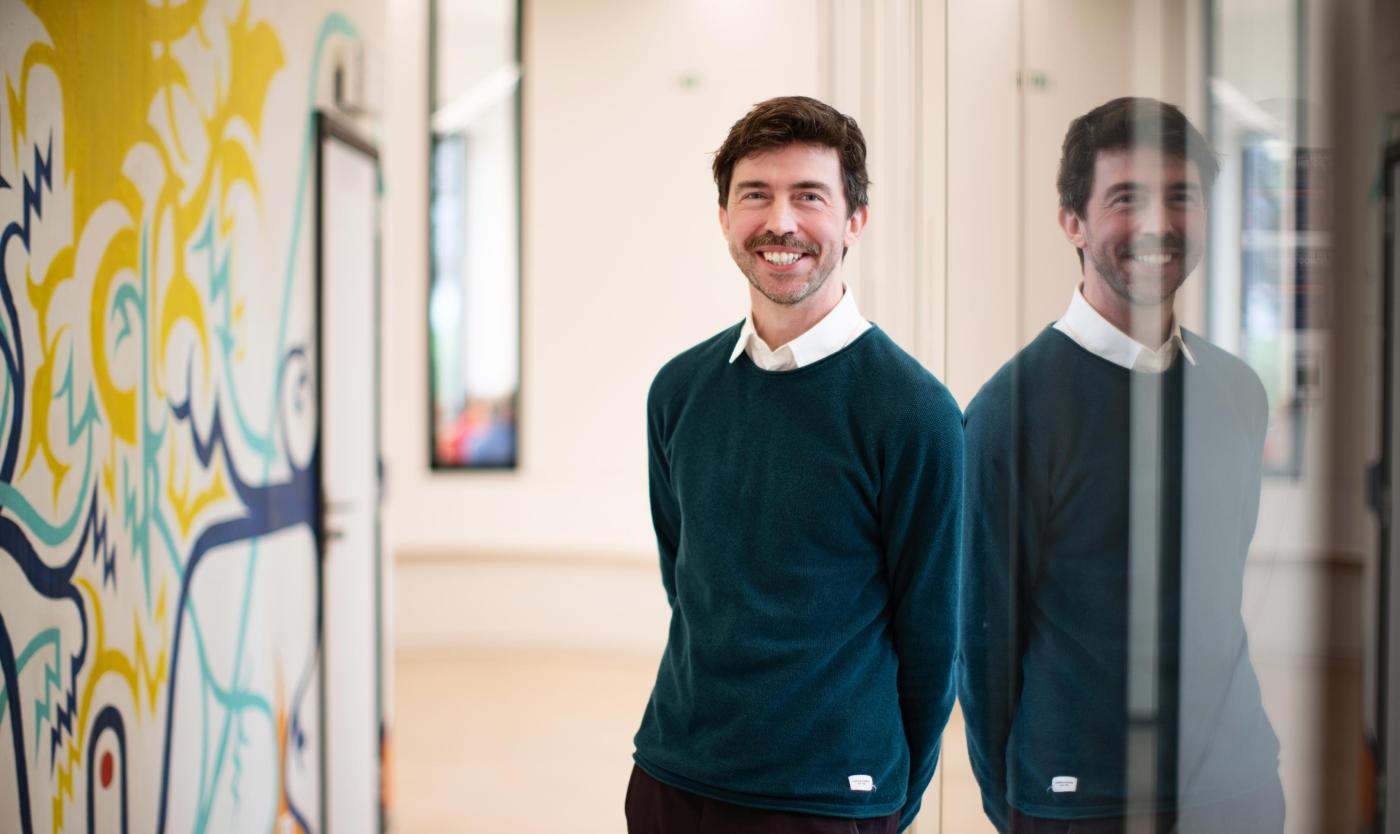



Elke Jorens has been Director of People & Organisation (P&O) since 2024. She plays a major part in advancing Engaged Leading at the VUB. “Leadership is an inherent part of working at the VUB. That’s why we want to set clear expectations about the kind of leadership we stand for.”
“We see personal leadership as the way to bring the VUB’s vision and mission to life. Engaged leading means colleagues dare and want to take up and share leadership, name issues, act decisively, claim ownership, and enter into dialogue with one another so we can work together towards our shared goals. In 2022, Engaged Leading was launched as a strong, well-developed concept. It’s one of the main pillars of the rector’s strategic plan. I’m still relatively new in my role as P&O director, but I see it as essential to give shape to that vision so the strategic plan becomes more firmly rooted in the coming years. Every year we organise Engaged Leading Week (this week, 24–28 November, ed.) with a range of training sessions linked to that concept. But in my view, it still feels a bit too optional. I’m considering making a number of sessions mandatory to build essential skills.”
“We see personal leadership as the way to bring the VUB’s vision and mission to life”
Where do you want to go with the P&O vision?
“We want to activate the VUB in taking up leadership in the sustainable connection between people and the organisation. That means, among other things, that managers should be the ones making decisions about their staff policies. We still see too often that, when the pressure rises, decisions and their execution are handed over to P&O. We provide services, faculties and managers with strategic frameworks to help them understand what matters in terms of composition, competences, profiles, leadership development, team dynamics, wellbeing, and so on. But in the end, they must make the decisions themselves.”
Is that still not happening enough today?
“I notice that leadership at the VUB is not yet sufficiently developed. I often hear people say the academic world is simply different. But every sector has its own character and context. That’s no reason to avoid putting leadership – which connects an organisation with its people – on the agenda. Academic excellence may come first, but strong leadership is precisely what you need to achieve it. Managing people is a core part of the job, not a ‘nice to have’ or something you squeeze in on the side. Choosing a managerial role means embracing leadership. We want to deploy strategic HR business partners at faculty level and in research departments. They can coach teams directly and link partnership, wellbeing and leadership in a way that creates real impact and change.”
“Managing people is a core part of the job, not a ‘nice to have’ or something you just add on”
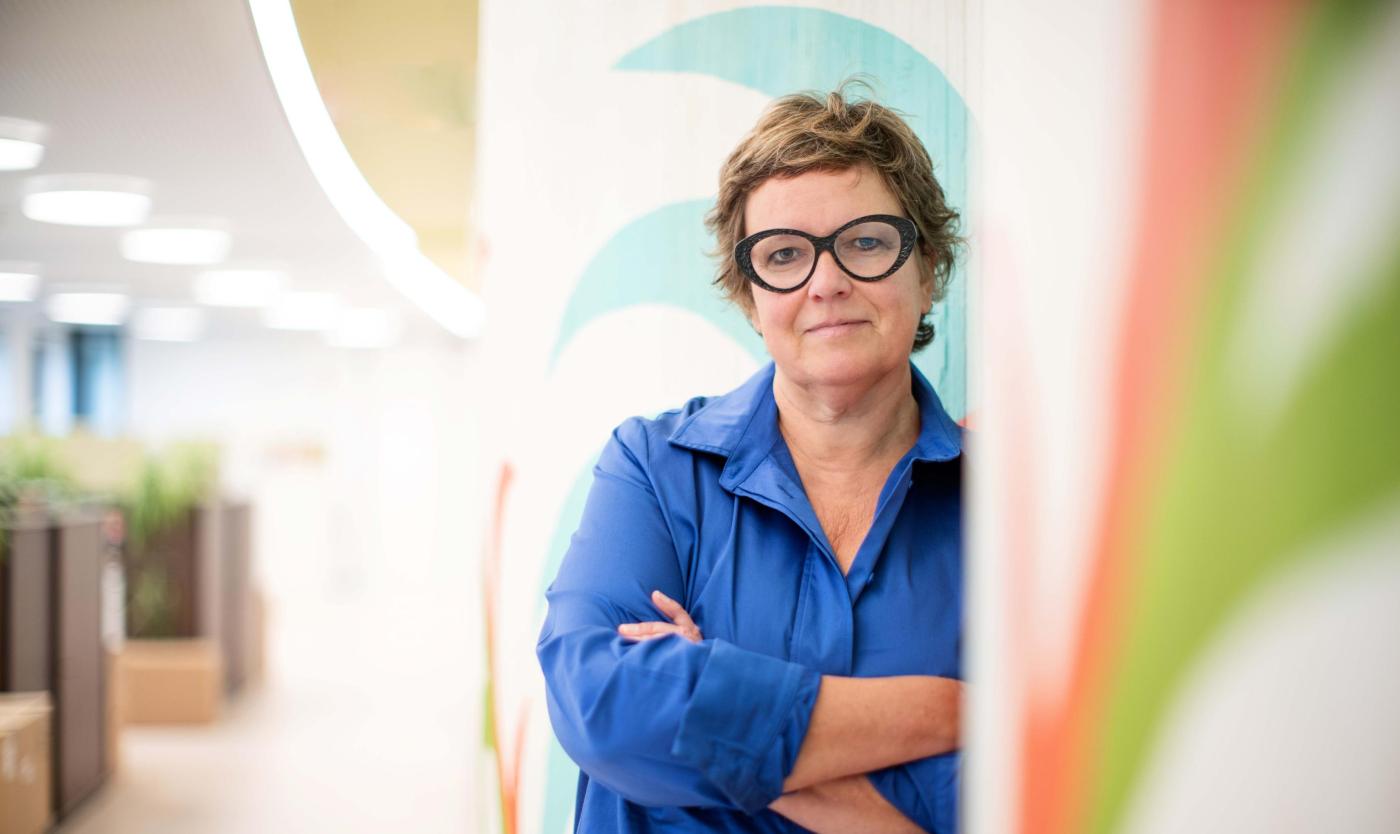
Elke Jorens
Pursuing an academic career and leading a team – is that still a tough combination?
“In other organisations and companies, managers are experts in their field too. In universities you still often have to search for academics willing to take on leadership roles. That’s no recipe for strong leadership. One of the projects we’re working on is the project around the hierarchical line. Who should be a manager at the VUB? At the moment we have deans and department chairs, but the number of people they oversee runs into the dozens, which is not a healthy span of control. We need a clearer framework and properly defined leadership roles.”
Another major achievement is the renewed career policy for ZAP.
“One result that fits within the idea of personal leadership is the renewed career policy for independent academic staff. We launched it in March this year. The concept is based on a feedback model built around an agreement note. Before that, a ZAP member was evaluated on paper every five years, and there were no conversations at all. The evaluation focused solely on research and teaching, not on leadership. In the new career policy, in addition to research output and teaching quality, we now also look at leadership and collaboration skills. In the long run, that will be game changing for the VUB because it allows us to give clearer direction on what is expected. In the biennial reflection talks, staff receive feedback and guidance on what development is still needed.”
Wellbeing is a top priority at the VUB. What is P&O doing about it?
“We’ve just developed a new wellbeing vision, and I quote: ‘Wellbeing forms the beating heart of the VUB. We build together an inclusive and pleasant environment in which respect for each individual’s identity and for one another is central. Freedom, equality and connection are the foundations of our culture, encouraging colleagues to reach shared goals.’ Here I return to what I said earlier: I want an HR policy that doesn’t treat wellbeing and excellence as opposites, but as catalysts for growth.”
“Wellbeing forms the beating heart of VUB”
How do you want to bring that wellbeing vision to life?
“We’ve defined five objectives to realise that vision. Next year we’ll start implementing them fully. Two objectives focus on a warm welcome for everyone, a healthy workload and more clarity so colleagues know their role within the whole. Many people now get everything piled on their plate: research, teaching and administration. That’s why the agreement note in the career trajectory is so important. It sets out what is essential and what has priority.”
In recent years, the university appeared in the news because of toxic leadership.
“That’s why we’ve also set other objectives. They include fostering connecting leaders and creating a safe, respectful workplace with a strong approach to inappropriate behaviour. Compared with the corporate world I came from, there are far more concerning situations at the VUB, and the response is not always strong enough. It’s essential that we prevent such situations in future and act in time when they do arise. It will also be important for colleagues to know better where to turn. Our fifth objective focuses on the research-support environment, especially PhD candidates. Their precarious status means they can end up in a dependent position towards their supervisors. We need to explore how to create a clearer framework of rights and responsibilities within that status.”
Looking forward?
Absolutely. There’s plenty of work ahead for P&O in general, and for leadership and wellbeing in particular.”
The Faculty of Social Sciences and Solvay Business School were early adopters of the new career policy
Professor Diane Breesch, full professor of Accounting and Auditing and academic director of the Faculty of Social Sciences and Solvay Business School, helped shape the new ZAP career policy within her faculty.
“The Rectorate announced plans a few years ago for a new ZAP career policy. The trigger was the amendment to the Higher Education Act in 2024, which removed the compulsory five-year evaluation. Those evaluations disappeared at the VUB, and the new ZAP policy now aims to build a culture of dialogue and feedback. All ZAP members are expected to draft an agreement note with clear ambitions and goals for the next six years. Based on that, they will have interim reflection talks with the academic director and a feedback meeting at the end of the period with the Feedback, Evaluation and Promotion Committee.”
“This approach encourages ZAP staff to think ahead about their goals and gives them a clear guide"
“The strength of this approach is that ZAP members now have to think about their goals beforehand. It gives you something firm to hold on to because you know what you’re working towards. At the same time, the note provides reassurance because the agreements are made in mutual understanding with the faculty. Our faculty was consulted by P&O in developing the new policy because we already asked our ZAP members to prepare a vision document for their evaluations, including an explanation of which activities – teaching, research or administration – they wanted to emphasise more or less in future. It was our so-called profile approach. You could see it as a precursor to the more detailed agreement note now required. Writing such a note isn’t easy, but once it’s there, most ZAP members find it very useful.”
“The promotion policy also changed. Until last year, the VUB still used a quota-based policy that assigned each faculty only a limited number of promotion places each year. As a result, ZAP members often weren’t promoted even after the formal four-year waiting period and despite strong dossiers, simply because there weren’t enough places. Our faculty moved away from this quota system about eight years ago—we were ahead of the VUB in that sense. We abolished it because it led to unhealthy competition and frustration. The formal four-year waiting period for promotion didn’t match the much longer reality. The lack of promotion also harmed colleagues’ wellbeing. We switched to a more realistic ‘5+10+10’ timing: after 5 years from lecturer to senior lecturer, after 10 years to professor, and after another 10 years to full professor. Anyone who met the timing and received a positive evaluation was promoted. The VUB abolished the quota system last year and adopted a ‘5+6+7’ timing for appointments. Our faculty has been gradually aligning with that timing.”
Criminology Professor Sofie De Kimpe followed leadership training
She leads a team of policing researchers, supervises PhD candidates and other students, and is part of a research group and department. Recently, Professor Sofie De Kimpe chaired the Criminology Programme Board. She is vice-dean of the Faculty of Law and Criminology.
“My background is in public administration, so I’ve always been interested in leadership and its impact on work and teams. My PhD in criminology focused on police managers. I experienced myself how much uncertainty comes with leading others. You search for something to hold on to and for tools to coach and guide people better. That’s how I ended up with these training sessions. I was mainly looking for self-direction, for an answer to who I am as a leader. I’d had several experiences with researchers that didn’t go the way I wanted. That prompted me to look inward and examine where I stand and whether I’m on the right track.”
“They really made me look in the mirror during the training, and I needed that. Especially because the academic world has few built-in moments for reflection. You usually don’t have a manager above you, so there’s no one to advise you or help map out the path ahead. In the second phase of the training, it was about creating more support within your team and steering people in the direction you want.”
“The training sessions took me out of my work environment for four days – I had nothing to face but myself”
“I followed the courses on my own initiative, at True Colours, an external consultancy. The liberating thing about the training is that you step out of your own work environment for four days. The only person you face is yourself. Taking time for yourself and reflecting happens far too rarely in academia. Nor is there usually someone beside you to tell you what you’re doing well and what you could improve. That did happen during the training, and it felt reassuring. I also met professors from other universities. Talking to non-VUB academics shows you the grass isn’t always greener elsewhere. It puts your own situation into perspective when you see others aren’t all excellent at everything either. People often expect professors to excel across the board. But we’re only human, doing our job as well as we can.”
“What I mainly took away is the importance of making choices. In the past, I jumped on everything. I couldn’t say no and ended up taking on far too much, to the point where I overworked myself. Now I try to set clear goals based on what I’ve decided for myself. That’s crucial: setting markers for where you want to go. It makes choosing what to do – and what not to do – much easier. The second thing I learnt is that teams are made up of different people who all need different approaches. You can’t simply impose your way of working. In the final part of the training, I learnt about shared leadership, about being able and willing to hand over responsibility. Looking for solutions together, setting goals together and clarifying everyone’s role creates more transparency. Too often one person keeps all the information, which starts to resemble divide-and-rule rather than good leadership. And when it comes to supervising PhD candidates, you must realise they are the owners of the journey you take with them. Your experience is there to support them and be attentive to their personal challenges and resilience.”